Data Analyst Course in Pune With Placement Assistance
Hiring teams across Pune look for analysts who can take raw operational records, audit them for errors, and turn them into clear business reports—not someone who only knows how to click through pre-formatted spreadsheet templates. SevenMentor Data Analyst Course in Pune (also offered as our comprehensive Data Analytics Course in Pune) teaches the core tools analysts use every day: Advanced Excel, SQL, Python, Probability and Statistics, and Power BI or Tableau.
Instead of relying on passive theory, learners work directly with practical datasets to clean messy records, write relational database queries, spot statistical trends, and build interactive dashboards. Training is available through in-person classroom sessions across Pune and live instructor-led online batches, supported by structured placement assistance for eligible learners. Use the sections below to review the syllabus, practical exercises, batch schedules, career support, and current fee verification details.
Course Fees, Duration, and Batch Snapshot
Before exploring the module-by-module syllabus, review the verified programme details and current fee items awaiting final confirmation:
- Course Name: Data Analytics Course (preparing learners for Data Analyst and BI reporting roles)
- Core Tools Covered: Advanced Excel, SQL, Python, Probability and Statistics, and Power BI or Tableau
- Training Modes: Classroom training in Pune, live instructor-led online sessions, and hybrid options
- Verified Pune Centres: Shivaji Nagar (Head Branch), Deccan, Pimpri Chinchwad, Akurdi, and Hadapsar
- Batch Schedules: Regular weekday batches and Saturday–Sunday weekend batches
- Upcoming Batch Dates: Weekend batches starting 14th and 15th November 2026 and regular weekday batches starting 16th and 23rd November 2026
- Course Fee & Installments: Internal records currently show two sets of figures—a listed fee of ₹65,000 (with one-time/group discount entries of ₹45,000 / ₹55,000, classroom/hybrid figures of ₹55,000, and a ₹3,300 installment/deduction entry) alongside an audit reference range of ₹35,000–₹45,000 (confirm exact applicable fee, discount eligibility, and EMI breakup with our Pune admissions team before enrolling)
- Course Duration: Internal schedule notes list 9 / 9.5 months while the audit notes 2–4 months depending on batch format (confirm exact calendar duration for your chosen weekday or weekend track with admissions)
- Trial Class & Demo: Free demo and academic counselling sessions are available upon request so you can review the teaching approach before enrolling
- Placement Support: Resume preparation, mock technical interviews, and interview coordination with hiring partners
Who Can Join the Data Analytics Training in Pune?
Analysts in Pune work across IT services, automotive manufacturing, banking, healthcare, retail, and e-commerce. Because business teams need people who can bridge raw numbers and operational decisions, this Data Analytics training in Pune welcomes learners from diverse academic and professional backgrounds:
- Fresh Graduates Exploring Data Careers: Graduates from commerce, science, management, engineering, or computer applications looking to build job-ready analytical skills from the ground up.
- Students from Non-Technical Backgrounds: Learners who have not studied computer science or advanced mathematics and want a structured path into data reporting and business intelligence.
- Excel Users Ready to Level Up: Operations coordinators, MIS executives, and back-office staff who already manage spreadsheets and want to add SQL, Python, and automated dashboards to their workflow.
- Working Professionals Planning a Career Transition: Professionals in finance, sales operations, supply chain, or customer support who regularly work with business reports and want to move into dedicated Data Analyst or Business Analyst roles.
You do not need prior coding experience or an advanced mathematics degree to start. Comfort with basic arithmetic and logical problem-solving is enough to begin. However, beginners should expect to invest extra practice time when transitioning from spreadsheet formulas to SQL join logic, Python syntax, and probability and statistical interpretation, where consistent hands-on drills make the biggest difference.
What Is The Actual Course Syllabus and Tool-Wise Learning Program At SevenMentor?
A practical Data Analytics course in Pune follows the same sequence an analyst uses on the job: extracting data from databases, cleaning and validating records, testing patterns statistically, and presenting findings visually. Below is how each subject in the curriculum builds your analytical workflow.
1. Advanced Excel
Even in organizations with modern data warehouses, Advanced Excel remains the fastest tool for quick data audits, ad-hoc summaries, and financial or operational checks.
- Spreadsheet Organisation and Data Cleaning: Structuring raw extracts, removing duplicates, standardising text and date formats, and applying conditional formatting rules.
- Core Formulas and Lookup Operations: Writing logical functions (IF, AND, OR, nested conditions), text and date functions, and lookup operations (VLOOKUP, XLOOKUP, INDEX-MATCH) to reconcile tables accurately.
- Pivot Tables and Reporting: Summarising multi-thousand-row datasets using Pivot Tables, Pivot Charts, slicers, and summary dashboards for business reviews.
2. SQL
Enterprise transactional records sit inside relational databases rather than standalone files. When a database query uses the wrong join condition, it silently duplicates rows and inflates revenue totals. SQL training focuses on retrieving accurate records cleanly:
- Database Fundamentals and Basic Commands: Understanding relational tables, primary/foreign keys, and executing core SELECT, WHERE, ORDER BY, and data manipulation queries.
- Aggregations and Grouping: Summarising operational metrics with COUNT, SUM, AVG, MIN, MAX, GROUP BY, and HAVING clauses.
- Joins and Complex Queries: Combining customer, order, and product tables using INNER, LEFT, RIGHT, and SELF joins alongside subqueries to answer multi-table business questions.
3. Python
When datasets grow too large for spreadsheets or require repeatable cleaning pipelines, Python automates the heavy lifting.
- Python Programming Fundamentals: Writing clean scripts using variables, data types, conditional logic, loops, functions, and core data structures (lists, dictionaries, tuples, and sets).
- Data Manipulation and Cleaning: Using data-handling workflows—including Pandas and NumPy where covered in the track—to load CSV or Excel extracts, handle missing values, fix inconsistent data types, and transform columns programmatically.
- Exploratory Analysis: Grouping, filtering, and summarising large datasets to uncover operational trends before building reports.
4. Probability and Statistics
Charts can look persuasive while hiding misleading conclusions. Probability and Statistics give you the discipline to verify whether a trend is meaningful or simply random noise:
- Descriptive Statistics: Measuring central tendency (mean, median, mode) and data spread (range, variance, standard deviation) to understand baseline performance.
- Probability and Distributions: Applying probability rules and understanding common distributions to evaluate risk and variability.
- Correlation and Data Interpretation: Measuring relationships between business variables and interpreting analytical outputs without confusing correlation with causation.
5. Power BI or Tableau
Stakeholders rarely read raw SQL outputs or Python notebooks—they make decisions from visual reports. Learners work with Power BI and Tableau (confirm with admissions whether your selected batch covers both tools in full or lets you specialize in one primary BI platform):
- Data Modeling and Preparation: Connecting structured data sources, cleaning fields in Power Query (Power BI) or Tableau data prep views, and structuring relationships across tables.
- Calculated Metrics and Visual Design: Creating calculated measures (including DAX basics in Power BI), designing interactive filters, and arranging KPI cards, trend lines, and comparison charts.
- Data Storytelling: Structuring executive dashboards so managers can spot bottlenecks and compare performance across regions or time periods at a glance.
Tool-Wise Training Hours
Exact hour allocations per tool (Advanced Excel, SQL, Python, Probability and Statistics, Power BI, and Tableau) vary by batch format and are confirmed in the official syllabus schedule shared during counselling. Rather than splitting hours arbitrarily, training follows a progressive sequence—moving from spreadsheet fundamentals and SQL querying into statistical reasoning, Python data handling, and final BI dashboard development.
Practical Projects and Live Learning Experience
Understanding tool syntax is only half the job; real analytical work involves spotting why numbers look wrong and fixing the underlying data before presenting a report. During lab sessions and guided assignments, learners practice realistic analytical tasks such as:
- Cleaning Messy Business Spreadsheets: Auditing raw sales or inventory sheets filled with missing entries, duplicate customer IDs, and inconsistent date formats before building summary reports.
- Querying and Auditing Relational Databases in SQL: Writing multi-table joins and aggregation queries to isolate duplicate transactions, track order fulfillment delays, or segment customer purchase frequency.
- Transforming and Analysing Operational Data in Python: Writing scripts to merge monthly CSV extracts, handle null values, compute retention or churn indicators, and export clean summary tables.
- Comparing Period-over-Period Business Performance: Evaluating month-on-month and quarter-on-quarter revenue shifts using statistical summaries to separate seasonal swings from real performance drops.
- Building Interactive Executive Dashboards in Power BI or Tableau: Designing drill-down dashboards that track sales, revenue, or operational KPIs and presenting the key findings clearly to instructors.
Through live classroom or online labs, trainers review your queries, help troubleshoot broken formulas or script errors, and evaluate how clearly your final dashboard answers a business question.
Placement Assistance and Career Opportunities
SevenMentor supports eligible learners through its dedicated placement assistance process, backed by 15+ years of training experience, 60,000+ students trained, and a network of 500+ SevenMentor hiring partners. Visit our SevenMentor placement assistance page to learn more about how our career support team operates.
Career Roles You Can Pursue
Depending on your prior background and project portfolio, completing Data Analytics classes in Pune prepares you to apply for roles such as:
- Data Analyst
- Junior Data Analyst
- Reporting Analyst
- Business Analyst
- MIS Analyst
- Power BI Developer
- Data Visualisation Analyst
What Employers Assess and How We Prepare You
Hiring managers in Pune's IT, consulting, BFSI, and manufacturing sectors typically test candidates on practical Excel reporting, live SQL query writing, Python data cleaning, dashboard design, and how clearly you explain business insights. Our placement process includes:
- Resume and Portfolio Structuring: Highlighting concrete Excel, SQL, Python, and Power BI/Tableau projects rather than listing generic course titles.
- Technical Practice and Mock Interviews: Conducting mock interview rounds focused on SQL joins, case-study problem solving, and dashboard walkthroughs.
- Interview Coordination and Placement Drives: Sharing relevant openings and coordinating interviews with hiring partners as vacancies open up.
Placement assistance provides structured interview preparation and recruiter introductions—it is not a guarantee of automatic employment or a fixed salary package. Consistent lab practice and active participation in mock assessments remain essential to clearing employer rounds.
Pune Classroom Centres and Live Online Batches
You can attend in-person Data Analytics classes in Pune across our five verified classroom branches or join live interactive online sessions from anywhere:
- Shivaji Nagar (Head Branch): Centrally accessible via major bus, railway, and metro routes.
- Deccan: Convenient for learners commuting from Kothrud, Karve Nagar, and central Pune.
- Pimpri Chinchwad: Suited for students and working professionals across the PCMC industrial and IT belt.
- Akurdi: Easily reachable from Nigdi, Ravet, and Pradhikaran.
- Hadapsar: Ideal for commuters working near Magarpatta City and eastern Pune IT parks.
If you live or work in Hinjawadi, Kharadi, Wakad, or Baner, you can attend at the nearest branch listed above or join our live online batches, which follow the same syllabus, trainer interaction, and Adaptive LMS recording access.
Frequently Asked Questions (FAQs)
1. What is the Data Analytics course fee in Pune at SevenMentor?
Internal fee records currently list a standard fee of ₹65,000 (with one-time/group discount figures of ₹45,000 / ₹55,000, classroom/hybrid figures of ₹55,000, and an installment/deduction entry of ₹3,300), while an audit reference notes a ₹35,000–₹45,000 range. Because applicable discounts and EMI splits vary by intake, please confirm the exact current fee quote with our Pune admissions team before enrolling.
2. How long does the Data Analyst course take to complete?
Program timelines depend on whether you enrol in a regular weekday batch or a weekend batch. Current internal documentation references both 2–4 months (audit benchmark) and 9/9.5 months (extended track schedule). Confirm the exact duration and weekly class hours for your preferred batch format with our academic coordinator.
3. Do I need prior coding or advanced mathematics experience to join?
No. You do not need prior software development experience or an advanced mathematics degree. The syllabus begins with Advanced Excel and foundational SQL before progressing to Probability and Statistics, Python, and Power BI or Tableau, making it accessible to commerce, science, management, and engineering graduates who practice consistently.
4. Will I learn both Power BI and Tableau in this course?
The curriculum covers business intelligence reporting and dashboard creation using Power BI and Tableau. Confirm with your batch coordinator during counselling whether your selected schedule includes full modules for both tools or lets you focus on one primary visualisation platform.
5. Which Pune branches offer classroom batches, and is online training available?
Classroom sessions run across SevenMentor's five verified Pune centres: Shivaji Nagar (Head Branch), Deccan, Pimpri Chinchwad, Akurdi, and Hadapsar. We also conduct live instructor-led online batches with recorded session backups on our Adaptive LMS for learners who prefer studying remotely.
6. What placement support is provided after completing the Data Analyst course?
Eligible learners receive resume preparation, portfolio guidance, mock technical interviews covering SQL, Excel, Python, and BI dashboards, and interview coordination with SevenMentor's network of 500+ hiring partners for roles such as Data Analyst, Junior Data Analyst, MIS Analyst, Reporting Analyst, and Power BI Developer.
Ready to Check Batch Timings, Syllabus Details, and Confirmed Fees?
Want to attend a free trial session, review the detailed tool-by-tool syllabus schedule, or confirm the exact course fee, duration, and EMI plan for your preferred Pune branch? Reach out to our admissions team directly:
- Phone: 020-71173071
- Email: support@sevenmentor.com
 Immersive Learning Experience With State-Of-The-Art Facilities
 In-Demand Skills For A Thriving Data Analytics Career
 Expert-Led Training With Flexible Schedules To Accommodate Everyone

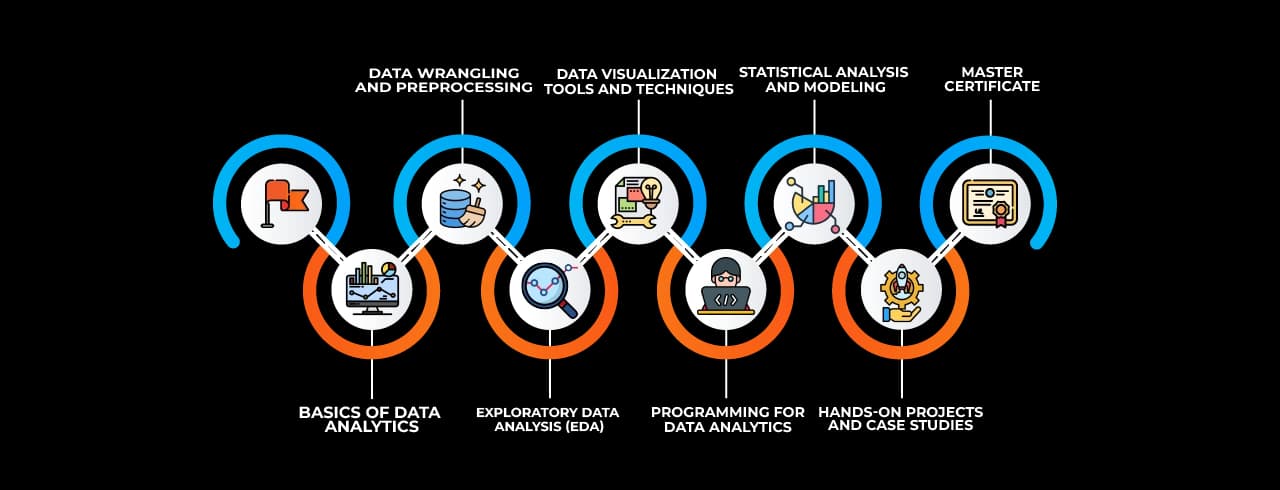
 Big Data Technologies Work with Hadoop, Spark, and other technologies to handle massive datasets.
 Business Intelligence Tools Use tools like Power BI and Tableau for interactive reporting and insights.
 Cloud Platforms and Data Warehousing Learn cloud-based solutions like AWS, Azure, and Google BigQuery for scalable data storage.
 Communication and Data Storytelling SkillsPresent data-driven insights clearly to stakeholders.
 Data Cleaning and Preprocessing Master techniques to clean, transform, and prepare raw data for analysis.
 Data Manipulation with LibrariesWork with Pandas, NumPy, and other libraries to process large datasets.
 Data Visualization Learn to create compelling charts and graphs to uncover insights effectively.
 Machine Learning AlgorithmsExplore supervised and unsupervised learning techniques for predictive analytics.
 Predictive ModelingBuild models to forecast trends and make data-driven business decisions.
 Proficiency in Excel Utilize advanced Excel functions for data analysis, pivot tables, and automation.
 Data Modeling and Database DesignUnderstand how to design optimized database structures for better performance.
 Statistical Analysis and Hypothesis TestingApply statistical methods to interpret data and validate assumptions.