Linux Classes in Pune

feature-iconUnlock Your Linux Potential And Elevate Your IT Career To New Heights

feature-iconDevelop Expertise In Server Management, Network Configuration, And Automation

feature-icon Start Your Journey Toward Becoming A Linux Expert With The Leading Program Today

020-71173071

Start Today!

CONSULT WITH
OUR ADVISORS

  • Course & Curriculum Details
  • Flexible Learning Options
  • Affordable Learning
  • Enrollment Process
  • Career Guidance
  • Internship Opportunities
  • General Communication
  • Certification Benefits

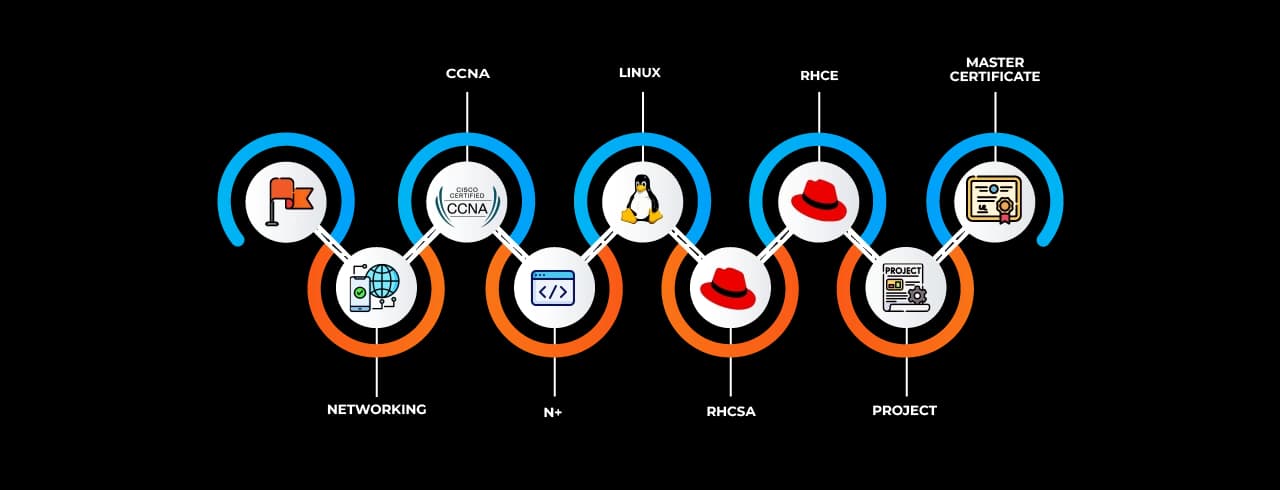
Learning Curve for Linux

Learning curve for Linux

Master In Linux Course

OneCourseMultipleRoles

Empower your career with in-demand data skills and open doors to top-tier opportunities.

Linux System Administrator
System Administrator
IT Support Specialist
Cloud Administrator
DevOps Engineer (Entry-Level)
Linux Support Engineer
Security Administrator
Storage Administrator
Automation Engineer
IT Operations Engineer
Site Reliability Engineer (SRE)
Linux Technician
Backup Administrator
Virtualization Administrator
Network Administrator

Skills & Tools You'll Learn -

Manage Linux networking iconManage Linux networking Configure IP addresses, routing, and network interfaces using nmcli and ip commands.
Access Linux file systems iconAccess Linux file systemsMount, unmount, and navigate file systems using mount, umount, and df.
Manage local users and groups iconManage local users and groupsCreate, modify, and delete users and groups using useradd, usermod, and groupadd.
Analyze and store log files iconAnalyze and store log filesView and manage logs using journalctl, dmesg, and /var/log/ files.
Manage network security iconManage network securityHarden network security using firewalld, iptables, and SELinux policies.
Manage and secure files and file systems iconManage and secure files and file systemsImplement encryption, permissions, and ACLs for file security.
Review the system log files iconReview the system log filesTroubleshoot and audit logs using journalctl and log analysis tools.
Control services and daemons iconControl services and daemonsManage system services using systemctl and service commands.
RHCSA iconRHCSACovers fundamental Linux system administration tasks, including user management, file permissions, and networking.
RHCE iconRHCEFocuses on advanced Linux system administration, automation, and enterprise networking concepts.
History of Linux iconHistory of LinuxOriginated in 1991 by Linus Torvalds, Linux evolved into a powerful open-source operating system.
Create, view, and edit text files iconCreate, view, and edit text filesUse tools like vim, nano, and cat to manage text files.
Monitor and manage Linux processes iconMonitor and manage Linux processesUse ps, top, htop, and kill to monitor and control processes.
Control access to files with file system permissions iconControl access to files with file system permissionsSet file and directory permissions with chmod, chown, and umask.
Configure and secure the OpenSSH service iconConfigure and secure the OpenSSH serviceSecure remote access using sshd_config and key-based authentication.
Managing physical storage iconManaging physical storagePartition and format storage devices using fdisk, parted, and mkfs.
Install and update software packages iconInstall and update software packagesUse dnf or yum to install, update, and remove packages.
Establish network connections and control firewall restrictions iconEstablish network connections and control firewall restrictionsUse firewall and iptables to manage network security.
Monitor and manage running processes iconMonitor and manage running processesTrack system performance with top, htop, and nice/renice commands.
Troubleshoot problems and analyze systems with Red Hat Insights iconTroubleshoot problems and analyze systems with Red Hat InsightsUse Red Hat’s proactive security and performance analysis tool.
Remotely manage systems with SSH and the Web Console iconRemotely manage systems with SSH and the Web ConsoleAdminister servers securely via SSH and Cockpit web UI.
Schedule future tasks iconSchedule future tasksAutomate tasks using cron and at scheduling commands.
Tune system performance iconTune system performanceOptimize system resources with sysctl, ulimit, and performance monitoring tools.
Control access to files with ACLs iconControl access to files with ACLsImplement fine-grained access control with setfacl and getfacl.
Manage SELinux security iconManage SELinux securityEnforce mandatory access controls using getenforce, setenforce, and semanage.
Maintain basic storage iconMaintain basic storageManage disk partitions, file systems, and swap space for optimal performance.
Manage logical volumes iconManage logical volumesUse LVM commands (lvcreate, vgextend, pvdisplay) for flexible storage management.
Implement advanced storage features iconImplement advanced storage featuresConfigure RAID, encryption, and multi-pathing for data redundancy.
Access network-attached storage - NFS iconAccess network-attached storage - NFSConfigure and mount NFS shares for remote file access.
Control the boot process iconControl the boot processManage GRUB and system startup processes for boot troubleshooting.
Container iconContainerDeploy, manage, and run containerized applications using Linux container tools.
Podman iconPodmanManage rootless containers as an alternative to Docker for running containerized applications.
DNS Server iconDNS ServerConfigure and maintain a DNS server using bind for domain name resolution.
DHCP Server iconDHCP ServerAssign dynamic IP addresses to clients using dhcpd configuration.
Web Server – Apache iconWeb Server – ApacheDeploy and manage an Apache HTTP server for hosting websites.
SAMBA Server iconSAMBA ServerConfigure Samba to enable file sharing between Linux and Windows systems.
Configure MariaDB iconConfigure MariaDBInstall and manage the MariaDB database server for relational data storage.
Ansible iconAnsibleAutomate system configuration and management with Ansible playbooks and modules.

Why Choose SevenMentor Linux

Empowering Careers with Industry-Ready Skills.

Specialized Pocket Friendly Programs as per your requirements

Specialized Pocket Friendly Programs as per your requirements

Live Projects With Hands-on Experience

Live Projects With Hands-on Experience

Corporate Soft-skills & Personality Building Sessions

Corporate Soft-skills & Personality Building Sessions

Digital Online, Classroom, Hybrid Batches

Digital Online, Classroom, Hybrid Batches

Interview Calls Assistance & Mock Sessions

Interview Calls Assistance & Mock Sessions

1:1 Mentorship when required

1:1 Mentorship when required

Industry Experienced Trainers

Industry Experienced Trainers

Class Recordings for Missed Classes

Class Recordings for Missed Classes

1 Year FREE Repeat Option

1 Year FREE Repeat Option

Bonus Resources

Bonus Resources

Curriculum For Linux

BATCH SCHEDULE

Linux Course

Find Your Perfect Training Session

Dec 28 - Jan 3

2 sessions
28
Sun
Classroom/ Online
Weekend Batch
03
Sat
Classroom/ OnlineToday
Weekend Batch

Jan 4 - Jan 10

1 sessions
05
Mon
Classroom/ Online
Regular Batch

Jan 11 - Jan 17

1 sessions
12
Mon
Classroom/ Online
Regular Batch

Learning Comes Alive Through Hands-On PROJECTS!

Comprehensive Training Programs Designed to Elevate Your Career

Setting Up a Linux Web Server

Setting Up a Linux Web Server

Building a Linux File Server

Building a Linux File Server

Creating a Linux-Based Home Automation System

Creating a Linux-Based Home Automation System

Setting Up a Linux-Based Mail Server

Setting Up a Linux-Based Mail Server

Building a Linux-Based Media Center

Building a Linux-Based Media Center

No active project selected.

Transform Your Future with Elite Certification

Add Our Training Certificate In Your LinkedIn ProfileLinkedIn

Our industry-relevant certification equips you with essential skills required to succeed in a highly dynamic job market.

Join us and be part of over 50,000 successful certified graduates.

Student 1
Student 2
Student 3
Student 4
Student 5
Join 15,258 others learning today
Certificate Preview

KEY Features that Makes Us Better and Best FIT For You

Expert Trainers

Industry professionals with extensive experience to guide your learning journey.

Comprehensive Curriculum

In-depth courses designed to meet current industry standards and trends.

Hands-on Training

Real-world projects and practical sessions to enhance learning outcomes.

Flexible Schedules

Options for weekday, weekend, and online batches to suit your convenience.

Industry-Recognized Certifications

Globally accepted credentials to boost your career prospects.

State-of-the-Art Infrastructure

Modern facilities and tools for an engaging learning experience.

100% Placement Assistance

Dedicated support to help you secure your dream job.

Affordable Fees

Quality training at competitive prices with flexible payment options.

Lifetime Access to Learning Materials

Revisit course content anytime for continuous learning.

Personalized Attention

Small batch sizes for individualized mentoring and guidance.

Diverse Course Offerings

A wide range of programs in IT, business, design, and more.

Course Content

About Linux 

Linux course will provide a deep understanding of Red Hat Linux. The students or employees will learn how to be able to perform all tasks expected of Red Hat Certified System Administrators and understand and use essential tools, Redhat Linux Training in Pune helps you to configure local storage along with that you will be able to create and configure file systems. In Red Hat Course, we will learn Best practices in tools & configurations; techniques to use for the growth to manage security.

What is Red Hat Linux?
– Linux is a popular operating system which is developed by Linus Torvalds and released on September 17, 1991, Linux is an open-source, secure operating system. Linux is based on the Unix Operating System. Red Hat Linux is the world’s leading enterprise Linux platform. It’s the base from which you can scale existing apps, and roll out emerging technologies, across bare-metal, virtual, container, and all types of cloud environments.
Linux has many flavors known as Linux distribution. For example Ubuntu, Fedora, Debian, CentOS, Red Hat Enterprise Linux, and SUSE Linux Enterprise Server. Linux is everywhere. It’s in your smartphones, in your televisions, in your refrigerators, and in your cars. It runs the world’s stock exchanges, supercomputers, most of internet servers, and networking devices. Our Linux Certificate Course in Pimpri Chinchwad gives you an edge over the current competition. We guarantee industry-relevant jobs and placement in leading businesses worldwide. Our Linux classes in Pimpri Chinchwad have helped our students launch successful careers. So, if you want to work for the greatest IT businesses and have the finest possibilities, enroll in the best Linux RedHat Training in Pimpri Chinchwad.
Linux was not considered suitable for desktops, it was used only for servers. But its user interface and ease of use have been continuously improving over the last few years. Linux is easy to use. Linux can replace Windows on desktops. It is being used by people across the globe.

Why go for Red Hat Linux Training in Pune at SevenMentor?
– Choosing the right Red Hat Linux Classes can be difficult. There are a few reasons we have discussed why you should go for the Red Hat Linux Course in Pune at SevenMentor.

Security: 
The security aspect was kept in mind when developing Linux and it is much less vulnerable to viruses compared to Windows. Install and use Linux to avoid viruses and malware

It’s Free, Open Source:
Linux source code is open source. Linux is completely free and no need to pay for anything. All software required by a typical user and even an advanced user is available. Educational, professional software is available under Linux. We can use the software free of cost and reduce budgets substantially.

Stability:

The Linux system is very stable. It is not prone to crashes. The Linux OS runs longer even after several years. Linux server’s uptime is very high. No need to reboot a Linux server after every update or patch.

Maintenance:
Linux is easy to maintain, as the user can centrally update the OS and all the software installed very easily. Linux uses a central software repository to update the system and keep it safe. There are regular updates and the system is updated without rebooting it.

Customization:
Linux is flexible to customize the system as per requirements. There are GNOME, KDE, etc desktop environments to choose from. Linux uses several small programs, These programs can be used to write really powerful programs and utilities. Linux has several shells used in the command-line interface. We use shell scripts to automate routine maintenance and various other tasks.

Support:
There are various forums to provide support for Linux over the Internet. Questions posed in forums usually get a quick response as a lot of volunteers are online and working to solve the problems due to their passion for Linux. Many commercial enterprises have paid support options like Red Hat and Novell providing 24×7 support for critical applications and services.

RedHat Linux with Ansible
– Ansible is an open-source tool. It is used for IT Configuration Management, Deployment & Orchestration. The main objective of this product is to produce large productivity gains to a wide variety of automation challenges. Learn Redhat 8 with SevenMentor Training in Pune and Understand the functionality of this tool. This tool is extremely easy and straightforward to use yet powerful enough to automate complex multi-tier IT application environments. Previously the method of network deployment and managing servers reliably and efficiently has been a challenge. In the past generation, system administrators managed servers by hand, installing software, changing configurations, and administering services on individual servers.
As data centers grew, and in these data centers most of the hosted applications are more complex, because of that administrators realized they couldn’t scale their manual systems management as fast as the applications they were enabling. It also hampered the speed and performance of the work of the developers since the development team was agile and released software frequently, but IT operations were spending more time configuring the systems. That’s why server provisioning and configuration management tools came into the picture. Previously administrator tasks made things very complicated and time-consuming. But let me tell you that there is a solution to the above-stated problem. The solution is – Ansible.
SevenMentor Provides new advanced training on different tools with Redhat Linux Training Institutes in Pimpri Chinchwad with industry experts. Redhat 8 has come up with Ansible. So we can easily provision and configure your infrastructure using Ansible with different features. RedHat Linux Course in Pimpri Chinchwad will ensure that you grasp the understanding of system setup, administration, and security, as well as prepare you for the most popular Linux administration certification, RHCSA (Red Hat Certification), which will aid in your job search. In the corporate world, you are compensated.

Designed For Any Enterprise
– Red Hat Enterprise Linux 8 is engineered to help enterprises reach new horizons. Red Hat Enterprise Linux is important to the worldwide economy. It’s expected to contribute to trillions of business revenues in 2019 alone. And it’s growing global impact and it affects our world. Red Hat Linux Courses in Pune with SevenMentor will help to understand and use essential tools. Linux helps to operate running systems and configure local storage. It understands the core components of Ansible like Inventories, Modules, Variables, Facts, Configuration files, and more.

What are RHCE Linux Classes?
– SevenMentor is one of the Best Linux Training in Pimpri Chinchwad providers. This is in the system administration domain and well known Best Red Hat Linux Certification in Pune Stands for “Red Hat Certified Engineer”. Red Hat Linux RHCE is the most common track to start our career.

Why Redhat Linux Course in Pune at SevenMentor?
This gives a wholesome idea of the Red Hat Linux concept
– Working knowledge of RHEL 8 server
– You will have familiarity with other Red Hat Linux product
– Industry recognized Linux Training
– Feasible time duration

Available Linux Certification Exams And Fees
– A few versions in Red Hat Linux keep changing. Linux has become one of the most important factors for main server and security as well it is used for the cloud and many more places. When a company hires fresher students, they check out whether they have done any certifications or not. Usually, students who have multiple skills described on their resume, but they don’t have any Best Redhat Linux Classes In Pune to show so the chances are likely to drop from consideration.

There are many benefits of acquiring professional Best Red Hat Linux Certification Training
– Help to kick-start your professional career
– Provide an opportunity to get familiar with tools
– Demonstrate your continuous learning skills
– Provide a platform where we can check deep understanding of theoretical and practical knowledge
– Provide an advantage over your competitors at job interviews.

Following are the Red Hat Linux Certifications that need to do
– RHCSA – Red Hat Certified System Administrator
– RHCE – Red Hat Certified Engineer
– Exam fees are 17500 INR with 18% Service Tax – subject to change by Red Hat every 3 Months
– Exam Duration 150 minutes for RHCSA and 240 minutes for RHCE
– Passing Score Minimum 210 out of 300

Jobs for Red Hat Linux Course RHCE Trained Engineer
– Red Hat Technical Support Engineer
– Red Hat Linux System Administrator
– Levels are L1, L2 & L3
– As a fresher, we start the L1 position.

Red Hat Certified System Administrator (RHCSA), is an entry certificate class that covers Linux requirements (RH124), and Linux management (RH134) that concentrates on real competencies at system administration, including installation and configuration of a Red Hat Enterprise Linux Classes in Chinchwad and attach it into a live system running network solutions. RHCE is a midsize range to advanced-level certification class that covers Linux network and security (RH254) that builds on topics covered in the RHCSA certificate to add more advanced topics like installing and security shared enterprise networking (IP) services.
Intro To Linux, Obtaining the control line, Handle Documents from the command line, Get Assist in a Red hat Enterprise Linux Creating, Viewing, and editing the text documents. Administer Groups and Users Controlling Access documents with Linux file system permissions

Tracking & handling Linux procedures Controlling providers & Daemons and Configuring and OpenSSH support Configuring and procuring OpenSSH support Assessing and keeping logsHandling Red Hat Enterprise Linux Media Archiving and copying files between systems. Installing and updating applications Packages Accessing Linux file systems. Employing Virtualized systems Scheduling Future Steam Jobs. Managing Temporary Files and Handling Priority of Linux Processes Controlling Access to Documents with Access Control Lists (ACLs). Handling SELinux SecurityLinking to Network-defined Groups and Users. Accessing Network Storage with SMBPairing and Troubleshooting the Red Hat Enterprise Linux Boot Procedure Limiting Network.
Communication with anti-virus RHCEThe performance-based Red Hat Certified Engineer exam (EX300) evaluations to learn whether your knowledge, ability, and skill meet those demanded of a senior program administrator accountable for Red Hat Enterprise Linux (RHEL) systems. The Red Hat Certified System Administrator (RHCSA) certificate must make RHCE certification.
Review for this class Improve control line Controls employing innovative features of the bash shell scripts, and utilities, efficiently offered by Red Hat Enterprise Linux. Schedule future jobs Schedule commands to operate in the future or on a schedule. Tune system functionality Boost system performance by correcting the scheduling priority of procedures and placing tuning parameters. Control access to documents with ACLsInterpret and place access control lists (ACLs) on files to take care of situations requiring complicated user and group access permissions. Handle SELinux security
Protect and manage the safety of a server using SELinux. Maintain fundamental storage Create and manage storage devices, partitions, file systems, and switch distances in the control line. Manage logical volumes Produce and manage volumes comprising swap distances and file systems. Storage attributes advanced Manage storage with the Stratis storage control system that is neighborhood and utilizes VDO volumes to maximize storage space. Access network-attached storage Utilize storage to be administered by the NFS protocol. Control the boot Procedure Handle services to be controlled by the boot procedure and to fix and fix issues. Manage network security. Control network links to providers utilizing SELinux rules and the machine firewall. Install Red Hat Enterprise LinuxInstall Red Hat Enterprise Linux on machines and servers.
 

Online Classes

Linux is one of the most popular and open-source operating systems which sits underneath all other software on computers. Online Linux Training will help you to perform admin tasks right from the command line by learning installation, deploying Linux kernel, debugging, testing, and boot process. Linux Online Training will give you in-depth knowledge and enhance the skills necessary for working as a Linux administrator. Online Linux Training also teaches you about Red Hat systems, it’s installation, managing, troubleshooting, and performing various processes by understanding Linux Kernel with testing and debugging. Linux operating system is used by large organizations and in IT companies for servers and developing applications more securely in a fast performing environment. Linux Online Courses will make sure that you will get a master in configuring, managing and securing your system and also assist you to land a high paying job in the corporate world by preparing you for the most in-demand certification of Linux administration is RHCSA (RedHat Certified System Administrator) and RHCE (RedHat Certified Engineer).


Corporate Training

As Linux is an open source operating system with secure kernel and fast to operate. Linux servers are generally used on servers for speed and security purposes. Corporate Linux Training will provide your workforce with necessary skills to manage and troubleshoot by performing different tasks with the in-depth awareness of the Linux kernel and its command line functionality. Corporate Linux Training will help your organization to deploy Linux environments to safeguard from malicious malware attack as Linux kernel is considered as secure.


Through our comprehensive Corporate Linux Training your employees will learn:

  • – Using execution of Linux command
  • – Managing boot processes
  • – Work efficiently with FHS/directories
  • – NFS server connection and back-up
  • – Adding and removing Linux Kernel

Frequently Asked Questions

Everything you need to know about our revolutionary job platform

1

Why should I choose SevenMentor Institute for DevOps training?

Ans:
SevenMentor offers a hands-on learning experience, industry-relevant curriculum, expert mentors, real-world projects, and dedicated placement assistance, ensuring a career boost in DevOps.
2

Does the DevOps Training at SevenMentor include hands-on projects?

Ans:
Yes, practical experience is a key focus. You’ll work on real-world projects like CI/CD implementation with Jenkins, Kubernetes deployment, cloud infrastructure automation with Terraform, and security integration in DevOps pipelines.
3

Which tools and technologies will I learn in the DevOps training curriculum?

Ans:
You will gain expertise in Git, Jenkins, Docker, Kubernetes, Ansible, Terraform, Prometheus, Grafana, AWS DevOps tools, and scripting for automation.
4

What career opportunities are available after completing the DevOps Training Program?

Ans:
After completing the course, you can apply for roles such as DevOps Engineer, Site Reliability Engineer, Cloud Engineer, Infrastructure Engineer, CI/CD Engineer, and Automation Engineer.
5

Is the DevOps Course suitable for beginners?

Ans:
Yes, the course is designed for both beginners and professionals. It starts with fundamental DevOps concepts and progresses to advanced automation, cloud deployments, and security best practices.
6

How does the DevOps certification benefit my career?

Ans:
Earning a DevOps certification validates your expertise in automation, cloud computing, and continuous deployment, making you a highly desirable candidate for IT roles in top companies.
7

Does SevenMentor provide placement support for DevOps training?

Ans:
Yes, we offer 100% placement assistance, including resume building, mock interviews, and job referrals with leading IT firms.
8

How long does the DevOps Course take to complete?

Ans:
The course duration ranges from 2 to 6 months, depending on your learning track, with both weekday and weekend batch options available.
9

What is the teaching methodology at SevenMentor Institute?

Ans:
We follow a project-based learning approach, including live training, interactive sessions, real-world problem-solving, and hands-on labs to ensure practical knowledge.
10

Can I take the DevOps course online?

Ans:
Yes, SevenMentor offers flexible learning options, including both classroom and online training to suit your schedule and learning preferences.
11

Does the DevOps Course cover cloud platforms like AWS, Azure, or Google Cloud?

Ans:
Yes, the training includes cloud deployments on AWS, Azure, and Google Cloud, covering services like AWS CodePipeline, Azure DevOps, and Kubernetes on GCP.
12

Will I receive study materials for the DevOps Certification?

Ans:
Yes, students receive comprehensive study materials, including notes, assignments, practical exercises, and access to recorded sessions.
13

Does the course include advanced topics like security and monitoring?

Ans:
Definitely yes, you’ll learn security best practices in DevOps (DevSecOps), infrastructure monitoring with Prometheus, log analysis with ELK Stack, and performance monitoring with Grafana.
14

How does SevenMentor help with career growth after the course?

Ans:
We provide career guidance, technical mentorship, interview preparation, networking opportunities, and ongoing learning resources to help you succeed in the DevOps field.
15

What topics are covered in the DevOps Course?

Ans:
The course covers CI/CD pipelines, version control with Git, containerization with Docker, Kubernetes orchestration, automation with Ansible, infrastructure as code using Terraform, monitoring with Prometheus & Grafana, and cloud deployments.

Explore Other Demanding Courses

No courses available for the selected domain.