What is Generative AI, and How Is It Transforming the World of Technology?
Generative AI technology has been transforming content creation across all the domains of technology, evolving from data analytics to content creation. As next-generation artificial intelligence is revolutionizing the way businesses generate content, the Generative AI course is ideal for software developers, tech enthusiasts, and creative individuals alike. The most advanced machine learning models today are capable of writing code, generating high-quality images and graphics, and even creating original music and business strategies from scratch. Large neural networks are able to process huge amounts of data and then generate new content from said data, which can be just as intelligent and even creative as human-produced work. As industries around the world are transitioning to automation, it is imperative for any software engineering professional to learn how to implement generative AI models within their workflows in order to remain relevant in the ever-changing landscape of technology.
- Unprecedented Market Demand: The whole world is searching for professionals that can fine-tune large language models to generate automated workflows and fine-tune them to larger applications of generative and creative computing.
- Massive Salary Trajectories: As there is not enough supply of people who have been through generative AI training, it’s now paying some of the highest paying job in the IT market for people who have been through training in large language models and fine-tuning them for large-scale generation and automating workflows to produce a massive amount of content, much higher than software engineers who don’t have such skills.
- True Cross-Industry Versatility: Create innovative solutions and work in industries like healthcare, financial risk & portfolio management, and entertainment & movie & music production, in addition to software development in various IT organizations across the globe.
- Worldwide Opportunities: High-growth countries like the USA, UK, Germany, and the UAE are increasingly investing in talent in generative AI to build outperformance against competitors.
- Work on the cutting edge of technology and the core of the innovation—driving how humans interact with the machines that are increasingly taking center stage in most areas of our projects (developing custom chatbots, automated discovery pipelines, etc.).
What Specific Industry Skills and Tools Will You Master in This Training Program?
Most academic courses cover the theory of intelligence engineering, which is necessary to understand how to apply generative AI to problems in the business world, but theoretical knowledge is not enough to succeed in today’s highly competitive technology sector. To develop meaningful skills with generative AI, students in this specialized certification program will learn how to apply their newfound knowledge in real-world applications. In the first place, it's important for students to learn the basic knowledge of any good intelligence engineer, which is programming. The good knowledge of programming languages that are best for intelligent engineering, combined with practical learning experience, will provide students with enough knowledge to create production-ready models to apply at work. Also, students will acquire the knowledge of how neural networks and natural language processing algorithms work and will be able to use that knowledge to process, analyze, and even generate human language. Furthermore, our training will cover how to use that knowledge to implement contextual optimization and work with complex vector data structures to build workflows of intelligent applications to solve real business problems.
This specialized Generative AI certification program will train you to develop deep technical skills to address complex problems of large corporations using various skills and state-of-the-art developer tools.
- Python Programming: In-depth study of Python, specifically how to develop AI-related projects that incorporate data structures and implement asynchronous execution, as well as work with a variety of mathematical libraries.
- Machine Learning & Deep Learning Core: Study of mathematical background, layers of neural networks, and backpropagation in order to understand machine learning well.
- Natural Language Processing (NLP): Implementation of such algorithms as tokenization, sequence-to-sequence models with attention mechanisms, etc., to analyze texts.
- Advanced Prompt Engineering: Learn how to design, test, and optimize structured inputs to get accurate and even hallucination-free outputs from large language models.
- Enterprise Framework Mastery: Students will get hands-on with some of the leading production frameworks and developer tools, including the OpenAI APIs and Hugging Face repositories for models and datasets, as well as the most commonly used deep learning frameworks, TensorFlow and PyTorch. Students will also get up to speed with the rapidly growing field of intelligence engineering with a focus on corporate problems with the LangChain framework for end-to-end AI workflow orchestration.
Why is SevenMentor the Preferred Choice for Advancing Your AI Career?
A person cannot learn to build intelligent systems only through learning to build systems. One needs to experiment, refine models, and work through simulations in deep dives. That is why all our training programs are designed to ensure that the vast majority of time that one spends in learning is spent in building simulations, refining models to run on data,, and working through scenarios in deep dives. SevenMentor’s training programs are thus designed to make sure that one can continue to learn and to work at the same time. Whether you are fresh out of college and are looking to get into the IT industry or are already working as a software engineer and are looking to make a big career change, our training programs are a great way to learn to build intelligent systems to work on the next generation of technology platforms.
Our training programs at SevenMentor have several benefits that set us apart from other learning institutions to help you achieve your goals.
- Flexible Learning Environments: Our training sessions are offered in real time through online or offline formats and are equally engaging for students across the globe. Interactive online sessions, led by instructors, and hands-on learning through offline sessions help students get the benefit of flexibility.
- Rigorous Project-Based Learning: The majority of your time spent in the course will be in completing rigorous project-based learning modules, which involve simulation of real world scenarios, adapting open-source code to satisfy user needs and automating different testings procedures.
- Career Oriented: Our course is extremely career-oriented. The following steps are undertaken for placement of our students: (1) Resume help and a review of portfolios of students (2) Simulating real life mock interviews (3) Numerous hiring drives for students in top companies.
- Expert Guidance from Experienced Researchers: Learning becomes effective when you learn from an expert who has had years of experience handling data and has great expertise and experience in model deployment.
- Corporate Training: We also conduct custom made corporate training programs which help companies leverage automated workflow, improve operating efficiency and trigger digital transformation.
How does the Project-Based Learning Method equip you for challenges in the Real World of AI?
A high-tier technical education means moving from a purely abstract program to a program that teaches production-ready software development. The main pillar of our The Generative AI course is an immersive, simulator-based framework where you design, optimize, and scale deep learning modules locally and in the cloud. Instead of watching videos and reading through code snippets, in our 4-month program, you tackle a data pipeline from start to finish, simulating the workflow of an engineering team at a modern tech company. You manage a full-stack workflow, for example, tokenization, embedding, deep learning, fine-tuning, and API integration. You learn how to configure the parameters of a model to get it to run efficiently, i.e., to get good results at a low cost. By working with the latest graphical processors and cloud execution nodes for latent space manipulation and system debugging for hallucinations, you get a feeling for what it takes to be a proficient engineer for generative AI.
For the 4-month period of the Generative AI course, you will have the chance to implement and to deploy architectures that you have designed through practical tasks of implementation related to the following subjects of the course.
- Conversational Q&A Chatbots: Build out responsive, memory-intensive intelligent agents such as chatbots utilizing LangChain and deep vector databases to get the best contextual recall for any given context.
- The program also looks to educate students on how to build and deploy AI to create large amounts of high-value content. Projects such as building an automated blog-writing service or summary service for writing using advanced natural language processing APIs to generate large amounts of intelligent content.
- Text-to-Image Generation Tools: Students use latent diffusion models and generative adversarial networks (GANs) for creative computing projects to generate realistic images from text prompts.
- Predictive Sequence Simulators: Building robust stock price prediction pipelines using stock & time-series data, including the use of long short-term memory (LSTM) neural networks.
- Production-Level Model Deployment: Students learn how to deploy their generated models in a production-level setting using Flask and Docker containers to perform live inferences on cloud-based infrastructure platforms.
What Career Opportunities and Salary Paths Await Certified Generative AI Specialists?
Generative AI, arguably today’s hottest technology, is poised to be one of the most lucrative fields to work in – rivaling the high salaries seen in global technology behemoths during their respective growth spurts. More importantly, with the severe lack of qualified AI engineering talent, an accredited Generative AI certification will immediately upgrade your designation to that of a skilled engineer—with institutions and organizations globally locked in a fierce talent war. The landscape of companies across industries (from Finance and Entertainment, Healthcare and Retail) is undergoing radical transformation, leveraging automated generation of assets and, in the process, offering up unprecedented compensation for various levels of experience and hands-on hours of coding, building, and mastery of various frameworks—entering the space as a fresher can command up to ₹6 LPA and rise dramatically as your hours of coding increase and your portfolio grows in depth, while the middle-level specialist can expect anywhere between ₹10-25 LPA and senior architects can expect up to ₹25-40 LPA or even more.
As a graduate of a recognized Gen AI training program, you will have the option to choose from a variety of high-growth job roles in the ecosystem of technical partners and service providers:
- Generative AI Engineer: He/She will develop, train, and optimize the deep learning models (like neural networks) and their variants (like specialized transformers) as well as develop layers and complete applications for enterprises within the generative AI domain.
- Prompt Engineer: Designing, testing, and standardizing input prompts that are likely to elicit the desired output from a large language model consistently, securely, and with due context.
- NLP Specialist: He/She would design and build solutions around specialized computational linguistics, semantic classification, text processing, and other forms of interactive dialog systems for humans and/or machines.
- AI Automation Specialist: Automate current workflows within companies to build decision-making capabilities within the process. Automate to cut costs and increase speed of work.
- AI Solutions Consultant: Provide guidance to executive leadership on a company’s digital transformation to utilize AI, and then outline a plan on how to go about integrating the new technology into the organization and how to ensure an ethical execution of the new AI solutions.
How Do Our Corporate Training and Flexible Learning Paths Drive Modern Business Transformation?
It’s important to sustain the business by developing workforce to keep pace with latest algorithms. SevenMentor supports organization to leverage technology to get maximum efficiency by providing bespoke corporate training solutions. At SevenMentor, we conduct workshop by delivering practical session on real world data and tools used by participants in their job. This helps engineering team to develop automated reports, build local helpdesk and create intelligent code assistant which aligns with objective of organization. Also, we enable individual to learn latest technologies used in industry, through flexible online-offline structure, thus, enabling working software professionals and researchers to learn latest technologies at their own pace without leaving their job.
Our Training and Course programs are designed to deliver high accessibility, high business value and high retention.
- Tailored Corporate Case Studies: We will structure to cover your business objectives, work in your secure proprietary environment and automate the industry specific processes you are targeting.
- Live Instructor-Led Sessions: Our Live Interactive Training Sessions are conducted by our team of data science experts and are delivered in fully interactive virtual classrooms or in intensive training labs.
- End-to-End Placement Assistance: The SevenMentor approach of end-to-end Placement assistance program helps in career transition of learners by creating best-in-class resume, best-in-class portfolio and help in Mock Interviews.
- Review in your own time with a LMS (Learning Management System) for a complex curriculum that has been end to end designed by data science practitioners. Review in your own time from coding sandboxes to recorded reference lectures for complex topics, all lifetime.
- Comprehensive Global Access: Our learners benefit from the industry’s most aligned learning ecosystem that compares to the recruitment standards prevalent in the USA, UK, Canada and India.
How Does Our Quality Assurance Model Protect and Guarantee Your Educational Investment?
Our vision for premier technical education is that of absolute transparency in learning, sure-shot verified learning metrics, and accountable education institutions. To get rid of much uncertainty faced by modern students looking for premier generative AI education, SevenMentor has put up a very rigid quality assurance map for our course on generative AI. As we at SevenMentor believe that creating the next generation of machine learning modules requires the best of mentorship and the most transparent of financial structures and the highest consistency of formats from day one of the student’s first day of training, our best of the technology and expert teaching staff at SevenMentor has devised a curriculum elite in its quality and structure and guaranteed verified Generative AI certification in hand and in the student’s portfolio along with the best of the enterprise software engineering placements globally, in hand, at the end of the course. This is further ensured by the most stringent quality checks at SevenMentor on the format adopted by both the academic and career development divisions of the organization.
Our strict quality framework is designed to ensure the highest level of Student Security and Professional Transparency with five strong arms of SevenMentor’s quality structure, i.e.,
- Elite Peer Mentorship: Every technical lecture is held by senior data scientists who are verified to have deployed large language models in real commercial environments, including generative AI.
- Our Transparent Placement Ecosystem: All job descriptions go through a multi-step verification process to ensure that the interview parameters, stipend, etc. are what students can expect and match with their career goals.
- No Hidden Charges: SevenMentor does not charge any hidden fees or charges post training, and also there are no additional charges for documentation once you receive the offer letter from the corporation for software engineering placements.
- Guaranteed Format Continuity: For those students enrolling in our immersive learning model (face-to-face lab sessions), we guarantee to continue the offline learning format for the student experienced in the hands-on lab sessions. This ensures that students have sufficient hands-on coding time and interactions with their peer group.
- Constructive Performance Portals: SevenMentor actively uses student feedback to update our learning system and refine our prompt engineering sandbox environments in real time.
How Does Interdisciplinary Tech Integration Maximize the Impact of Advanced Intelligent Systems?
Software engineering today can no longer exist in a bubble. That is to say, constructing truly innovative software requires an integrated framework of technological solutions. As is the case with deploying a modern machine learning architecture, the core intelligent model is just the ‘brain’. It can be ‘fed’ data by a plethora of specialized frameworks in order to ‘train’ the model to solve complex problems. Then, once a model has been specialized to perform within a specific remit, the intelligent output can be ingested by other frameworks in order to support the creation of scalable, secure, and highly interactive web-based applications. From provisioning cloud containerized solutions to the development of highly innovative interactive data dashboards that allow end-users to ‘interact’ with data in real time, true innovation requires a comprehensive systems approach that encompasses the most advanced forms of cognitive automation and allows the engineer to create a wide variety of web-based applications.
Our curriculum focuses on building complete mastery of full enterprise ecosystems. How to apply latest automation technology across different areas of enterprise technology.
- Data Science & Analytics: Build data-driven web applications and analyze user behavior in real time to optimize the performance of machine learning models.
- Core Software Engineering (Python & Java): The fundamentals of backend development with the two leading programming languages for building web applications and constructing layers and microservices for large-scale enterprises.
- Cloud Computing & DevOps: Set up of continuous integration and deployment pipelines for the hosting of very scalable intelligent systems as cloud-native applications.
- Cyber Security Frameworks: Use of cryptographic methods and access control for the protection of the cognitive web application from unwanted data extraction.
- Also in our enterprise ERP & CRM courses (SAP & Salesforce), students of our data science courses learn to implement their automated workflows and predictive analytics in real global business management platforms.
- Advanced AI & Conversational Tools (ChatGPT & Prompt Engineering): Building intelligent & automated chatbots that engage with users in natural and context-aware, human-like conversations to automate high-volume business communication.
- Power BI Dashboards: Transformation of a large amount of processed data into highly visual interactive information for decision-making by senior management.
Got Questions? Here Are Some FAQs
1. What is a Generative AI Course?
A Generative AI Course is a training that teaches you how to create content (text, images, video, etc.) with the help of AI. On such a course you will get to know several AI tools for generative tasks, the underlying machine learning concepts, and also how to get the best out of your AI with the right prompts. Besides that, you also will learn how to apply AI in your day to day work.
2. Who can join a Generative AI Course?
A generative AI course is suited for everyone who is interested in AI. This can be a student as well as a working professional. Also, a developer, a marketer, or a business owner.
3. Do I need coding knowledge to learn Generative AI?
Most of the generative AI courses are designed for complete beginners to the subject and do not require any prior coding knowledge or experience. However, having some prior knowledge of programming can be of great benefit to learn more about the AI concepts.
4. What career opportunities are available after a Generative AI Course?
After completing the Generative AI Course, you can start your career as an AI engineer, as a prompt engineer, as an AI consultant, as a data scientist, or even as an AI application developer.
5. How long does it take to complete a Generative AI Course?
The duration of generative AI courses can vary depending on the training provider but generally can be completed within a few weeks to a few months.
Blog Links:
Anthropic AI Tool
What is Writesonic
What is Claude AI
AI Engineer Roadmap
What is JasperAI
 Generative AI (Generative Artificial Intelligence) refers to a class of AI models that can create new content, such as text, images, audio, video, and even code.
  Unlike traditional AI, which primarily analyzes and classifies data, generative AI learns patterns from large datasets and generates new, human-like outputs based on that learning.
 SevenMentor has specialized trainers who educate you on Generative AI
-1744727040985.webp&w=3840&q=75)
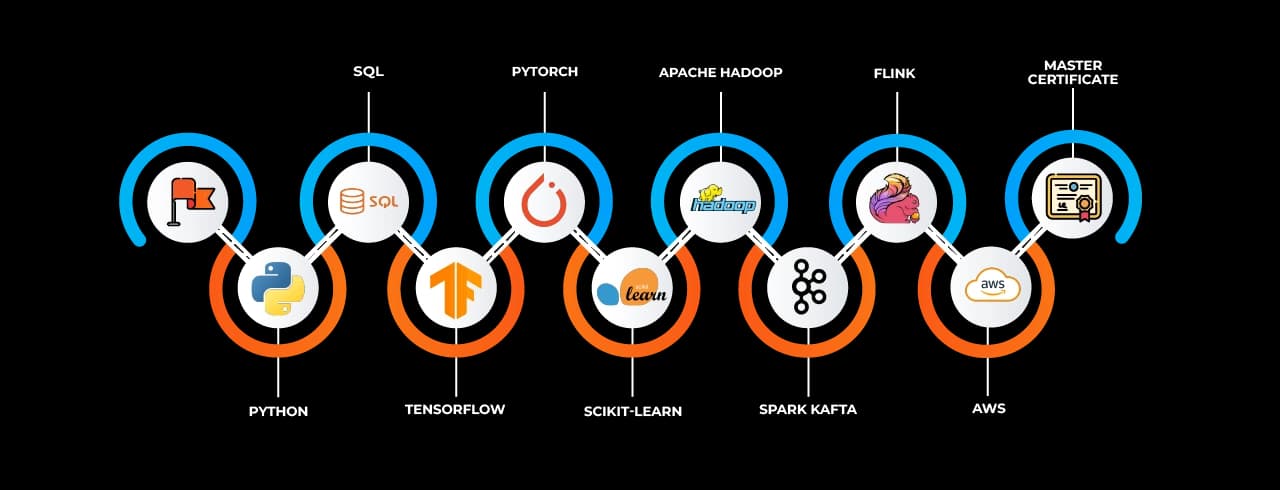
 PytorchA deep learning framework offering dynamic computation graphs and flexibility.
 Microsoft AzureExplore cloud computing with Microsoft Azure for hosting, deploying, and managing applications.
 FlaskFlask
 Apache SparkBig data processing engine for large-scale analytics and real-time processing.
 Hadoop Open-source framework for distributed storage and big data processing.
 Docker A containerization platform that enables developers to package, distribute, and run applications in isolated environments.
 Kubernetes A container orchestration system for automating deployment, scaling, and management of containerized applications.
 AWSAmazon Web Services, a cloud computing platform offering scalable infrastructure and services.
 Kafka (Real-Time Data Streaming) – Enable real-time data ingestion, processing, and streaming with Apache Kafka.
 Python A versatile programming language widely used for data analysis and modeling.
 SQL A database language for querying and managing structured data.
 Matplotlib A visualization library for creating charts and graphs.
 Seaborn An advanced data visualization library built on Matplotlib.
 Scikit-learnA machine learning library for predictive modeling and analysis.
 TensorFlow A framework for building and deploying deep learning models.
 Power BIA business intelligence tool for data visualization and reporting.
 Tableau A data visualization software for creating interactive dashboards.
 FastAPIA high-performance framework for building APIs in machine learning and AI applications.
 FlinkA framework for real-time stream and batch processing of data.
 Google CloudA cloud platform providing computing, storage, and AI services.
 KerasA high-level deep learning API running on TensorFlow.
 BERTA transformer-based NLP model for contextual understanding of text.
 GPTA generative AI model for text-based applications like chatbots and content creation.
 Hugging Face TransformersA library for working with pre-trained NLP models like BERT and GPT.