What is Data Science, and Why is it a Lucrative Career Choice?
Data science has emerged as the ultimate tool for decision-making by any modern enterprise that lies at the crossroads between computer science, advanced mathematics, and domain-based business intelligence. With the advent of digital technologies, companies now have access to an abundance of unstructured data coming from different sources, which, however, will not work without translation. A data science course will teach you to extract, refine, and develop predictive models from this unstructured data, which will help solve many pressing problems. Starting from forecasting diseases in health care and automatic detection of fraudulent transactions in the global financial system to analyzing customer behavior in retail, the field of data science helps enterprises become more efficient and save money.
Given that companies need such knowledge to be successful and expand their operations, there is currently an unprecedented demand for specialists, making it a highly paid and stable career path within the tech market. The global data science certification is the best tool proving your expertise to the market.
- Salary Prospects With Exponential Growth Potential: Fresh graduates joining the field can expect their starting salary in data science to be between 5 to 7 LPA. On the other hand, experts working in the field and experts in the realm of artificial intelligence and machine learning will find themselves capable of earning up to 10 to 20+ LPA.
- Huge Requirement Worldwide: Industries such as health care, finance, retail, and e-commerce are increasingly using analytical models to redefine their core business model, generating thousands of well-paying jobs each year.
- Career Potential With Longevity: The right choice of data science training program guarantees you a future-ready skillset.
What Does the SevenMentor Data Science Course in Pune Cover?
The Data Science Training Program, delivered through the renowned platform of SevenMentor, is designed with precision to develop an individual from scratch to an expert professional within 7 to 9 months. Our course framework is based on the exact architecture, which conforms to global standards, thus enabling students to learn the exact tech stack sought after by leading firms in the domain of information technology and analytics. Extensive learning of basic programming languages is conducted, starting off with Python, as it is a versatile language offering a variety of packages such as NumPy and Pandas. Furthermore, it includes R for high-level statistical analysis and visualization.
In order to connect the technical code with the business-oriented decisions, our training is highly focused on advanced tools for business intelligence dashboarding. We ensure that our students become experts at configuring data pipelines and automated analytical platforms.
- Technical Core Competency: Develop skills by programming in adaptive systems through Python, R, and specific SQL queries for databases.
- Competency in Business Intelligence Software: Create interactive dashboards utilizing leading business intelligence software, such as Tableau and Power BI.
- Knowledge of Cloud Architecture: Learn about processing and managing big data in cloud architectures, including AWS Data Services and Google Cloud Platform.
- AI Prediction Model Building: Build intelligent models that can predict future trends in the markets.
How Does SevenMentor Ensure Hands-on Learning and Placement Success?
At SevenMentor, the method of data science training at our institution does not include the conventional approach where learning is purely theoretical. The practical training conducted under expert industry professionals allows the learners to experience a full project immersion setting to gain confidence through using clean codes in real-life chaos. That is why our students work on creating complete project portfolios by working with live data from domains like retail, banking, and e-commerce.
In addition to the technical training, we have a specialized career assistance program to guide you through the modern world of job hunting. We arrange intensive resume-building sessions and mock technical interviews along with conducting exclusive recruitment drives with leading IT and analytical conglomerates.
- Mentorship by Experts: Get trained directly by expert data scientists with many years of real-life corporate experience to bring their case studies into the interactive classroom.
- Industry-Specific Capstones: Create your very own professional portfolio through tackling real-life business problems in essential industries such as finance, retail, and health care.
- Placement Support: Benefit from career grooming services, interactive mock interview sessions, and placement drives that link you with the best IT companies in the industry.
- Career Pathways: Receive the required multidisciplinary training to prepare you for the highly demanding and lucrative positions of data analyst, machine learning engineer, and enterprise data scientist.
What Flexible Learning Formats and Formats are Available for Students and Working Professionals?
The present-day Data Science Course needs to cater to the different schedules of students at university, of professional individuals who are working, and those changing their career path. The institution named SevenMentor fulfills this requirement by offering very flexible modes of learning for all those enrolled. There are offline courses, online courses, or a combination of both that one can opt for as per convenience. We do not want you to make any compromise on your schedule by making the batches available during morning, evening, and weekend slots.
Each individual is entitled to full access to our latest LMS (Learning Management System). It will serve as an e-campus that will enable you to keep track of your assignments, review the recorded video lectures, and monitor your progress.
- Flexible Training Modes: Go through different training modes that include online, offline physical, or hybrid classroom depending on your choice.
- Time Batch Customization: Balance your personal and professional obligations with ease by choosing morning, late evening, or weekend time batches.
- Sophisticated LMS Monitoring: Be disciplined and systematic by utilizing our digital system to access your lessons automatically recorded and also submit your assignments.
- Interactive Virtual Guidance: Get over coding roadblocks effectively by fixing an appointment with your course mentors virtually.
Why is a Specialized Data Science Certification Crucial for Your Career?
The most straightforward approach to establishing your technical credentials in such a highly competitive employment marketplace would be enrolling in a professional data science training program. Although self-training can give you the knowledge of basic syntaxes, data science certification recognized by the ISO becomes the official acknowledgment of your structural knowledge. Managers of reputable IT and analytic companies receive hundreds of resumes weekly, and getting such a certificate instantly proves that your technical competences are up to the international occupational standards. It will turn you from one of many "Python programmers" into a specialist who can work with data throughout its life cycle.
Another aspect is that such a certificate will be a great trigger for increasing your data science salary.
- International Corporate Recognition: Make your global search for work more successful with a certificate that will be appreciated and acknowledged by all major IT companies and enterprises around the world.
- Professional Credibility: Stand out from other professionals who are self-trained by demonstrating your competence in complicated cloud systems and predictive analysis.
- High Negotiating Capabilities: Use your certificate to get the best job offers that will guarantee premium salaries from the very beginning.
- Full Lifecycle Confirmation: Prove your prospective employer that you have successfully passed all stages from data gathering to executive dashboards.
How Does SevenMentor Deliver Tailored Corporate Data Science Training for Teams?
In addition to personal career growth opportunities, SevenMentor is the go-to place for tailor-made corporate data science training, which is designed to enable contemporary companies to skill their workforce in data science practices. It is imperative in today’s number-driven economy that the processes of data analysis are not limited only to the IT department. The corporate programs offered by us are meticulously devised to incorporate data-based decision-making into every crucial aspect of business, including marketing, finances, human resources, and logistics.
We will work together with you and your management to develop a tailor-made program suited entirely to your specific business requirements. Our seasoned corporate mentors will take an entirely different approach from using regular textbook examples. Instead, they will train your employees by using actual data sets belonging to your company.
- Customized Enterprise Curriculum: Develop an entirely customized program that is aligned with the unique technical challenges, processes, and analytical requirements of your business organization.
- In-Company Data Integration: Increase your learning investment's efficiency by allowing your employees to clean data and run statistical models on your business organization's data set.
- Modernization of Departments: Train your sales, finance, and operations department employees to be able to use AI technologies to automate processes and find trends in the marketplace.
- Business Automation: Let your team members know how to build scalable data pipelines and automate report generation.
SevenMentor strongly believes that feedback is an essential element for quality improvement.
We at SevenMentor bridge the gap and show you how our data science course seamlessly fits into the entire tech stack. Instead of running away from problems faced by previous students, our management makes use of constructive feedback to make changes to our teaching approach. Over the years, we have completely transformed our administrative process, placement process, and academics in order to make sure each and every student gets nothing but the best learning experience. From ensuring transparency in the learning process to updating our technical course content, we have implemented measures to make feedback work for the benefit of the student.
Opting for our data science training program is an indication of your choice for excellence.
- Learning Format Assurance: It is our strict non-disruption policy that guarantees your batch to be on campus throughout and will never make you undergo forced digitization midway into the course.
- Proactive Career Orientation Framework: We have thoroughly revamped our corporate cell to give practical expectations from jobs along with mock assessments and placement drives with real tech companies.
- Hierarchical Mentoring System and Quality Audits: Our advanced modules including artificial intelligence and machine learning modules are trained only by enterprise-level quality auditors who can fix code problems.
- Feedback Redressal System: Every batch has a student success manager assigned to your needs so that all your concerns pertaining to academics and schedules are attended to within 24 business hours.
How Do Modern Web Technologies Integrate with Data Science for Advanced Solutions?
Nowadays, in the digital world where everything is connected, data science is no longer an isolated concept. Data scientists need to know about how modern analytics works in relation to modern software development, cloud computing, and intelligent automation techniques. It can be building predictive models in the cloud, designing easy-to-use dashboards, or securing your system. The multi-disciplinary approach will allow you to build complete web apps using data.
With this multidisciplinary knowledge, you don't just become a backend coder but a technical architect who can deploy intelligent systems to any company infrastructure.
- Data Science & Analytics Fundamentals: Harness the power of specialized techniques in data science together with powerful data analytics to model the metrics, recognize the trends, and analyze the user behavior as well as application performance accurately.
- Backend and Enterprise Programming: Employ Python, the most popular programming language used in the backend, or Java, the language extensively used for enterprise-level web applications, to develop server-side code.
- AI Integration in the Future: Step into future technologies and learn about our Generative AI & AI courses to create intelligent applications, or take our ChatGPT courses for the efficient integration of the AI chatbot into your application.
- Cloud Infrastructures and Scalability: Learn the basics of cloud computing and deploy robust applications on the cloud to ensure scalability of your application across the globe while employing the DevOps practices to ensure smooth CI/CD pipelines.
- Visuals and Enterprise Architecture: Develop beautiful, real-time interactive business dashboards with Power BI, integrate your predictive pipelines with Salesforce for CRM web-based solutions, and coordinate with SAP for resource planning.
- Web Application Security: Implement the protocols of cybersecurity throughout your development cycle to secure web applications and protect the company’s database as well as the private data of the users.
Got Questions? Here Are Some FAQs
Q1. What is a Data Science Course?
In a data science course, you will be able to acquire the skills of collecting, analyzing, and interpreting data using Python, SQL, machine learning, and data visualization and apply it to solve business challenges.
Q2. Who can do a Data Science Course?
Anybody who has an interest in data and analytics can do a Data Science Course. Both students, freshers, and even working professionals from any domain can take up this course.
Q3. What will be my skill set in a Data Science Course?
Some of the skills gained during a Data Science Course are Python Programming, Data Analysis, Machine Learning, Statistics, Data Visualization, and Database Management.
Q4. Is Data Science a good career choice?
Yes, Data Science is one of the emerging career options today. Professionals from the field of data science are required in all industries to make data-driven decisions for companies.
Q5. What will be the job roles after doing a Data Science Course?
Once you complete your Data Science Course, some of the job roles that you can target are Data Scientist, Data Analyst, Machine Learning Engineer, Business Analyst, and Data Engineer.
Blog Links:
Anthropic AI Tool
What is Writesonic
What is Claude AI
AI Engineer Roadmap
What is JasperAI
 Data Science Course with Live Hands-On Projects Experience
 Build a Strong Foundation in Data Science with Industry-Oriented Program.
 Master Data science with Gen AI Tools and Techniques from SevenMentor
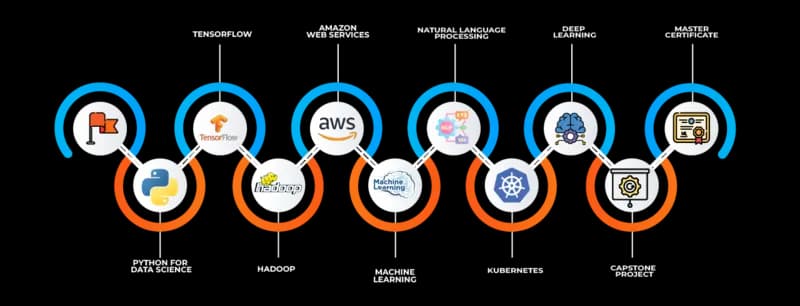
 Data Visualization Learn to create compelling charts and graphs to uncover insights effectively.
 Python A versatile programming language widely used for data analysis and modeling.
 SQL A database language for querying and managing structured data.
 Pandas A Python library for data manipulation and analysis.
 NumPy A library for numerical computing and handling large datasets.
 Scikit-learnA machine learning library for predictive modeling and analysis.
 Deep LearningAn advanced subset of machine learning using neural networks.
 Power Query & DAXTools for data transformation and advanced analytics in Power BI.
 Model Evaluation & OptimizationStrategies to fine-tune machine learning models for better performance.
 OpenCVA library for computer vision tasks like image processing and object detection.
 FastAPIA high-performance framework for building APIs in machine learning and AI applications.
 RA statistical programming language widely used for data analysis and visualization.
 Matplotlib & SeabornLibraries for creating insightful and visually appealing data visualizations.
 Power BI & TableauBusiness intelligence tools for interactive data visualization and reporting.
 Data Preprocessing & Feature EngineeringTechniques for preparing and optimizing data for modeling.
 Statistical Modeling & Hypothesis TestingMethods for analyzing trends and validating assumptions.