What is Included in the Business Analyst Course Curriculum?
Most textbooks don’t show you how to start with a world of data-driven decision-making. That’s why our business analyst course at SevenMentor is so specifically designed to make you ready for the way real organizations work. We don’t load you up with so much technical material from the start. Instead, we begin by teaching you to think analytically in order to find the root cause of a problem. You’ll learn to identify the various types of problems that affect businesses on a day-to-day basis, to recognize when a team has lost track of key performance indicators, and to split up complex problems so that you can deal with them one by one in a systematic fashion.
From basic data management to functional workflows—once you become comfortable in analyzing problems, our trainer will guide you to learn various technical tools that business analysts use to solve problems. You will learn various Excel functions and practice creating summaries using data with the help of real scenarios. In addition, you will learn to write SQL queries and thereby work with databases, such as extracting records from databases and joining tables of relational databases to retrieve data. SQL is often used for answering day-to-day operations questions.
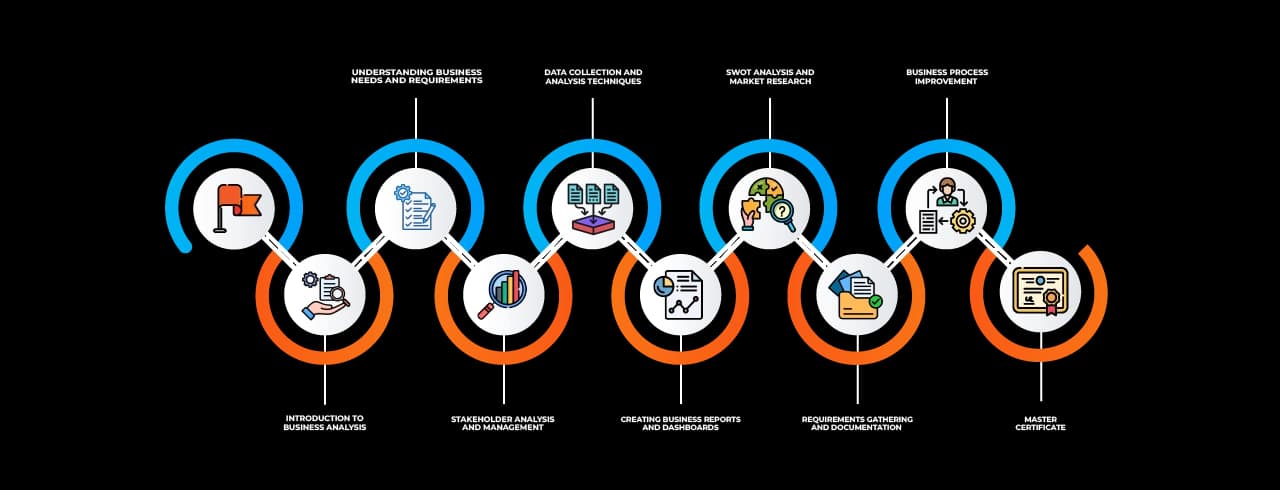
- Root Cause Analysis: Learn to analyze problems in order to determine the root causes of the problem instead of solving symptoms of a problem.
- Data Handling: In this course, you will be trained to process huge amounts of data using Excel. Here, you will also be able to learn how to clean and arrange data, write complex formulas, and create summaries with the help of macros.
- SQL for Business Analysts: SQL to write queries, to extract data from databases, to join tables to retrieve information from relational databases, and to answer daily business questions.
- Requirement Gathering & Documentation: The business analyst translates the ambiguous conversations held with stakeholders to develop and write out the functional requirement documents that the development teams can then execute.
- Interactive Dashboard Creation: Create simple, clear, and interactive visual reports that allow the manager to easily monitor and track trends by using the latest business intelligence tools.
- Cross-Industry Case Studies: We provide business analyst course training using real-life scenarios such as retail, banking, customer service, and supply chain along with other industries to make our students familiar with different business models followed in different industries.
Why Do Business Analysis Techniques and Tools Matter Today?
The biggest benefit of business analyst training is the significant change in your perspective on your work. You suddenly start to see your usual work in the office in a new light, and instead of seeing it as just more work, you start to see it as yet another system that can be optimized. After a few weeks of practice at work, you will start to automatically recognize patterns, anticipate problems before they occur, find the root cause of any sudden increase in output as well as the reason for any decrease in output, and more. Your colleagues will marvel at your ability to come up with innovative solutions to complex problems. Your manager will be relieved at the weight that has been taken off his/her hands.
Business analyst training also dramatically enhances your communication. Many professionals have a hard time conveying their advice and ideas to their superiors. It is not that their advice is particularly poor, but rather it has not been sufficiently backed up with hard data and/or poorly structured. After completing a few weeks of solid practice of business analyst skills, a person is very quickly able to organize information, ask very deliberate questions, and then back up his or her advice with solid average numbers that have been tracked as necessary to support any recommendations that have been made. People who possess such business analyst skills command a great deal of respect.
- Rapid Career Advancement: As a trained business analyst, you quickly become the one for managing to analyze internal processes and to make key decisions with absolute clarity after checking the available data.
- High Market Demand: There is high demand for analytical expertise in every industry globally and therefore high geographical mobility.
- Low Coding: The role of business analyst is high-value-add in technology and does not require any coding.
- Improve Your Presentation Skills: Learn how to present data summaries in an organized and clear manner to clients, stakeholders, and corporate officers.
All problem-solving is based on logic, which can be learned. Business analyst training helps you to learn this logic in order to apply it to everyday business problems in order to increase your own productivity, improve your project management, and help your team with their task delegation.
What are the Key Benefits of Learning Business Analysis?
Business analyst training changes the way one looks at day-to-day work in the office dramatically for the better after completion of only a few weeks of practice. One starts to see work in terms of systems that can be optimized instead of merely doing day-to-day work. He/She would be able to naturally start identifying patterns, issues (obstacles), and factors (factors such as variables) that are affecting an increase in performance. They will become very valuable to their team and manager after completion of only a few weeks of practice, as business analyst work is different from the work of other business professionals.
Also, your ability to effectively communicate with your colleagues and senior staff will greatly increase, and this is particularly powerful when communicating with your company’s executives. Many people feel that they are unable to effectively present their ideas to their company’s executives because they lack data to support their recommendations and ways to effectively structure the information that they do have. The business analyst training that you receive will provide you with the skills to not only better ask questions in order to gather more information regarding a problem, but also to effectively organize the information that you do have and present it to others in a clear and organized fashion. This is something that many people are not able to do well, but with the business analyst training that you receive, you will be able to present your ideas to your company’s executives in a way that is sure to command their respect, even if you don’t have all of the answers, such as not being a computer science major and not knowing how to write code, but being able to translate numbers into recommendations for actions that will increase value.
- Accelerated Career Progression: You rapidly evolve into the go-to strategist that managers rely on whenever an internal process breaks down or a critical decision requires absolute clarity.
- High Market Demand: There is a huge demand for business analysts in every single industry and business, and therefore lots of geographic and industry flexibility.
- Minimal Coding Barriers: The business analyst career path offers the opportunity of a lucrative technology career without the need to write hundreds of lines of complex code.
- Improved Presentation Skills: Learn to present simple summaries of large amounts of data to a variety of audiences (stakeholders, clients, and corporate leaders).
- Universal Problem Solving: This business analyst training teaches you the foundational logic that can be used to streamline your own work, including your own productivity, project management, and task delegation.
Why Choose SevenMentor Institute for Business Analyst Training?
Many institutes offer professional courses. But very few courses emphasize the practical over the theoretical. Our operational philosophy at SevenMentor is to impart education in a real workplace environment. Hence, we do not have career lecturers on our rolls. All our mentors are working senior analysts of corporates, and they bring in real-life problems, real-life data, and real-life solutions to problems, which they apply in their day-to-day work while teaching in our training labs. The ambiance is very casual, interactive, and relaxed. This is how we deliver education to our students.
By restricting the number of seats available in our physical and online training centers, we are able to ensure that we maintain a strict ratio of students to mentors. This small-batch training approach to our course allows for a relaxed and interactive atmosphere. It also affords students the ability to pose questions, debug tricky technical areas, and grapple with abstruse concepts without feeling pressured or lost for time. In effect, our robust architecture is geared towards long-term professional development as opposed to mere instruction in the way of dry textbook reading.
- Active Corporate Mentorship: Find out from a leader in the industry the practical cases he solved and learn to apply the same operational tricks of the trade he uses on a daily basis to manage large projects.
- Small student batches: The low student-to-teacher ratio is critical to us, and we strive to keep the physical and virtual classroom sizes low so that every student gets the space they need to complete their own intense software training while having the opportunity to ask all their tricky questions and to have their own set of doubts cleared immediately.
- Hands-on Application: You will engage in daily micro-assignments, whiteboard sessions of working with software and tools for modeling business processes, etc.
- Job Placement Assistance: We have career support services that can assist you with getting placed in a job. We can even practice mock interviews, create your portfolio and even start from scratch and write your resume for you. Our corporate certification is also recognized and looked for by recruitment teams globally.
- Industry Recognition: We award our students a corporately recognized certification after completion of their training, which can be produced as proof of one’s technical skills to potential employers around the world.
Can I Attend the Business Analyst Classes Online?
Many upskilling initiatives require additional time to upskill in addition to time devoted to existing work or studies. SevenMentor’s Online Business Analysis Classes are provided as fully interactive ONLINE “Live” Classes that are designed to provide the same quality of business analysis education that is provided in classroom sessions. These are NOT a set of video playlists that students go through on their own. The classes are completely "LIVE," where students can ask and get answers to questions immediately, participate in class discussions, share screens for reviewing code together, request additional examples for better understanding, etc. in real time.
However, the default pace of our digital learning content is such that even a complete beginner would not get overwhelmed with technical topics very quickly. Also, with our student management system, even if you miss a live class due to an unexpected personal or work crisis, you can get instant cloud access to the recorded high-definition video of the class. All the exercises, all the sprint challenges, all the data visualization projects, etc. that are part of the learning in the live class are available in the same format in the cloud.
- Live Virtual Classrooms - Our live sessions are held in highly interactive live virtual classrooms where students can connect with corporate experts as well as their fellow peers via real-time live virtual streaming tools.
- Unrestricted Cloud Access: We give you high-quality, high-definition video recordings of past sessions whenever you want to go through complex analytical concepts on your own at any time of day or night.
- Digital Project Collaboration: Using the exact same software that real-world analytics teams use, our students can collaborate in real time, building and presenting interactive data visualizations, such as dashboards, to one another.
- Flexible Scheduling Options: We have fixed scheduled weekday classes for rigid schedules & intensive weekend classes for those who want to finish learning in a short time.
- Location Independence: Learn data analytics using the latest data and gain placement assistance all from the comfort of your home.
Is Specialized Corporate BA Training Available for Corporate Teams?
SevenMentor Institute also provides corporate BA training for enterprise teams at large and from diverse industries to gain maximum operational return on their investments in their work. At SevenMentor, our BA training framework is not made of off-the-shelf content. Senior corporate trainers from SevenMentor spend time and go through each company’s reporting process, cross-functional communication, data storage and retrieval process, etc. before they write any content for the training of business analysts from that organization to be conducted in the form of BA workshops. The corporate BA training is then conducted in the form of BA sessions and BA workshops in the form of BA boot camps held at the client location or conducted as virtual BA training for the corporation.
SevenMentor recognizes that there are many reporting inefficiencies that businesses currently are experiencing. Some of the most common include Inefficient Documentation of Business Processes, Costly Communication Silos between product managers and software engineering developers and the inability to translate large amounts of historical data into business strategy. SevenMentor's Corporate BA Training Solutions is designed to address each of these enterprise-level reporting inefficiencies by creating customized business analyst training that your business can immediately put to work within your company's specific framework. Our senior instructors will spend as much time as necessary reviewing your company's historical data as well as current reporting processes in order to tailor a course of study that will provide the greatest return on investment for your business. This customized business analyst training can be delivered via a combination of online delivery and onsite bootcamps, or simply via online delivery for those businesses with remote staff that require business analyst training.
- Custom Framework Alignment: Within the scope of our business analyst training, we align the internal employees (new and old) with corresponding frameworks (Agile, Scrum, and Waterfall).
- Optimized Requirement Engineering: We train the BA in your company to write the best functional requirement documents for software development that do not generate any waste for the developers.
- Unified Enterprise Reporting: Create a unified visualization standard for data across departments with a common set of Excel, Tableau, or Power BI templates.
- Data-Driven Decision Culture: Help non-business managers like department managers to extract required data for business analysis using SQL for business analysts.
- Measurable Productivity Shifts: As your employees tackle analyzing for operational bottlenecks, documenting for system requirements, and presenting for executive metrics in improved fashion.
How Does SevenMentor Directly Address Common Training Challenges?
Choosing the right institute is important for any academy, as it is crucial for them to understand the learner feedback and work on it to improve and provide better services. SevenMentor is also engineered to remove typical problems that students face while undergoing business analyst training. These problems are fee leakage due to weak placement follow-ups, inconsistent training methods, and an inability to resolve learners' doubts on time. We at SevenMentor believe that a premium service requires transparency, a fixed learning method, and accountability even after the learner has completed the course.
- Accountable Placement Cell: We are not just a job portal, and we do not just post your resume on a job board. We have a career support cell that is responsible and accountable for placing every student in the right job through verified interview calls and through our corporate partners.
- Strict Mode Protection: If a student has enrolled in the on-campus premium classroom mode, then he or she would be strictly stuck in the mode. We never mix the physical batch of students with the virtual batch of students due to the constraint of timing and just for the sake of taking one more student in the program.
- Standardized Mentor Excellence: SevenMentor employs best-in-class business analyst trainers (corporate trainers) for its training program. Every trainer goes through stringent criteria to check his/her mentoring capabilities. Also, a well-defined protocol has been created to swap a mentor in case the assigned mentor is unable to continue the sessions due to personal issues or any other reasons, and that too without rushing basic topics like SQL for business analysts.
- Dedicated Post-Enrollment Support: We remain committed to your growth even after you have paid the fees. We assign a Student Success Manager to every student post-enrollment to handle any queries or requests, including changes to batches or timings, access to additional resources, etc., immediately.
- Extended Doubt-Clearing Laboratories: Our weekend workshops for the beginners have been designed to deliver advanced data analytics techniques, through extended hours of focused learning, with ample time given to each topic to clear any doubts and ensure comfortable learning.
Which Advanced Technologies Intersect with Modern Business Analysis?
The Business Analyst Course at SevenMentor focuses on making business analysts the center of an organization's digital transformation and equipping them to work effectively with engineers, security experts, and cloud experts to develop key strategies and translate those into production-ready system architecture to create organizational value.
- Data Science: Work with engineering teams to develop innovative web applications and predictive models.
- Data Analytics: Study user behavior, web usage, and product metrics such as sales or conversion for business use.
- Python: Logical approach behind the most popular language today for secure and scalable backend web development.
- Cloud Computing: Learn the cloud first and then how to deploy your applications on the cloud so that they can scale up and scale down as required.
- Cyber Security: Convert compliance rules into functional requirements to develop secure web applications.
- SAP: Understand and learn to configure SAP solutions that are used for resource planning for global companies.
- Generative AI & AI Course: How to help a company to evolve from traditional systems to intelligent applications and test them in production.
- ChatGPT Course: Learn how to integrate the latest chatbot frameworks in supporting customer interactions.
- DevOps: Aligning business requirements with continuous integration and automated software deployment (CI/CD) pipelines.
- Power BI: Take large enterprise data into an interactive data dashboard to enable senior management to easily make decisions.
- Salesforce: Analyze ways to better utilize cloud-based CRM web solutions to help drive sales and automate processes in marketing.
- Java: Learn to write clear functional documentation for web applications, which can be used by engineers to develop secure and scalable enterprise web applications.
Got Questions? Here Are Some FAQs
1. What is a Business Analyst Course?
A Business Analyst Course is a course of study that teaches individuals to become better Business Analysts. Business Analysts analyze business needs, improve processes, and act as liaisons between business organizations and their IT departments. Business Analyst Courses contain tools, real world examples and training in a wide array of Business Analyst skills.
2. Who can join a Business Analyst Course?
The Business Analyst Course is designed for anyone interested in business analysis. So, whether you are a fresh graduate, a working professional, an IT employee looking for a change, or simply a career changer, you can benefit from the Business Analyst Course – no prior business analyst experience needed for our beginner courses.
3. What skills will I learn in a Business Analyst Course?
Skills: You will learn how to gather requirements, model business processes, analyze data, create documentation, manage stakeholders and work using Agile. In addition to these skills you will learn how to use a variety of tools such as: spreadsheets (e.g. Excel), databases (e.g. SQL), business intelligence tools (e.g. Power BI) and project management tools (e.g. JIRA).
4. Is a Business Analyst Course good for career growth?
A Business Analyst Course can open doors to jobs in a wide array of industries, including IT, Finance, Healthcare, Retail, and many more. A Business Analyst Course will improve your ability to carry out analysis and solve problems as a Business Analyst.
5. Does a Business Analyst Course include practical training?
Yes, most quality Business Analyst courses include hands-on projects, case studies, assignments, and interview preparation to help you gain practical experience and job-ready skills.
Anthropic AI Tool
What is Writesonic
What is Claude AI
AI Engineer Roadmap
What is JasperAI
What is Copy AI
Do visit our channel to know more: SevenMentor
 Company analysts discover areas that can be improved to increase efficiency and strengthen company operations.
  They frequently collaborate with people throughout the organization's structure to discuss their findings and help execute improvements.
 SevenMentor provides various Business Analyst Programs that covers all the aspects necessary for job growth.
 PythonA versatile programming language widely used for machine learning.
R: A statistical computing language popular for data analysis and visualization.
Scikit-learn: A powerful Python library for implementing machine learning algorithms.
PythonA versatile programming language widely used for machine learning.
R: A statistical computing language popular for data analysis and visualization.
Scikit-learn: A powerful Python library for implementing machine learning algorithms.
 Microsoft ExcelSpreadsheet software for data analysis, visualization, and automation with formulas and macros.
 Tableau Powerful data visualization tool for creating interactive dashboards and reports.
 Power BIBusiness intelligence platform for data visualization, reporting, and analytics.
 Google Data StudioCloud-based BI tool for creating shareable and interactive reports.
 SQL Language for querying, managing, and manipulating relational databases.
 R ProgrammingStatistical computing and graphics programming language for data analysis.
 SAS Advanced analytics and statistical software for data management and predictive modeling.
 Apache SparkBig data processing engine for large-scale analytics and real-time processing.
 Hadoop Open-source framework for distributed storage and big data processing.
 KNIME Open-source data analytics platform for visual workflow automation.
 Alteryx Self-service data preparation and analytics tool for ETL and predictive modeling.
 QlikView Business intelligence tool for data visualization and associative analytics.
 RapidMiner Data science platform for machine learning, predictive analytics, and automation.
 Looker Cloud-based BI tool for data exploration, visualization, and embedded analytics.
 IBM CognosEnterprise-level business intelligence and performance management software.