How Do You Secure Code In Modern Cloud Deployments?
The release pipeline passed. The deployment finished at 4:30 PM. Everyone went home.
By midnight, an automated bot picked up a leaked database password inside an open S3 bucket mapped through a raw Infrastructure as Code file. By 2:00 AM, the incident response team was on a call trying to understand how a single unvetted dependency brought down three core microservices.
That is the reality of shipping code fast without guardrails. Months between releases? That's not how modern teams operate anymore, containers ship to live clusters dozens of times in a single day now. Manual line-by-line reviews. Delayed penetration testing. Compliance audits that drag on for weeks. All of it turns into a bottleneck, and developers find ways around it just to hit a sprint deadline. Bolting security tools onto an existing pipeline at the very last second rarely works. It usually creates friction along with breaks builds and causes endless team arguments over false positives.
Organizations across India and globally now look for engineers who can weave automated checks directly into developer workflows. This shift in how software gets built is why the Certified DevSecOps Engineer Course Global at SevenMentor Institute has become a high-demand career path. The goal isn't just turning developers into security auditors. It is about teaching ops engineers, systems leads, and software creators how to automate guardrails, secure the software supply chain, together with shift security checks left — from the moment a developer hits git push all the way to runtime monitoring.
SevenMentor has spent over 15 years building hands-on training environments that reflect modern infrastructure pressures. With more than 60,000 alumni working at enterprises like Infosys along with Wipro and Tech Mahindra plus fast-scaling product startups, our program moves past textbook theory. We simulate real pipeline failures and compromised dependencies, as well as cloud misconfigurations inside live lab consoles. Shivaji Nagar's the head branch, Deccan, Pimpri Chinchwad, Akurdi, Hadapsar, and Nanded each run their own batches, Mumbai too (022-48904395). Wherever you sit, the instructor at the front has actually worked this stuff professionally. EC-Council's ECDE and Practical DevSecOps' CDP, that's what the curriculum tracks against. Weight that carries whether you're interviewing in Pune or applying remote for a role abroad.
Why Is SevenMentor Training So Practical For DevSecOps?
Most training institutes use pre-packaged cloud sandboxes that reset cleanly every time you refresh your browser. That setup builds basic comfort with a dashboard, but it does not prepare you for what happens when a deployment crashes in production.
Our main focus is live-console labs where students troubleshoot real-world misconfigurations. When you step into our Certified DevSecOps Engineer Course Global, you do not just memorize commands for Terraform. You actively fix a drifted state file that accidentally opened sensitive ports to the public internet. You do not just read theoretical concepts about static analysis; you plug SonarQube as well as Checkmarx into a broken Jenkins build along with filter out non-critical alerts and write custom rules to flag logic flaws specific to enterprise applications.
TYPICAL TRADITIONAL TRAINING
[Slide Deck] -> [Pre-configured Sandbox] -> [Reset Lab] -> [Paper Certificate]
VS.
SEVENMENTOR PRACTICAL APPROACH
[Live Console] -> [Real Pipeline Failure] -> [Custom Rules & Fixes] -> [Job Ready]
Our trainers are active security architects and engineering consultants. They spend their weekdays securing enterprise setups and their weekends teaching our cohorts. Threats shift fast. The syllabus keeps pace with them and not the other way around. Log4j hits the news always and a supply-chain compromise makes headlines also then within days there's a new exploitation-and-mitigation lab that is already sitting in the active curriculum at SevenMentor Institute.
We also update technology based directly on student feedback. Every batch retrospective gives us clear notes on where learners get stuck. If a group needs extra help understanding Kubernetes network policies, we pull back on slides and add an immediate hands-on workshop.
Our facilities across Pune and Mumbai use high-capacity hardware setups alongside cloud accounts. You work with bare-metal configurations, virtual machines, plus managed Kubernetes environments including EKS along with AKS and GKE. Seeing where responsibility shifts across these layers is key to understanding cloud architecture. It is also why our Google rating sits consistently at 4.9 across our branches. For learners considering a broader infrastructure path, this course also complements our dedicated AWS course and our hands-on ethical hacking course.
So What Is Taught Inside The DevSecOps Curriculum In SevenMentor Institute?
Start to finish, the entire Secure Software Development Lifecycle (SSDLC) gets mapped out across this curriculum. Nothing here sits isolated. Security culture comes first, and each module stacks on the last, all the way up to automated incident response running live in production.
Module
Core Focus Area
Primary Tools & Technologies
Practical Learning Outcome
1. Security Foundations & Culture
Threat Modeling (STRIDE/PASTA] or Risk Assessment Compliance as Code
Git and OWASP Threat Dragon or Regula + Checkov
Map regulatory rules directly into code templates and design threat models.
2. Supply Chain & Source Code
SAST and Software Composition Analysis (SCA) and then Secret Detection or SBOM
SonarQube Snyk Dependency-Chec Syft Grype
Block insecure code commits generate SBOMs and catch hardcoded secrets.
3. Pipeline Hardening
CI/CD Security Policy Enforcement and Immutable Build Steps
Jenkins and GitLab CI GitHub Actions Kyverno OPA Gatekeeper
Build resilient pipelines, block unapproved images and maintain audit trails.
4. Cloud Infrastructure Security
IaC Scanning, Drift Management, Automated Patching
Terraform, Ansible, Packer, tfsec, Bridgecrew
Write compliant infra code and fix drift across cloud resources automatically.
5. Container & Runtime Defense
Container Image Hardening Admission Controls Behavioral Monitoring
Docker- Kubernetes, Helm- Istio, and Falco-Kube-bench
Protect running microservices and enforce zero-trust network policies and catch root exploits.
6. Observability & Incident Response
Automated Alerts, Log Aggregation, Incident Mitigation Playbooks
Prometheus, Grafana, Loki, ELK Stack, Shuffle SOAR
Detect live application anomalies and run automated scripts to isolate compromised nodes.
How much actual coding does this involve? That question comes up constantly. Full-time developer experience isn't a prerequisite here. Basic Python or Bash scripting does make policy writing a lot less painful though. Want that foundation stronger before diving in? Our Python course or full stack developer course are both solid starting points.
[Developer Commit]
|
v
+-----------------+
| SAST / SCA | ---> (Secret leaks / CVEs detected? Block build)
+-----------------+
|
v
+-----------------+
| IaC & Container| ---> (Non-root user / Policy checks pass?)
+-----------------+
|
v
+-----------------+
| Signed Artifact | ---> (Verify Sigstore provenance)
+-----------------+
|
v
+-----------------+
| Runtime Defense | ---> (Falco monitors system calls in production)
+-----------------+
Learners retain lifetime access to our online Learning Management System (LMS). That includes all updated lab guides, recorded sessions, and refreshed exercise repositories, making it easy to revisit technical material whenever cloud security platforms update their feature sets.
How Are DevSecOps Tools Used In Hands-On Projects?
Reading documentation is simple enough. Building a self-defending pipeline from scratch inside a multi-tier application is where real skill shows up.
During the training, every student takes ownership of a dedicated capstone project: migrating a legacy "brownfield" monolithic application into a microservices architecture running on managed Kubernetes. You are handed a messy repository with hardcoded configurations and unpatched base images, as well as zero security checks.
[Developer]
|
v (Git Commit & Push)
+--------------------+
| GitLab CI / CD |
+--------------------+
|
+-----+-----+
| |
v v
[SonarQube] [Trivy / Grype]
(SAST Code) (Container Scan)
| |
+-----+-----+
|
v
+--------------------+
| HashiCorp Vault | ---> (Injects dynamic DB credentials at runtime)
+--------------------+
|
v
+--------------------+
| OPA Gatekeeper | ---> (Validates Kubernetes Rego policies)
+--------------------+
|
v
+--------------------+
| Production EKS | <--- [Falco] (Monitors unauthorized terminal spawns)
+--------------------+
Your mission is to fix the application step-by-step:
- Secret Management. You remove hardcoded database passwords stored inside values.yaml files and wire up HashiCorp Vault to generate temporary credentials dynamically when pods launch.
- Policy Enforcement. Rego policies get written using Open Policy Agent (OPA), the goal being no pod ever runs root, and nothing pulls an image from a registry nobody's vetted.
- Supply Chain Security. Once a vulnerability scan clears, Sigstore and Cosign get configured to cryptographically sign the container artifact. The Kubernetes cluster is configured with admission webhooks that reject any unsigned image.
- Runtime Security Monitoring. You set up Falco rules on live cluster nodes. When a simulated attack spawns an interactive shell inside a running web service container along with Falco captures the system call, plus sends an alert through Loki and Grafana and triggers a automated playbook to quarantine the node.
Students across our Deccan, Pimpri Chinchwad, plus Mumbai centers work on shared GitLab instances that recreate real team dynamics. You handle merge conflicts and review peer pull requests for security flaws, as well as debug pipeline failures together. Employers respect this setup because you walk into technical interviews with concrete proof of production-grade work rather than basic textbook definitions.
Where Does This Career Roadmap Actually Lead?
A dedicated DevSecOps role puts you in a different bracket entirely compared to today's broader hiring market. Instead of competing with thousands of generalist developers or system administrators, you target specialized engineering teams focused on cloud defense and platform reliability.
Below is mentioned the practical overview of career progression and salary trends that is actually based on recent placement tracking data from our alumni network across Indian tech hubs as well as from international remote roles globally that we have connection with.
Career Level & Roles
Industry Experience
Average Salary Range (India)
Global / Remote Range
Primary Core Capabilities
Junior DevSecOps Engineer / AppSec Associate
0–2 Years
₹6 Lakhs to ₹12 Lakhs
$70000 – $105000
Automated SAST/SCA setup, pipeline bug triaging, basic Linux & CI/CD maintenance.
Senior DevSecOps Lead / Cloud Security Engineer
3–5 Years
₹14 Lakhs – ₹26 Lakhs
$115000 – $155000
Kubernetes runtime hardening, Policy as Code, supply chain protection, threat modeling.
DevSecOps Architect / Security Platform Lead
6–8 Years
₹28 Lakhs – ₹42 Lakhs
$160000 – $210000
Cross-cloud strategy, regulatory compliance automation (SOC2/ISO), enterprise pipeline design.
Principal Security Architect / AppSec Director Track
8+ Years
₹45+ Lakhs
$220000+
Enterprise risk governance, security culture strategy, board-level risk reporting.
Our internal placement team works through our direct relationships with hiring partners listed on our 100 Percent Job Placement Institute In Pune program. We do not rely on automated resume blasts. Our team assists with resume engineering along with helps refine your technical profile and arranges mock interview rounds led by senior technical leads.
[SysAdmin / Developer / Tester]
|
v (Enrolls in DevSecOps Global Course)
+-------------------------------------------+
| Gains Hands-On CI/CD & Security Skills |
+-------------------------------------------+
|
v
+-------------------------------------------+
| Builds Capstone Project + Custom Resume |
+-------------------------------------------+
|
v
[Direct Mock Interviews & Hiring Partner Introductions]
|
v
[DevSecOps Engineer / Cloud Security Lead Roles]
We connect students with companies directly through our hiring partners network, which spans enterprise service providers along with product development firms and financial institutions located across Mumbai's BKC, Pune's Hinjewadi, and global remote setups.
What's The Actual Enrollment Process Look Like?
Practical instruction that actually fits your schedule, that's really what picking the right program comes down to.
SevenMentor offers flexible training formats. Working professional or fresh graduate, either way there's a format built around you:
- In-Person Classroom Batches: Join us at our central head branch in Shivaji Nagar, or at our campus locations in Deccan, Pimpri Chinchwad, Akurdi, Hadapsar, Nanded, together with Mumbai.
- Live Interactive Online Batches: Stream live sessions with full screen-sharing capabilities and direct audio interactions with instructors, as well as remote lab access.
- Flexible Schedules: Select from weekday morning/evening batches or weekend intensive tracks designed for working systems leads and developers.
Batch sizes are strictly limited to 18 learners per group. This cap ensures every student receives individual attention when debugging lab environments along with configuring complex CI/CD tools and reviewing project code.
READY TO START YOUR DEVSECOPS JOURNEY?
[ Request A Free Demo ] ---> Meet the active instructor
|
v
[ Choose Batch Format ] ---> In-Person (Pune/Mumbai) or Online Live
|
v
[ Access Cloud Labs ] ---> Start building secure pipelines
Reserving a seat, checking batch timing, or sitting in on a free live demo with a senior trainer, any of that starts with one of these channels: the head branch in Pune at 020-71173071, the Mumbai branch at 022-48904395, WhatsApp on +91-8237077325, or a direct email to support@sevenmentor.com.
Shivaji Nagar's head office is open for a visit too, sit down with a counselor and see for yourself how this course actually fits into where you're trying to go professionally.
Questions Learners Ask Most Often
I don't come from a cybersecurity background, can I still join? You can, yes. Basic Linux, command-line comfort, some Git experience, all of that helps but none of it's mandatory, and penetration testing or security auditing backgrounds definitely aren't required. Week one levels everyone out anyway, security fundamentals, networking basics, a bit of scripting.
What if work or life makes me miss a scheduled class? You will not fall behind. All live classroom and online sessions are recorded and uploaded to your LMS account within a few hours. You can review the video along with access the matching lab steps and drop into weekend doubt-clearing sessions to catch up with your trainer.
How does SevenMentor help me prepare for job interviews after the course? Our dedicated placement team works with you directly. We help rebuild your resume to highlight your hands-on capstone project, set up 3 to 5 technical mock interviews with industry leads, and submit your profile directly to our 500+ hiring partners across Pune, Mumbai, plus remote platforms.
Will I work on actual cloud environments or local network simulations? You will work on actual cloud infrastructure. We provide dedicated AWS and cloud lab access alongside local container setups. Terraform scripts get written live. Workloads actually deploy to real EKS and GKE clusters. CI/CD pipelines you secure in these labs are the real thing, not a mockup.
Vendor-specific vs vendor-neutral certifications, what's the real difference? Proprietary tools inside a single cloud provider's ecosystem, that's the entire scope of a vendor-specific certification. Vendor-neutral programs — like the ECDE and CDP tracks we prepare you for — focus on open-source tools and universal frameworks, as well as adaptable security patterns that apply whether your company uses AWS, Azure, as well as GCP, along with on-premises servers.
Can working professionals balance this course with full-time job commitments? Yes. Over 60% of our enrolled students are full-time developers along with QA leads and system administrators. Our weekend-only batches and evening weekday tracks are structured specifically to give you enough time to complete practical lab assignments without disrupting your work schedule.
How long do I keep access to the course materials and lab guides after graduating? You get lifetime access to the SevenMentor LMS. This includes all class presentations, step-by-step lab walk-throughs, updated project code repositories, and recorded video sessions, ensuring you can review updated technology anytime your project requirements change.
Explore Related Programs at SevenMentor
- AWS Course — a natural pairing for DevSecOps engineers who want deeper cloud infrastructure fundamentals alongside security automation.
- Ethical Hacking Course — for anyone who wants to go deeper into offensive security before specializing in defensive pipeline work.
- Python Course — strengthens the scripting foundation that makes policy-as-code and automation work significantly easier.
- Full Stack Developer Course — useful if you're coming from a non-developer background and want application-level context before tackling SSDLC security.
 Bridge the Gap Between Development & Operations with Hands-On Training
 Learn To Master DevOps Tools and Automation for Seamless IT Operations
 Unlock High-Paying DevOps Roles with Industry-Focused Course at SevenMentor
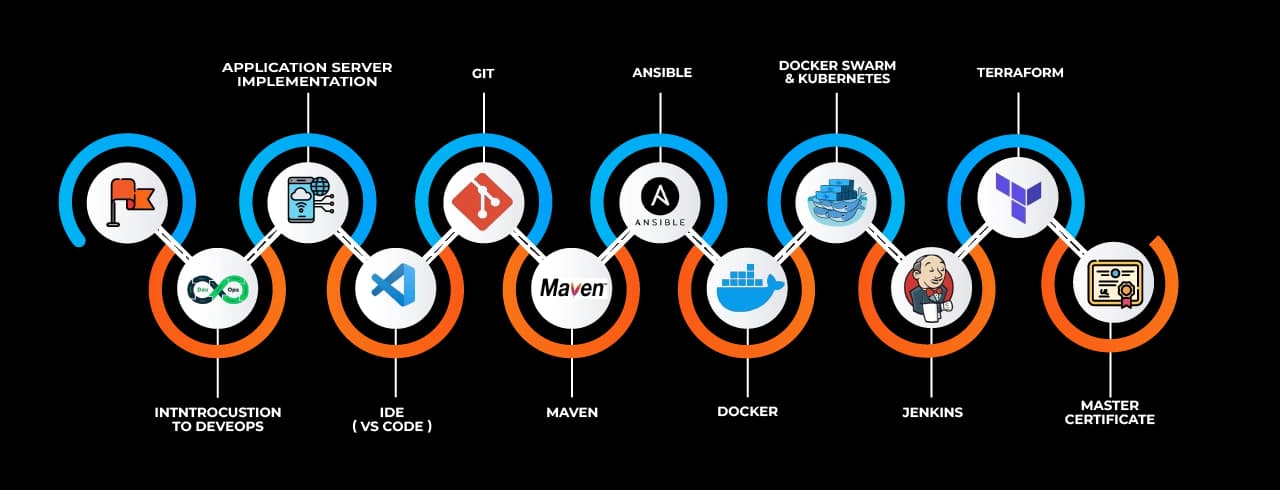
 DevOps A culture and practice that integrates software development and IT operations for faster and more reliable releases.
 CI/CDA methodology for automating code integration, testing, and deployment to improve software delivery speed.
 Continuous IntegrationThe process of automatically integrating code changes into a shared repository multiple times a day.
 Continuous Delivery/DeploymentAutomating software releases to ensure reliable updates with minimal manual intervention.
 Git A distributed version control system used for tracking code changes and collaboration.
 Jenkins An open-source automation tool for implementing CI/CD pipelines.
 Maven A build automation tool primarily used for Java projects, managing dependencies and builds.
 Ant A Java-based build tool for automating software compilation, testing, and deployment.
 Ansible A configuration management tool for automating IT infrastructure and application deployment.
 Terraform An IaC tool used to define and provision cloud infrastructure using declarative configuration files.
 Container A lightweight, portable, and consistent runtime environment for applications.
 Docker A containerization platform that enables developers to package, distribute, and run applications in isolated environments.
 Podman A daemonless container engine that provides a secure alternative to Docker.
 Kubernetes A container orchestration system for automating deployment, scaling, and management of containerized applications.
 Docker SwarmA native clustering tool for managing and orchestrating Docker containers.
 SDLC The Software Development Life Cycle, outlining stages from planning to maintenance in software development.
 Tomcat An open-source Java application server used for deploying Java-based web applications.
 Apache HTTPDA widely used open-source web server for hosting and serving web applications.
 VSCode A lightweight yet powerful code editor with support for debugging, Git, and extensions.
 IaC (Infrastructure as Code)Managing and provisioning infrastructure using machine-readable scripts instead of manual processes.