Why Should One Learn Data Structures & Algorithms for Career Advancement?
The data structures and algorithms form an essential part of software engineering. It is almost impossible for any high-performance software, highly scalable web application, or automated script to function without proper data storage and retrieval techniques that are based on data structures and algorithms. If you are a coder who writes code and, after mastering data structures and algorithms, becomes a problem solver who writes optimal code, then SevenMentor’s Data Structures and Algorithms course is where you should start your journey. We start with simple examples from your real life and slowly move on to more complex problems typically encountered in large-scale enterprise applications. This training will help you in cracking the technical round of top product companies and also help you write code that can run at high scale.
After gaining in-depth knowledge of data structures and algorithms through SevenMentor’s DSA training program, students can reap the following benefits and grow in their respective careers with ease:
- Deep Memory Understanding: Learn how to handle variables, references, and objects within system memory. The way objects behave is usually unknown to developers until they actually start to work with it.
- Core Logic Development: Train your brain to break down vague, massive problems into small, logical, step-by-step programmatic actions.
- Sturdy Career Foundations: The training provided through the DSA course aids in the design of a solid technical base that leads to growth in backend engineering, full-stack web development, AI & cloud architecture.
- Non-IT Career Transition: If you are a non-programmer, then you can also benefit from this training as it helps in improving your analytical skills, and once you are comfortable with these advanced frameworks, then you can easily learn DSA and start coding.
- Learn to naturally choose the smartest (optimal) solution and also the most cost-effective (efficient) solution to any problem instead of settling for a solution that just works and is too complex.
What Are the Unique Benefits of Joining SevenMentor’s DSA Training Program?
Choosing the right institute to learn algorithmic logic is very important. A good DSA class doesn’t just teach you to memorize sorting code in DSA training. Rather, it teaches you to recognize the structures that form the basis of your algorithmic logic for CS education. Our signature DSA training at SevenMentor bridges the gap between the basic CS theory that you learn in college and applying that in your software development work. Our practice-driven approach in DSA training involves writing code, intentionally breaking it, debugging the code, and finally fixing it independently. This process helps you get over the fear of getting stuck while doing your independent work for your college education and for your career in engineering. Our DSA training is designed to be very flexible so that whether you are a full-time college student or a working professional, you can do your DSA training for engineering career growth while you continue to work on your tech career for your massive tech pivot.
Here’s what we bring to the table:
- Mentorship from Industry Experts: Learn the DSA training course from a pool of software developers who have tackled problems related to optimization and performance bugs and have implemented them in production for applications.
- Real-World Coding Problems: Practice DSA with a huge library of questions and problems, including problem datasets, competitive programming challenges, and many interview questions asked in top tech companies.
- Flexible Batch Timings: Our DSA Class for Engineering Students is conducted in physical classrooms as well as in hybrid and online formats to suit students' commitments.
- Comprehensive Placement Assistance: Our SevenMentor team works with the students to write resumes, challenges views, and delivers feedback on students’ presentation skills to maximize placements.
- Fast Track Course Structure: Get trained on Core and Intermediate Algorithmic Concepts within a span of 2-3 months to learn all about core and intermediate concepts of algorithmic theory in a well-defined 2-3-month period.
What is Covered in the Complete Data Structures and Algorithms Curriculum?
The well-structured and comprehensive data structures and algorithms course at SevenMentor starts from the basics like loop structures in programming and ends at advanced non-linear data structures. Our learning roadmap does not start off by delving into the intricacies of data structures on the very first day of training. Each module is meticulously developed as building blocks to help the learner understand the practical uses of data structures with reasons and scenarios to apply them. Moreover, every theoretical concept is immediately put to practice in the hands-on coding lab, where the learner learns to implement data structures from scratch. Our learning is structured as a practical engineering workshop that will enable you to get a strong grip on the time and space complexity of data structures and hence aid you in developing scalable code for a large volume of users.
- Linear Data Structures: Understand array-based data structures and learn about implementing linear data structures like linked lists, stacks, and queues. Optimize them for better performance. Searching and Sorting: Start off with simple search and sort and then move on to the optimized versions of search and sort, i.e., binary search and sorting using quicksort and mergesort.
- Master optimized searching and sorting: Move from basic approaches, like brute force search, to more complex but optimized algorithms like the binary search, quicksort, and mergesort.
- Hierarchical Trees and Binary Structures: In this module you will learn how to do a deep traversal of trees, add / remove nodes from trees, and how trees are used for hierarchical data storage in real-life scenarios.
- Advanced Tree Optimization: Study self-balancing binary search trees (BSTrees) like AVL trees, max/min heaps, min heaps, and space-efficient Tries, to name a few, to solve complex problems.
- Graph Theory and Network Systems: Learn how to apply various graph traversals, such as Breadth-First Search (BFS) and Depth-First Search (DFS), for various purposes. You will also learn how to calculate shortest paths and handle a network and solve various other connectivity issues in structural data.
How Does the Online Data Structures and Algorithms Training Work at SevenMentor?
Our online Data Structures and Algorithms course is designed to give you the maximum flexibility without losing the intensity of a physical classroom. Unlike the usual pre-recorded video that you watch while sitting passively and where the trainer types out sample logic to explain a concept, each session of our online course is a live, instructor-led, interactive coding session with your industry mentor where you write code simultaneously. We aim to create a real-time collaborative workshop where you can work on assignments and have your coding struggles resolved in real-time by the trainer.
Go through our highly interactive online data structures and algorithms training sessions:
- Live Screen-Share Coding: Our trainers sketch out architectures, solve problems (from scratch),, and go line by line to write out the complete solution to a problem.
- Real-Time Collaborative Debugging: We can share your screen and thus your code. This way, you can get direct, personal guidance and the exact error correction you needful for fixing that problem that’s been holding you back in your learning of data structures, and algorithms for coding due to that frustrating block or logical fallacy in your coding work.
- A virtual collaborative ecosystem: virtual group sessions of live discussions, technical mock rounds, etc., and shared assignments on data structures and algorithms, just like a physical workspace.
- Continuous Mentor Access: With our online sessions, you can get access to our technical experts for any doubts regarding your assignments and any logical doubts you have, 24/7, through our dedicated channels.
- Flexible Access Infrastructure: Our student has 24/7 access to all the updated learning resources and can play back any session he missed due to his changing work shifts.
What Value Does Corporate DSA Training Bring to Your Engineering Team?
However, as technology rapidly evolves, production software in many cases works fine till the traffic of real users hits it hard due to suboptimal space and time complexity. This production vulnerability can be tackled by shifting your software development team from simply implementing features to optimizing their code rigorously for performance using data structures and algorithms. Our corporate DSA training sessions are specifically designed to bring about such transformation in your engineers, to help them in optimizing the production code written by them for optimal space and time complexity, thereby refactoring their current codebase, reducing memory leaks, making their algorithms run faster by reducing the number of loops, reducing database queries, etc., to improve the server operational cost and system stability in the long run by making them write code that is maintainable, scalable, and runs efficiently.
Our comprehensive enterprise data structures and algorithms corporate training is designed to give your software development organization an immediate boost in performance by providing them with the essential upskilling they need to tackle complex software engineering challenges.
- Tailored Engineering Curriculums: Our training programs are customized to match your organization’s software development stack and tackle specific architecture challenges.
- Direct Production Optimization: The same lessons applied to your specific problems to perform production optimization on the functions that your team Optimize the deep data structure traversals that your application has. Implement the least amount of memory to implement a given function. Together we focus on reducing the response time (RT) of your applications.
- Advanced Complexity Diagnostics: Teach your software engineers to use automated code execution analysis in order to immediately identify sluggish, high-overhead code in their production environments.
- Flexible Operation: On-site workshops in your own office or secure online training, depending on your distributed team’s location.
- Scalable Code Design: Teach your product engineers to develop robust, clean, extendable, and modular software that can grow with users without requiring little or no additional hardware when traffic grows dramatically.
Why Choose SevenMentor as the Premier Training Institute for DSA?
If you are looking for an institute that stresses practical software development, then it might get quite challenging to search for the right portal. SevenMentor is one of the leading data structures and algorithms training institutes that does not stick to the stereotypical method of teaching employed by the college lecturers. Our method of teaching is focused on providing our students with the best of the mentors or the engineers who are not just teachers but are also the software engineering mentors. The mentors at SevenMentor track the progress of each student and try to identify the logic errors in the code of the student and try to work on those errors. The entire session is focused on hands-on training in software development, and the mentors at SevenMentor do not believe in wasting the precious time of the students by making them read and memorize the syllabus. The career service at SevenMentor provides the students with the best of the portfolio optimization services, and the students are provided with the mock coding interview sessions that are conducted by the experienced and highly qualified engineers. These mock interview sessions are focused on making the students ready to face any kind of product-based technical round of interview conducted by the companies.
Our unique approach of learning data structures and algorithms for software development gives our students very comprehensive and industry-relevant training from the very first day of their program.
- Active Software Engineering Mentors: Active programmers who have solved Performance Bugs and Optimization Problems in real-life corporate applications.
- Immersive Hands-On Coding Focus: The majority of the training is spent writing code, analyzing program execution logs, and doing problems similar to those found in tech interviews, such as those conducted by product teams.
- Comprehensive Career Placement Support: We have a framework to support placement. Our engineers will review your resume and conduct a series of mock technical evaluations (as conducted by product teams in real interviews), and we have connections with large corporations to get you placed.
- Small Learning Groups: We provide small batches of students so that our engineering instructors can provide more focused attention and track students’ improvements in learning complex logic and also pinpoint the errors in their learning.
- Centrally Located Training Hubs: We have training centers across locations for your convenience, with physical classes and state-of-the-art tech labs to carry out hands-on learning.
How Does SevenMentor Directly Address Common Student Challenges in DSA Learning?
The students have started to look for advanced technical programs and hence are once again plagued by the same set of issues that plagued them when they looked for basic programs, i.e., how to ensure consistent quality of training, how to avoid getting swindled by academic costs, and how to ensure that the placement assistance being promised is real and is being provided transparently. Our data structures and algorithms training program has been revamped from the ground up, based on feedback from students, to ensure that we eliminate all the problems associated with training students for learning core computational logic by mastering data structures, that we ensure that their educational investment is protected, and that they are provided with premium-quality career guidance.
Our student-first approach ensures you are learning in a premium and transparent technical learning environment:
All advanced technical programs are led by expert, senior software professionals with extensive experience in engineering at leading MNCs and startups. They have hands-on real-world experience developing production-level software and can train students on how to write robust code for the development of scalable applications.
- Upfront Fee Transparency: As a technical training organization, SevenMentor follows a zero hidden fee policy for all our courses, and there are no additional charges post candidate’s onboarding. placed in a job.
- All job openings posted on SevenMentor are verified by its corporate hiring partners and are verified by SevenMentor’s placement cell. We do not post jobs like unpaid internships, third-party training jobs that charge students in the name of placement, and job openings that require students to sign a bond in the name of the company.
- Guaranteed Batch Format: If you have enrolled in an offline / in-person lab setup, we guarantee to maintain the promised format throughout the course. You won’t be suddenly shifted to online mode in the middle of the course.
- Honest Technical Career Counseling: SevenMentor always will strive to match a student’s skills to the most suitable course offered by SevenMentor against any attempt to sell highly expensive academic programs by SevenMentor’s academic admissions teams. Hence, SevenMentor does not take any fees for academic admissions, and it clearly projects the educational milestones to be covered in any given course of study prior to the student's payment for an academic program.
How Does Mastering DSA Connect with Other Advanced Technology Ecosystems?
In today’s technology-driven world, every high-performance technology ecosystem is powered by a combination of data structures and algorithms. Whether you are planning to design a real-time data visualizer, secure a financial network, or build a generative machine learning system, the computational efficiency of your solution will directly impact its performance. SevenMentor’s specialized programmatic training is perfectly complemented by our multidisciplinary array of technical programs. By anchoring your cognitive problem-solving skills with a robust understanding of Big O optimization, you will be able to learn any advanced tech stack in no time. With this understanding of how data is processed under the hood, you will become a versatile full-stack engineer capable of creating robust solutions for a variety of industries and enterprise applications.
After you’ve learned the techniques of how to optimize data structures and algorithms to optimize your problem-solving skills. The integration of your newfound skills enables you to easily master all the industrial technology tracks listed below:
- Data Science: Optimizing algorithms to clean large datasets of a corporation, predictive modeling, and the fast back-end implementation for data-driven web applications.
- Data Analytics: Build complex space-time tracking loops on huge transaction logs and business intelligence on user behavior and performance.
- Python Programming: Learn how the dynamic object references and complex memory mapping work in this clean and very popular backend development ecosystem.
- Cloud Computing: Scale your applications and minimize compute overhead to save your corporate dollars and minimize compute overhead down to milliseconds to save billions of dollars of infrastructure cost and deploy applications in the cloud to scale up and down as needed.
- Cyber-Security: Hashing functions, cryptography & more complex tracking parameters for securing web applications against attacks of malicious input.
- SAP Systems: Learn to create fast search arrays and to efficiently traverse through indexes when you design relational modules in a low-latency fashion for large enterprises.
- Generative AI & AI Course: Optimize recursive neural models, heavy matrix operations, and complex vector space databases to seamlessly build intelligent applications.
- Learn how to use deep traversal models and efficient token memory buffers to create AI-powered chatbot integration that is highly responsive.
- DevOps Pipelines: Build optimized automation scripts and rapid automated compilation testing steps to maintain clean, reliable environments for continuous integration and deployment.
- Power BI Dashboards: Organize large operational data models cleanly from scratch, ensuring fast refresh rates when loading analytical data visualization dashboards.
- Salesforce Architecture: Maximize platform runtime efficiency and eliminate standard query governor limits when deploying complex logic for custom CRM-based web solutions.
- Java Development: Leverage rich built-in frameworks and strong multithreading features, rendering it exceptionally widely used for enterprise web applications.
Got Questions? Here Are Some FAQs
Q1. Who can join a Data Structures & Algorithms course?
The Data Structures & Algorithms course is for anyone with some knowledge of programming. If you are a student, a recent graduate, or a working professional, you can join the course to develop your coding skills and to learn how to apply your knowledge to solve real problems.
Q2. Why should I learn Data Structures & Algorithms?
Learning data structures & algorithms is essential for writing efficient code, solving complex problems in programming, and cracking technical interviews of top IT companies.
Q3. Which programming languages are used in a Data Structures & Algorithms course?
The programming languages used in a Data Structures & Algorithms course are mainly C++, Java, or Python. The learner can choose the language in which he / she is most comfortable and start learning data structures & algorithms.
Q4. Does a Data Structures & Algorithms course include practical coding?
The courses for Data Structures & Algorithms should have hands-on coding practice in the form of problems and examples, as well as a vast collection of practice questions that are required to hone a student’s analytical skills and enable them to be ready to solve any real-life programming problem and crack top IT job interviews.
Q5. How will a Data Structures & Algorithms course help me to get a job of a software developer?
Learning data structures & algorithms helps a person write efficient code and solve complex problems and thus prepares him/her for technical interviews at top IT companies and can help him/her get a software developer job.
Related Links:
Anthropic AI Tool
What is Writesonic
What is Claude AI
AI Engineer Roadmap
What is JasperAI
What is Copy AI
Do visit our channel to know more: SevenMentor
 Build a strong foundation in problem-solving with the Data Structures and Algorithms course by SevenMentor.
  Open doors to high-paying software development roles in top tech companies.
 With industry experts learn hands-on practical skills that will upscale your DSA journey.
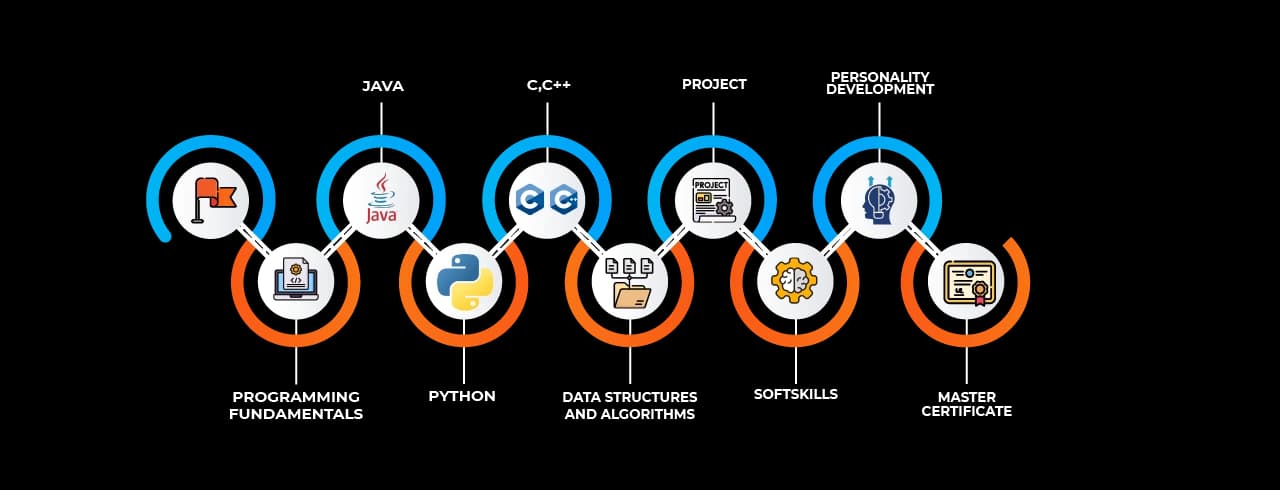
 Variables, Data Types, and OperatorsFundamental components of programming used to store information (variables), define the type of data (data types), and perform computations or logic (operators).
 Control Flow Structures such as if, else, for, and while that determine the order in which code executes, enabling decision-making and repetition in programs.
 FunctionsReusable blocks of organized code that perform specific tasks, helping to simplify complex programs and improve modularity and clarity.
 Arrays and Strings Arrays are ordered collections of elements stored at contiguous memory locations, while strings are sequences of characters used to represent text.
 Object-Oriented Programming A programming paradigm based on the concept of "objects", which contain both data (attributes) and behavior (methods), promoting modularity and reusability.
 Encapsulation The practice of restricting access to the internal state and behavior of an object, allowing only controlled interaction through public methods.
 Inheritance A mechanism in object-oriented programming that allows one class to inherit attributes and methods from another, enabling code reuse and hierarchy.
 Polymorphism The ability of different classes to respond to the same method call in different ways, allowing functions to use entities of different types at runtime.
 Abstraction The concept of hiding complex implementation details and showing only essential features of an object, improving code readability and maintainability.
 Stacks and Queues Linear data structures where stacks follow a Last-In-First-Out (LIFO) approach and queues follow a First-In-First-Out (FIFO) approach, used in data processing.
 LIFO and FIFO Two types of data access strategies: LIFO (Last-In-First-Out), used in stacks, and FIFO (First-In-First-Out), used in queues, each serving different use cases.
 Recursion and Backtracking Recursion is a method where a function calls itself to solve subproblems, while backtracking is an algorithmic technique used to find solutions by exploring all possibilities and undoing steps when necessary.
Algorithms-1750776608894.webp&w=96&q=75) Searching Algorithms Algorithms designed to retrieve data from a structure, including methods like linear search and binary search, which vary in efficiency and use cases.
Searching Algorithms Algorithms designed to retrieve data from a structure, including methods like linear search and binary search, which vary in efficiency and use cases. Sorting Algorithms Algorithms that arrange data in a specific order, such as bubble sort, selection sort, quicksort, and mergesort, essential for organizing and optimizing data.
 Hash Tables and Hash Functions Hash tables store key-value pairs for fast access, using hash functions to compute an index that determines where data is stored in the table.
 Binary Trees A hierarchical data structure where each node has up to two child nodes, used for efficient searching, insertion, and deletion operations.
 Heap Structures Specialized binary trees that maintain a heap property—used to implement priority queues where the highest (or lowest) priority element is always accessible.
 Greedy Algorithms Algorithms that make the most optimal choice at each step in the hope of finding a global optimum, often used in optimization problems like scheduling and pathfinding.
 Dynamic Programming An optimization technique that solves complex problems by breaking them into simpler overlapping subproblems and storing their solutions to avoid redundant calculations.
 Graphs Data structures made up of vertices (nodes) and edges (connections) used to represent and solve problems involving networks, such as routing and relationships.