Data Structures with C & C++ Course in Canada

feature-iconData structures are used to keep and organize information.

feature-iconAn array is a type of data structure that may store several elements in a single variable.

feature-iconC++ also supports some other data structures, each of which is used to manage data in a unique way.

020-71173035

Start Today!

CONSULT WITH
OUR ADVISORS

  • Course & Curriculum Details
  • Flexible Learning Options
  • Affordable Learning
  • Enrollment Process
  • Career Guidance
  • Internship Opportunities
  • General Communication
  • Certification Benefits

Learning Curve for Data Structures with C & C++ in Canada
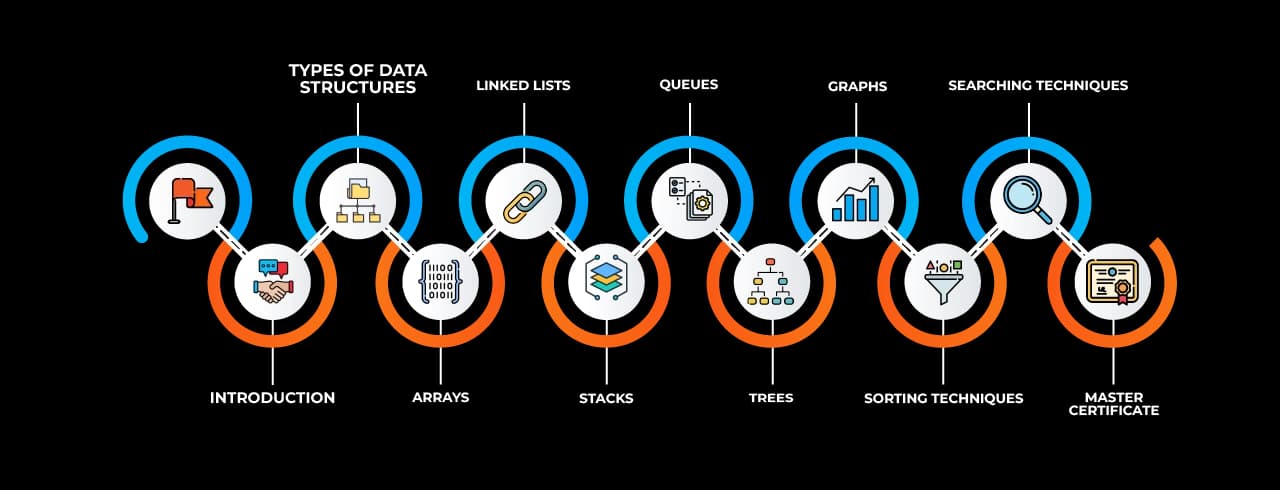
Learning curve for Data Structures with C & C++ in Canada

Master In Data Structures with C & C++ in Canada Course

OneCourseMultipleRoles

Empower your career with in-demand data skills and open doors to top-tier opportunities.

Software Developer
Data Architect
Database Administrator (DBA)
Data Engineer
Data Scientist
Machine Learning Engineer
Business Intelligence Analyst
Data Analyst
Quantitative Analyst and Data Storyteller

Skills & Tools You'll Learn -

C iconCA procedural programming language for system and application development.
C++ iconC++An object-oriented programming language with features like classes and polymorphism.
Tools & Software iconTools & SoftwareIDEs and utilities for coding, debugging, and compiling C/C++ programs.
Creating Array iconCreating ArrayDeclaring and initializing a collection of elements of the same type.
Types of Array iconTypes of ArrayOne-dimensional, multi-dimensional, and dynamic arrays.
Operations on Array iconOperations on ArrayInsertion, deletion, traversal, searching, and sorting.
Creating Linked List iconCreating Linked List Defining nodes and linking them dynamically in memory.
Types of Linked List iconTypes of Linked ListSingly, doubly, and circular linked lists.
Operations on Linked List iconOperations on Linked ListInsertion, deletion, traversal, searching, and reversing.
Creating Stack iconCreating StackImplementing a LIFO data structure using arrays or linked lists.
Terms in Stack iconTerms in StackPush, pop, top, underflow, overflow.
Operations on Stack iconOperations on StackPush, pop, peek, and checking for empty/full conditions.
Creating Queue iconCreating QueueImplementing a FIFO data structure using arrays or linked lists.
Terms in Queue iconTerms in QueueFront, rear, enqueue, dequeue, overflow, underflow.
Creating Tree iconCreating TreeDefining a hierarchical structure with nodes and edges.
Types of Trees iconTypes of TreesBinary tree, BST, AVL tree, B-tree, etc.
Terms in Trees iconTerms in TreesRoot, parent, child, leaf, depth, height.
Operations on Trees iconOperations on TreesInsertion, deletion, traversal (inorder, preorder, postorder).
Creating Graph iconCreating GraphRepresenting networks using nodes and edges.
Types of Graphs iconTypes of GraphsDirected, undirected, weighted, unweighted.
Terms in Graphs iconTerms in GraphsVertex, edge, adjacency, degree, path.
Operations on Graphs iconOperations on Graphs BFS, DFS, adding/removing edges or vertices.
Searching Methods iconSearching MethodsLinear search, binary search, depth-first search, breadth-first search.
Sorting Methods iconSorting MethodsBubble sort, selection sort, insertion sort, merge sort, quick sort, heap sort.
Code Blocks iconCode BlocksA popular open-source IDE for C/C++ development.

Why Choose SevenMentor Data Structures with C & C++ in Canada

Empowering Careers with Industry-Ready Skills.

Specialized Pocket Friendly Programs as per your requirements

Specialized Pocket Friendly Programs as per your requirements

Live Projects With Hands-on Experience

Live Projects With Hands-on Experience

Corporate Soft-skills & Personality Building Sessions

Corporate Soft-skills & Personality Building Sessions

Digital Online, Classroom, Hybrid Batches

Digital Online, Classroom, Hybrid Batches

Interview Calls Assistance & Mock Sessions

Interview Calls Assistance & Mock Sessions

1:1 Mentorship when required

1:1 Mentorship when required

Industry Experienced Trainers

Industry Experienced Trainers

Class Recordings for Missed Classes

Class Recordings for Missed Classes

1 Year FREE Repeat Option

1 Year FREE Repeat Option

Bonus Resources

Bonus Resources

Curriculum For Data Structures with C & C++ in Canada

BATCH SCHEDULE

Data Structures with C & C++ in Canada Course

Find Your Perfect Training Session

Jan 4 - Jan 10

2 sessions
04
Sun
Classroom/ Online
Weekend Batch
10
Sat
Classroom/ Online
Weekend Batch

Jan 11 - Jan 17

1 sessions
12
Mon
Classroom/ Online
Regular Batch

Jan 18 - Jan 24

1 sessions
19
Mon
Classroom/ Online
Regular Batch

Learning Comes Alive Through Hands-On PROJECTS!

Comprehensive Training Programs Designed to Elevate Your Career

Phonebook

Phonebook

Bank management system

Bank management system

Plagiarism detection system

Plagiarism detection system

Crossword Puzzle

Crossword Puzzle

Library Management System

Library Management System

Real Estate Property Search

Real Estate Property Search

No active project selected.

Transform Your Future with Elite Certification

Add Our Training Certificate In Your LinkedIn ProfileLinkedIn

Our industry-relevant certification equips you with essential skills required to succeed in a highly dynamic job market.

Join us and be part of over 50,000 successful certified graduates.

Student 1
Student 2
Student 3
Student 4
Student 5
Join 15,258 others learning today
Certificate Preview

KEY Features that Makes Us Better and Best FIT For You

Expert Trainers

Industry professionals with extensive experience to guide your learning journey.

Comprehensive Curriculum

In-depth courses designed to meet current industry standards and trends.

Hands-on Training

Real-world projects and practical sessions to enhance learning outcomes.

Flexible Schedules

Options for weekday, weekend, and online batches to suit your convenience.

Industry-Recognized Certifications

Globally accepted credentials to boost your career prospects.

State-of-the-Art Infrastructure

Modern facilities and tools for an engaging learning experience.

100% Placement Assistance

Dedicated support to help you secure your dream job.

Affordable Fees

Quality training at competitive prices with flexible payment options.

Lifetime Access to Learning Materials

Revisit course content anytime for continuous learning.

Personalized Attention

Small batch sizes for individualized mentoring and guidance.

Diverse Course Offerings

A wide range of programs in IT, business, design, and more.

Course Content

About Data Structures with C & C++

In the realm of computer science, Data Structures with C & C++ Classes in Canada play a pivotal role in equipping students and professionals with the knowledge required to handle data efficiently. Programmers can store, organise, and modify data with ease because to data structures, which are the foundation of algorithms and software systems. Because they provide unmatched control over memory and hardware, C and C++ are still essential languages in the business and are therefore perfect for understanding the nuances of data structures.

These courses are designed to impart a deep understanding of the core concepts and to develop the ability to implement data structures practically. From arrays and linked lists to trees, trie, graphs, and hash tables, learners gain insights into various structures and their applications in real-world programming. By combining theory and hands-on exercises, Data Structures with C & C++ Classes in Canada ensure students grasp the essentials and learn to optimize their code effectively.


Why Choose Data Structures with C & C++?

Anyone hoping to succeed in software development, competitive programming, or system design must have a solid understanding of data structures. Because they offer a close-to-metal experience that enables programmers to comprehend the internal management and memory layouts of various data structures, C and C++ are especially well-suited for this.

Data Structures with C & C++ Courses in Canada at SevenMentor cover both basic and advanced topics. Students start with fundamental structures such as arrays, stacks, queues, and linked lists before progressing to complex ones like binary trees, AVL trees, heaps, and graphs. Additionally, the courses focus on algorithmic methods including dynamic programming, recursion, sorting, and searching. This all-encompassing method guarantees that students will not only retain the information but also internalise it and be able to use it imaginatively in assignments and interviews.

In Canada's tech sector, there is a great need for developers with solid data structure foundations. Professionals with the ability to develop effective code, maximise resource utilisation, and solve issues creatively are sought after by employers. Gaining an advantage by grasping these ideas in C and C++ enables students to confidently take on high-performance applications, embedded systems, and complicated systems programming.


Curriculum and Methodology

The curriculum of Data Structures with C & C++ training in Canada at SevenMentor is meticulously designed to bridge the gap between theory and practice. Students are first introduced to the syntax and semantics of C and C++, making sure they understand memory allocation, pointers, and object-oriented programming when appropriate. After laying a strong foundation, the course delves into linear and non-linear data structures.

One of the main components of the course is practical programming exercises. For each structure, students develop code, debug their programs, and examine the intricacies of their solutions in terms of time and space. This hands-on learning promotes greater comprehension and boosts self-esteem.

Additionally, the course covers real-world applications where data structures are essential, like file system implementation, compiler design, gaming engines, and network routing methods. Students are guaranteed to be able to demonstrate their learning through real-world applications through frequent exams and projects. 


Learning Outcomes

At the end of the training, students of SevenMentor’s Data Structures with C & C++ Courses in Canada acquire several key skills. They learn to write effective and understandable code, analyse algorithm complexity, and choose the right data structures for the tasks at hand. They also learn how to optimise pre-existing systems and create bespoke data structures as necessary.

Better success in coding interviews, improved problem-solving skills, and preparedness to tackle difficult programming tasks in work environments are all results of these outcomes. Additionally, students learn the fundamentals of software development, qualifying them for jobs in high-frequency trading, embedded development, and operating systems.


Why Choose SevenMentor?

When it comes to choosing the right training provider, SevenMentor the best training institute for Data Structures with C & C++ Training stands out for its commitment to quality education and career growth. SevenMentor combines experienced trainers, comprehensive content, and a supportive learning environment to help students achieve their goals.

The instructors at SevenMentor bring years of industry experience to the classroom, offering insights beyond textbooks and enabling students to learn industry-relevant skills. With state-of-the-art infrastructure, small batch sizes for personalized attention, and a well-defined pedagogy, SevenMentor ensures that students receive the best possible training in data structures with C and C++.

SevenMentor also focuses on employability. Its career support services include mock interviews, resume-building assistance, and exposure to real-world projects, enhancing the chances of landing desirable roles in the competitive job market.


The Role of Data Structures in Career Advancement

Professionals who master data structures with C and C++ are better positioned to excel in technical interviews and succeed in roles that demand efficient coding skills. Many Canadian technology companies, from startups to large enterprises, assess candidates based on their problem-solving capabilities using data structures and algorithms.

Learning these concepts under the guidance of SevenMentor, the best training institute for Data Structures with C & C++ Training not only builds technical proficiency but also instills confidence. Whether you’re preparing for a job change, pursuing higher education, or aiming to strengthen your programming foundation, this training equips you with the tools needed for success.

Data Structures with C & C++ Classes in Canada provide a solid foundation for anyone looking to excel in software development. The combination of theoretical concepts, practical implementation, and real-world applications make these classes invaluable for students and professionals alike. By learning how to use data structures effectively in C and C++, learners gain an edge in solving complex problems, optimizing programs, and advancing their careers.

Choosing Data Structures with C & C++ training in Canada through SevenMentor the best training institute for Data Structures with C & C++ Training ensures that you receive top-notch instruction, hands-on experience, and the support you need to succeed in the competitive technology sector.


Online Data Structures with C & C++ Training

SevenMentor offers comprehensive and flexible online Data Structures with C & C++ classes. These online Data Structures with C & C++ Courses in Canada deliver the same comprehensive curriculum and hands-on practice as the in-person classes. Students can attend live interactive sessions, access recorded lectures, and participate in online coding exercises from the comfort of their homes.

The online format also includes virtual labs where learners can practice implementing data structures, receive feedback from instructors, and collaborate with peers. With regular assessments and doubt-clearing sessions, the online training ensures that distance does not compromise the quality of education. This option is especially beneficial for working professionals or students residing in remote areas who wish to enhance their skills without disrupting their schedules.


Corporate Data Structures with C & C++ Course

SevenMentor offers customized corporate Data Structures with C & C++ training. The corporate Data Structures with C & C++ training in Canada equips employees with the knowledge to write optimized, maintainable, and efficient code, boosting overall productivity and performance.

Corporate training programs often include tailored content based on the organization’s technology stack, real-world projects aligned with the company’s goals, and post-training support to ensure continued learning. SevenMentor’s corporate training helps businesses build technically strong teams capable of solving complex problems and contributing to the company’s growth.

Frequently Asked Questions

Everything you need to know about our revolutionary job platform

1

What is the eligibility to study data structures in C/C++?

Ans:
To study "Data Structures with C/C++", you need a solid foundation in either C or C++ programming languages, including basic concepts like variables, loops, conditional statements, functions, and ideally some understanding of pointers, as these are crucial for implementing data structures effectively in both languages.
2

What is the C and C++ data structure?

Ans:
Data structures are tools for storing and organising data. An array is a data structure that allows for the storage of several elements in a single variable. C++ also supports several other data structures, each of which is used to manage data in a different way
3

Is it tough to perform DSA?

Ans:
DSA may appear difficult at first, but with the appropriate technique and enough practice, it becomes far more manageable. The goal is to start with the fundamentals, practice consistently, and recognise common problem-solving patterns. What seems to be challenging will become easier and more natural with time.
4

Is it difficult to perform DSA in Python?

Ans:
Is DSA difficult to understand? DSA is a bit more difficult than learning the fundamentals of a programming language. With practice and determination, you can grasp the fundamental ideas of DSA.
5

Is DSA in C appropriate for placement?

Ans:
DSA is essential for obtaining a position in any product-based organisation. You will be hired if you have a strong understanding of DSA and have completed assignments. However, having 4-5 years of experience will improve your resume. In addition to DSA, you should understand the fundamentals of system design.
6

Can I learn DSA without first understanding C++?

Ans:
Is it possible to study DSA without understanding any programming languages? A: It's difficult. A basic familiarity of programming fundamentals is suggested.
7

Which came first: web development or DSA?

Ans:
So the proper approach is to devote time studying data structures first, then go on to web development, and then devote 5-10 hours a week to data structure practice. This will allow you to flourish in software development while also providing you with a solid foundation in data structures.
8

C or C++ are better for DSA?

Ans:
However, if you are learning C for the first time, I would recommend C++. C++ is what I use for all of my DSA interviews and coding challenges. I like to write and debug code in C++. I hope this clarifies things.
9

Should I perform DSA using Python or C++?

Ans:
Conclusion. Finally, the decision between DSA with C++ and Python is influenced by a variety of considerations, including performance constraints, code complexity, and the necessity for rapid prototyping. C++ is well-suited for performance-critical applications and scientific computing, but Python is popular for web development and machine learning.
10

Is it appropriate to learn DSA in C?

Ans:
The following are the reasons why the C language is ideal for learning data structures and algorithms: Deep learning: The C programming language demands the programmer to manually implement each feature, which aids in learning how data structures work at a fundamental level.
11

What are the advantages of a data structure in programming?

Ans:
Data structures are required for developing efficient algorithms. It facilitates reusability and abstraction. Using suitable data structures can help programmers save time while executing data operations including storage, retrieval, and processing. Manipulation of enormous volumes of data is simplified.
12

What is the importance of data structure in C?

Ans:
Data structures are important for two reasons: they make the code more efficient and easier to understand. In terms of efficiency, data structures assist the computer run the code faster by organising the data in an easy-to-process format.
13

What are the different applications of data structures?

Ans:
Data structures are useful in a variety of disciplines and are required for the development of efficient algorithms. Here are some important applications of data structures. Database Management Systems (DBMS) B-trees and hash tables are essential for indexing and organising database data.
14

What is the advantage of having structure in C++?

Ans:
One of the major advantages of a struct is that it allows us to transfer the complete structure to another function without having to pass each variable separately. We may also add members to the struct without having to rewrite all of the functions.
15

Is DSA important for job creation?

Ans:
DSA is essential for obtaining employment in any product-based organisation. You will be hired if you have strong DSA knowledge and have completed projects. However, having 4-5 years of experience would enhance your résumé. In addition to DSA, you should be familiar with the fundamentals of systems design.

Explore Other Demanding Courses

No courses available for the selected domain.