SAP FICO Training in Nigeria

feature-iconTransform Your Finance Career with Practical SAP FICO Training
feature-iconLearn SAP FICO from Industry Experts and Build Real-World Expertise

feature-iconMaster Financial Accounting and Controlling with Hands-On SAP Training

020-71173116

Start Today!

CONSULT WITH
OUR ADVISORS

  • Course & Curriculum Details
  • Flexible Learning Options
  • Affordable Learning
  • Enrollment Process
  • Career Guidance
  • Internship Opportunities
  • General Communication
  • Certification Benefits

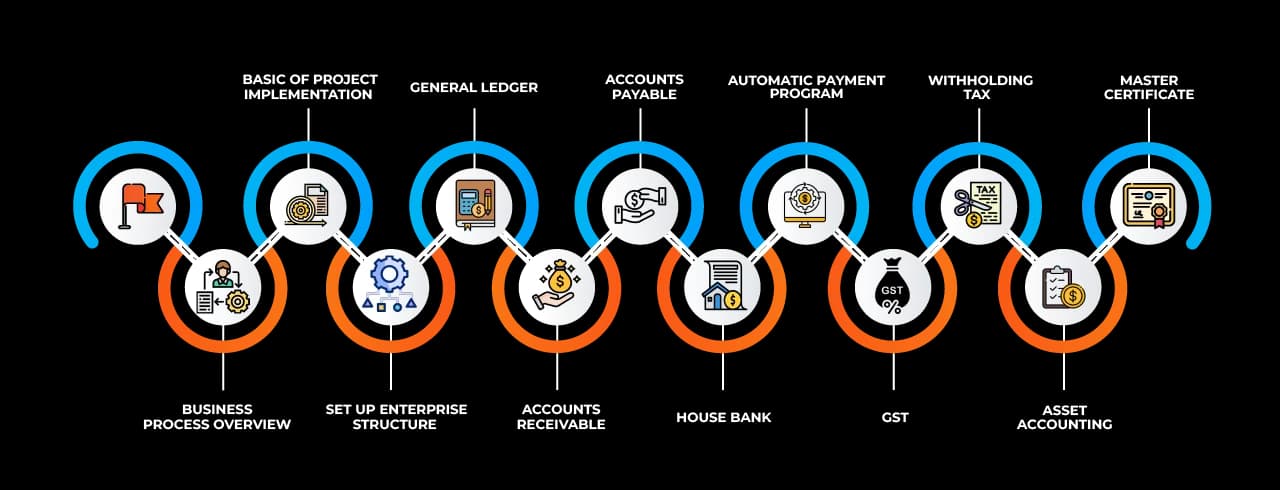
Learning Curve for SAP FICO

Learning curve for SAP FICO

Master In SAP FICO Course

OneCourseMultipleRoles

Empower your career with in-demand data skills and open doors to top-tier opportunities.

SAP Fico Consultant
Financial Accounting Manager
Controlling Manager
SAP FICO Analyst
Financial Analyst
Cost Accountant
General Ledger Accountant
SAP FICO Support Specialist
Financial Planning & Analysis Manager
SAP FICO Project Manager

Skills & Tools You'll Learn -

Enterprise Structure iconEnterprise StructureThink of this as the foundation of SAP FICO. It defines how a company is structured in the system, including different business units like company codes and departments.
Global Company Code Parameters iconGlobal Company Code ParametersThese are basic settings for your company in SAP, such as currency, fiscal year, and document types. They ensure financial transactions follow company rules.
General Ledger Accounting iconGeneral Ledger AccountingThis is like the main financial record of a company, where all transactions are stored and categorized for accurate reporting.
Accounts Payable iconAccounts PayableThis module helps manage everything related to vendor payments, including invoices, due dates, and outgoing transactions.
Accounts Receivable iconAccounts Receivable Here, we track money owed by customers, manage invoices, and handle incoming payments.
Asset Accounting iconAsset AccountingThis part deals with a company’s fixed assets—things like machinery, buildings, and vehicles—tracking their value, depreciation, and disposal.
Bank Reconciliation iconBank ReconciliationThis process ensures that the company's bank account records match the transactions recorded in SAP, helping avoid errors.
Monthly Closing iconMonthly ClosingAt the end of each month, we finalize all financial records, check for errors, and ensure everything is balanced for reporting.
Yearly Closing iconYearly ClosingSimilar to monthly closing, but on a larger scale. At the end of the financial year, we close accounts, generate reports, and ensure compliance with regulations.
Cost Center Accounting iconCost Center AccountingThis helps track expenses for different departments, like HR or Marketing, so we know where the money is being spent.
Cost Element Accounting iconCost Element AccountingThink of this as classifying costs into categories, like salaries, rent, or raw materials, to analyze financial data better.
Profit Center Accounting iconProfit Center AccountingThis helps companies see which divisions or products are making profits and which need improvement.
Internal Order iconInternal OrderUsed for tracking expenses related to specific projects or events, making sure budgets are maintained.
Business Partner iconBusiness PartnerInstead of managing separate records for customers and vendors, SAP allows you to handle all business relationships under one master record.
Customer iconCustomerIn SAP, customers are managed through master records, allowing us to track sales, invoices, and payments efficiently.
Vendor iconVendorSimilar to customers, vendors have their own master records where we store their details, track invoices, and process payments.

Why Choose SevenMentor SAP FICO

Empowering Careers with Industry-Ready Skills.

Specialized Pocket Friendly Programs as per your requirements

Specialized Pocket Friendly Programs as per your requirements

Live Projects With Hands-on Experience

Live Projects With Hands-on Experience

Corporate Soft-skills & Personality Building Sessions

Corporate Soft-skills & Personality Building Sessions

Digital Online, Classroom, Hybrid Batches

Digital Online, Classroom, Hybrid Batches

Interview Calls Assistance & Mock Sessions

Interview Calls Assistance & Mock Sessions

1:1 Mentorship when required

1:1 Mentorship when required

Industry Experienced Trainers

Industry Experienced Trainers

Class Recordings for Missed Classes

Class Recordings for Missed Classes

1 Year FREE Repeat Option

1 Year FREE Repeat Option

Bonus Resources

Bonus Resources

Curriculum For SAP FICO

BATCH SCHEDULE

SAP FICO Course

Find Your Perfect Training Session

Jan 4 - Jan 10

2 sessions
04
Sun
Classroom/ Online
Weekend Batch
10
Sat
Classroom/ Online
Weekend Batch

Jan 11 - Jan 17

1 sessions
12
Mon
Classroom/ Online
Regular Batch

Jan 18 - Jan 24

1 sessions
19
Mon
Classroom/ Online
Regular Batch

Learning Comes Alive Through Hands-On PROJECTS!

Comprehensive Training Programs Designed to Elevate Your Career

Implementation of Goods and Services Tax

Implementation of Goods and Services Tax

Implementation of Dunning Procedures

Implementation of Dunning Procedures

Vendor and Customer Down Payment Implementation

Vendor and Customer Down Payment Implementation

Create Custom Terms of Payment

Create Custom Terms of Payment

Master Data Migration

Master Data Migration

No active project selected.

Transform Your Future with Elite Certification

Add Our Training Certificate In Your LinkedIn ProfileLinkedIn

Our industry-relevant certification equips you with essential skills required to succeed in a highly dynamic job market.

Join us and be part of over 50,000 successful certified graduates.

Student 1
Student 2
Student 3
Student 4
Student 5
Join 15,258 others learning today
Certificate Preview

KEY Features that Makes Us Better and Best FIT For You

Expert Trainers

Industry professionals with extensive experience to guide your learning journey.

Comprehensive Curriculum

In-depth courses designed to meet current industry standards and trends.

Hands-on Training

Real-world projects and practical sessions to enhance learning outcomes.

Flexible Schedules

Options for weekday, weekend, and online batches to suit your convenience.

Industry-Recognized Certifications

Globally accepted credentials to boost your career prospects.

State-of-the-Art Infrastructure

Modern facilities and tools for an engaging learning experience.

100% Placement Assistance

Dedicated support to help you secure your dream job.

Affordable Fees

Quality training at competitive prices with flexible payment options.

Lifetime Access to Learning Materials

Revisit course content anytime for continuous learning.

Personalized Attention

Small batch sizes for individualized mentoring and guidance.

Diverse Course Offerings

A wide range of programs in IT, business, design, and more.

Course Content

About SAP FICO Course

Nigeria, as one of Africa’s largest and fastest-growing economies, is embracing digital transformation across all sectors, from oil and gas and telecommunications to banking, manufacturing, and public administration. Central to this shift is the adoption of enterprise resource planning (ERP) systems that streamline operations, ensure transparency, and enhance decision-making through integrated financial management. SAP, as the world’s leading ERP solution, is widely implemented across Nigerian enterprises, with the Financial Accounting and Controlling (FICO) module standing out as a core component. As a result, SAP FICO Classes in Nigeria have become increasingly vital for professionals looking to support the country’s digital finance landscape with industry-ready technical expertise.

The Nigerian economy presents a complex financial environment characterized by regulatory changes, foreign exchange volatility, tax compliance demands, and sector-specific financial reporting obligations. SAP FICO plays a crucial role in helping businesses navigate these challenges by enabling real-time financial visibility, multi-currency management, and automated tax configuration. SAP FICO Course in Nigeria is not just a certification program—it serves as a strategic training track for professionals and organizations aiming to digitize their financial operations, comply with national accounting standards, and make informed, data-driven decisions in an evolving economic climate.

Nigerian businesses face increasing pressure to automate processes, minimize fraud risks, and meet international financial reporting standards (IFRS) required by both regulatory bodies and global stakeholders. With SAP FICO’s capabilities to manage accounts receivable, payable, general ledgers, and internal cost centers under one integrated platform, it is rapidly becoming the preferred financial tool across large enterprises and mid-sized firms in Nigeria. SevenMentor align their programs to address these unique business challenges, ensuring learners are well-equipped to contribute to corporate efficiency, audit compliance, and profitability management through expert-level system configuration.

The significance of SAP FICO in Nigeria is underscored by its adoption across key industries. The oil and gas sector, for instance, relies heavily on SAP FICO for complex asset management, tax computation, and financial reporting across upstream and downstream operations. Financial institutions use SAP for automated reconciliation, real-time posting, and regulatory compliance under the Central Bank of Nigeria (CBN) guidelines. Similarly, public sector entities use SAP for budgeting, fund tracking, and donor reporting. SAP FICO Training in Nigeria therefore takes a contextual approach, enabling learners to grasp system applications that mirror the structure and workflows of major Nigerian sectors.

In a business climate where operational resilience and compliance are becoming critical, SAP FICO empowers organizations with tools to mitigate financial risks, detect anomalies, and improve internal controls. With the Nigerian government enhancing its focus on revenue generation, tax enforcement, and public financial management, businesses are compelled to implement systems that ensure fiscal transparency. SevenMentor institute supports this need by developing professionals who understand how to configure, audit, and optimize SAP systems to align with national and sectoral financial requirements.

The rising trend of Nigerian firms expanding into regional and global markets adds another layer of complexity to financial operations. SAP FICO is equipped to support multinational transactions, currency conversion, and consolidated financial reporting—features essential for enterprises operating across borders. Professionals trained in SAP FICO Classes in Nigeria are able to facilitate seamless financial management for such organizations, ensuring compliance with both domestic and international financial frameworks. Training programs are structured to emphasize these real-time, multi-entity capabilities, making them indispensable for Nigerian enterprises engaged in cross-border business.

As digitalization accelerates, many Nigerian enterprises are transitioning from manual record-keeping or outdated software to intelligent ERP platforms such as SAP S/4HANA. SAP FICO, in its S/4HANA version, offers a simplified data model, real-time processing, and predictive insights through embedded analytics. SevenMentor training has evolved accordingly, now integrating modules that cover these advanced capabilities. Learners are trained to configure the Universal Journal, manage SAP Fiori applications, and operate financial closing processes within this modern ERP ecosystem. These innovations position Nigerian professionals at the forefront of ERP-enabled financial transformation, equipping them for future-ready roles in both local and international markets.

Another aspect driving the demand for SAP FICO Classes in Nigeria is the country’s push for digitization in public finance. Federal and state governments are implementing integrated financial management information systems (IFMIS), many of which are powered by SAP. These systems help manage procurement, budgeting, payroll, and financial reporting in a centralized manner. SAP FICO’s role in public sector financial planning and monitoring is significant, especially in areas such as fund allocation, intergovernmental transfers, and statutory reporting. Training programs reflect this importance by tailoring use cases to include public sector scenarios relevant to Nigerian administrative structures.

Nigeria’s entrepreneurial landscape, especially in fintech, healthcare, and logistics, is also starting to leverage ERP systems at earlier stages of growth. These businesses, though initially small, require agile financial systems that scale with growth. SAP FICO provides them with such a foundation—allowing for automated billing, expense tracking, and budgeting. SAP FICO Course in Nigeria is therefore becoming a strategic asset not just for large corporations but also for startups and SMEs looking to professionalize their financial operations. Training providers are adapting by offering modular, flexible programs that cater to different organizational maturity levels.

The integration of SAP FICO with other digital technologies such as business intelligence, data analytics, and robotic process automation (RPA) is expanding the use cases of SAP in Nigeria. Enterprises are beginning to use FICO data for financial forecasting, risk modeling, and performance analytics. SAP FICO Training in Nigeria responds to these changes by preparing professionals to integrate FICO with tools like SAP Analytics Cloud and Power BI, enabling dynamic dashboards and reporting frameworks that enhance financial visibility at all levels of the organization.

Nigeria's ambitious journey toward digital and economic modernization has elevated the importance of ERP systems like SAP in both public and private enterprises. As businesses face increasing complexity, financial scrutiny, and the need for integrated solutions, SAP FICO emerges as a vital tool to manage accounting, compliance, and financial strategy. The growing availability and relevance of SAP FICO Classes in Nigeria enable professionals to master this powerful module in alignment with the country’s business and regulatory landscape. Whether through structured classroom sessions, self-paced online modules, or enterprise-specific corporate training, the SAP FICO Course in Nigeria empowers individuals to drive value, efficiency, and innovation within their organizations. As ERP adoption continues to expand across industries, SAP FICO Training in Nigeria will remain a key driver of digital transformation, financial transparency, and professional development in the country’s evolving economic narrative.

Access to certified SAP professionals is still relatively limited in many regions of Nigeria, which presents a significant opportunity for learners who complete advanced FICO training. With demand exceeding supply, especially in cities like Lagos, Abuja, Port Harcourt, and Kano, skilled SAP users command premium positions within consulting firms, corporate finance teams, and IT service providers. SAP FICO Classes in Nigeria are thus viewed as a key enabler of professional mobility and career growth within the country’s growing digital economy.

The availability of SAP Learning Hubs, academic partnerships, and local SAP-authorized training institutes in Nigeria further enhances the training ecosystem. Students benefit from real-time system access, expert instructors, and a curriculum updated to reflect SAP’s evolving functionality. These institutions ensure that SAP FICO Course in Nigeria maintains global standards while incorporating local business relevance. Learners are immersed in practical exercises, sandbox environments, and business simulations that simulate challenges encountered by Nigerian enterprises, resulting in well-rounded and deployment-ready SAP practitioners.


Online Course

The online SAP FICO Course in Nigeria provides an adaptable and interactive learning solution for professionals, students, and entrepreneurs across the country. Accessible from any location with internet connectivity, this mode of training offers virtual labs, instructor-led sessions, and hands-on configuration exercises in SAP’s cloud environment. Learners benefit from recorded lectures, live doubt-clearing, collaborative projects, and performance assessments. The online course ensures equal access for those outside urban hubs, democratizing SAP education in Nigeria. By removing geographical barriers and offering flexible learning schedules, the online SAP FICO course empowers individuals to gain globally relevant ERP skills without disrupting their personal or professional commitments.
 

Corporate Training

As Nigerian organizations continue to adopt SAP solutions for finance, operations, and compliance, there is a growing demand for tailored, in-house training programs. Corporate SAP FICO Training in Nigeria addresses this need by delivering custom-designed sessions aligned with the company’s ERP environment, financial workflows, and strategic goals. Delivered on-site or virtually, these sessions train internal teams on real business data, specific SAP configurations, and policy-driven processes such as tax filing, vendor settlements, and financial closing. Corporate training reduces reliance on external consultants, improves system utilization, and enhances operational accuracy, making it a strategic investment for Nigerian businesses focused on ERP optimization and workforce development.

Frequently Asked Questions

Everything you need to know about our revolutionary job platform

1

What is the salary range for an SAP FICO Consultant?

Ans:
If you complete the SAP FICO Course at SevenMentor, you can expect a salary as mentioned below: Entry-Level: ₹30,000 - ₹50,000 Mid-Level: ₹50,000 - ₹1,00,000 Senior-Level: ₹1,00,000 & above
2

Do I need a finance background to learn SAP FICO?

Ans:
No, not all learners, but having basic knowledge of accounting and finance is going to make learning easier. If you're new to finance, our training course will cover fundamental concepts before diving into SAP.
3

Is SAP FICO in demand for Indian markets and how much?

Ans:
Yes definitely it is in demand and companies across India rely on SAP for financial management. SAP FICO consultants are always in demand especially in industries like banking as well as manufacturing, and IT industry.
4

What are the career opportunities after completing the SAP FICO course?

Ans:
Students, you just remember that you can work as an SAP FICO Consultant, Financial Analyst, SAP End User. Better further even move into roles like SAP Project Manager with experience and higher skills.
5

Do I need to learn coding for SAP FICO usitlization?

Ans:
No not at all dear students, SAP FICO doesn’t require coding knowledge at all. However, basic understanding of ABAP (SAP’s programming language) can be helpful for advanced customization techniques if you want to become a better user.
6

Is SAP FICO only for large companies?

Ans:
No, businesses of all sizes use SAP FICO to manage financial transactions, reporting, and controlling. It's widely adopted across industries.
7

How long does it take to learn SAP FICO?

Ans:
A structured SAP FICO Course by SevenMentor typically takes 2-3 months, but mastering it depends on your practice and real-world exposure.
8

Do I need SAP experience before learning SAP FICO?

Ans:
No prior SAP experience is required to students in order for them to join this course. Our training course is designed to start from the basics and gradually move to advanced concepts.
9

Will this course help me prepare for SAP certification?

Ans:
The training for SAP FICO covers all essential topics needed for SAP FICO certification. We also provide help in clearing the exam for students that too with confidence.
10

Is SAP FICO a good career choice for freshers?

Ans:
Yes, many companies hire freshers with SAP FICO skills, especially if they have strong financial knowledge and hands-on SAP experience.
11

Will I get placement assistance after completing the SAP FICO Course at SevenMentor?

Ans:
We at SevenMentor Institute offer placement support, resume-building guidance, and interview preparation to help you secure a job after completing the course. We cannot guarantee you will get a job but you can be assured that you will get a job after this course.
12

What’s the difference between SAP FICO and other ERP financial modules?

Ans:
SAP FICO is a specialized module within SAP ERP, offering robust financial management features compared to other ERP solutions like Oracle Financials or Tally.
13

Can I work as a freelancer after learning SAP FICO?

Ans:
Many businesses need SAP FICO consultants for short-term projects, making freelancing a great option for experienced professionals. So in short the answer is yes and it is definitely rewarding as well.
14

Will I get hands-on practice in this course?

Ans:
Of course! Our SAP ABAP Training has practical coding, real-world projects and case studies so that you can learn in a hands-on way.
15

Will I receive a certificate after completing the course?

Ans:
Yes, at SevenMentor, you’ll get an SAP ABAP certification which proves your skills and helps in job search.

Explore Other Demanding Courses

No courses available for the selected domain.

SAP FICO Training in Nigeria | with Job Assistance