What is the Core Difference Between Generative AI and the New Era of Agentic AI?
Welcome to the newest digital revolution of our time, the bringing in of AI has tuned our lifestyles to a new clock. For those who are living under the rock, think of generative AI as basically a digital craftsman that is sitting quietly behind a text box waiting for you to tell it what to do next. When you sit down and type a detailed request into this chatbot which is actually powered by something called the large language model, it can instantly sift through its billions of large databases to whip up clean Python scripts as well as nice marketing pictures or even something as basic as company summary in just a few seconds for you. The catch here is that it remains a completely reactive system. It cannot think ahead, it does not understand context changes outside your text window, and it will basically sit idle forever until a human user manually enters another string of text to trigger the next action. It is essentially like possessing a highly skilled personal copywriter or junior developer who only speaks when spoken to directly.
Now if we shift your focus over to Agentic AI which is honestly a massive evolutionary leap where your software stops acting like a simple chat tool and actually starts behaving like an independent digital worker. Instead of just churning out plain blocks of text based on your single prompt, these new setups are built to go after complex, multi-step goals with barely any human oversight at all. You basically hand an AI agent a high-level corporate objective—like tracking down market competitor price drops and automatically updating your inventory sheets—and the system takes the wheel. It will independently figure out the sub-tasks, connect securely to external database APIs, run its own terminal code loops, and fix its own script errors on the fly until the final goal is met.
[Generative AI] -> It sits around waiting for your step-by-step text prompts to make files or code. [Agentic AI] -> You give it one big goal and it goes off running its own loops using external web tools.
If you really want to see how these two systems diverge when you deploy them inside real corporate offices, you must check for the most important operational style differences which we have listed down below:
- Trigger Mechanism: Generative tools rely entirely on constant, manual user prompt sequences, whereas agentic frameworks operate on a single, high-level goal initialization and run autonomously.
- Tool Integration: Traditional large models are usually locked inside their isolated text windows, while task-specific agents actively access external web browsers, command-line interfaces, and private corporate databases.
- Error Correction: When a standard chatbot generates broken code, it expects you to paste the error back in; conversely, an agentic loop reads its own console logs and fixes its own syntax breaks in real time.
- Workflow Continuity: Generative outputs are completely static and localized, whereas agentic systems manage complex, multi-layered workflows that span across completely different software platforms simultaneously.
Why is Learning Autonomous AI Systems the Ultimate Fast-Track for Your Career Growth?
Pivoting your skill set into the world of smart automation drops you straight into the fastest-growing tech sector in the current global marketplace. Recent market data for 2026 highlights that nearly 40% of all enterprise software applications are actively embedding task-specific AI agents into their core systems, up from less than 5% just a year ago. This massive corporate shift is completely changing how daily work gets executed, introducing revolutionary concepts like vibe coding—where engineers focus purely on designing macro system architectures while autonomous tools handle the bulk of raw syntax generation. Whether you are working in core software development, financial auditing, human resources, or creative content writing, absolutely every major sector is rebuilding its operational workflows around these intelligent models to drive efficiency.
What our experts suggest is to look past basic prompt engineering tutorials and focus on the deep economic impact these automated pipelines are making. Organizations implementing advanced automation setups are already pocketing an average return of $3.70 for every single dollar invested, creating an insatiable corporate demand for developers who can configure these frameworks safely. Our industry analysts have compiled the most critical market projections that are reshaping employment trends across the country:
- Unprecedented Productivity Surges: Early corporate adoptions show that incorporating advanced generative systems drives an immediate 26% efficiency increase in software engineering pipelines and a staggering 50% jump in marketing output.
- Massive Cost Reduction Metrics: Businesses successfully deploying multi-agent ecosystem workflows are projecting an average of 15.2% in direct operational cost savings due to minimized manual data handling.
- Sharp Funding Reallocation: Global corporate investments inside the specialized artificial intelligence space have more than doubled recently, with private capital surges actively favoring autonomous enterprise tooling over basic conversational chatbots.
In our opinion, we think that trying to pick up these advanced orchestration layers entirely on your own from random internet threads usually leads to a ton of wasted time. If you want to confidently position yourself ahead of this massive curve, exploring Generative and Agentic AI Courses in Pune is the single smartest safety net you can build for your professional future. Enrolling in a comprehensive program ensures you stop appearing like a hobbyist who just types basic questions into a chat window, and transforms you into a highly capable automation architect ready to command premium salary packages.
What Job Opportunities are There For Freshers and Newcomers in Gen AI and Agentic AI?
Breaking into this brand-new automation bracket right now as an absolute newcomer drops you straight into a highly lucrative market where tech employers are desperately looking for practical builders rather than people with fancy college degrees. Because these systems are so fresh on the market, companies cannot find veterans with ten years of experience, meaning they are actively hiring hungry freshers who simply know how to wire up large models and configure automated loops. If you can show a hiring panel a functional portfolio of active agents on your GitHub page, you instantly skip the crowded online job boards. Our industry analysts have tracked down the most prominent starter profiles popping up across local corporate tech zones alongside their realistic annual earnings:
- AI Prompt Engineer: You spend your shifts tweaking complex system instructions and structuring text inputs to get clean, reliable outputs from massive language models while pocketing a neat starter package of around ₹5 LPA to ₹8 LPA.
- Agentic Workflow Developer: Think of this role like building the actual nervous system for these smart digital workers. You spend your days connecting model APIs straight to external databases and live command-line environments, while pulling down a solid ₹7 Lakhs to ₹11 Lakhs per year.
- Generative AI Specialist: Your daily job basically revolves around customizing pre-built foundation models for specific company chores, like setting up smart customer service bots or automated content engines, which easily commands a premium starter salary of roughly ₹6.5 to ₹10 LPA.
- AI Integration Associate: You basically act as that core technical bridge that helps traditional non-tech firms hook up smart automation tools straight into their old legacy office systems, easily drawing around ₹6 LPA right out of college.
- Machine Learning Ops Support: This specific track focuses heavily on keeping remote server clusters running smoothly and constantly monitoring active AI pipelines so they never crash when heavy user traffic hits, pulling in roughly ₹8 LPA to ₹12 LPA once you clear a few live projects.
- Cognitive Automation Expert: You are assisting your corporate business teams to audit their repetitive and vast amount of daily paperwork/ digital documents and help figure them out exactly where deploying a smart autonomous agent (such as the one you might be using makes) the most financial sense and this job can actually help in commanding roughly ₹7.5 LPA on average.
Why Is SevenMentor the Best Choice For AI Courses in Pune Compared to Competitors?
As a student of new IT sector courses nowadays why trying to pick the right training center feels like such a massive gamble. This is actually because nearly every billboard across the tech parks promises the exact same career dreams without ever letting you touch a real live server or even learn the basics of actual workflow in corporate IT companies. Most traditional computer institutes across the city still make the huge mistake of keeping students trapped inside outdated classrooms where you just copy basic Python syntax from a whiteboard. They charge an absolute fortune for old, recorded slideshow links that never teach you how actual enterprise networks manage multi-agent frameworks on live servers. Choosing to train with the Best AI Training Centre in Pune completely fixes this learning gap by swapping boring academic lectures for fully interactive, lab-first execution.
What our experts suggest is to check how their practical model completely outperforms the rest by analyzing the specific trending features that smart students actually look for before signing up:
- Highly Affordable Fee Structures: They keep their overall course pricing completely transparent and honest so that you get maximum industry value along with flexible installment options without facing hidden financial surprises.
- Complete Learning Flexibility: You can easily balance these intensive lab modules alongside your regular full-time day job or college schedules by choosing between their interactive weekend batches or late-evening sessions.
- The Absolute Latest Curriculum: They completely skip the outdated textbook definitions and focus entirely on live development setups, making this track widely recognized as the premier Generative and Agentic AI Courses in Pune.
- Veteran Industry Mentors: You spend your hours configuring real-world data pipelines inside advanced simulation sandboxes where expert trainers review your actual coding errors in real time.
- Advanced Simulation Infrastructure: Access high-performance cloud computing nodes and deep learning environments designed to mimic the exact server setups used by top MNCs.
- Aggressive Placement Assistance: Their dedicated career cells don't just leave you stranded with a plain paper certificate; they actively run mock technical rounds and connect you straight to an active network of over 500+ hiring partners.
What is the Comprehensive Course Curriculum for Generative AI and Agentic AI?
A. Mastering the Generative AI Core Foundations
- Advanced Large Language Model Frameworks: Getting comfortable with foundational model scaling concepts, tokenization limits, and context windows.
- a. Understanding deep weights and embedding spaces.
- b. Tuning temperature parameters for creative vs. structured text outputs.
- Corporate Prompt Engineering & Context Management: Crafting ironclad prompt templates that block system jailbreaks and maintain data privacy.
- a. Building structured few-shot learning patterns for data parsing.
- b. Setting up system instructions to enforce strict enterprise compliance.
- Custom Vector Databases & Retrieval Pipelines (RAG): Connecting live private knowledge bases to public foundational models to avoid factual hallucinations.
- a. Indexing enterprise PDFs and documentation sheets using Pinecone or Milvus.
- b. Configuring semantic search chunks to pull relevant facts in real time.
- Use Of Open Source Architectures: There is a way of taking raw models like Llama 3 or Mistral and retraining them on specific domain vocabularies for your own needs every time.
- a. Preparing raw dataset text files for supervised training loops.
- b. Using low-rank adaptation techniques to save heavy computing hardware costs.
- Multimedia Synthesis & Generative Art Workflows: Deploying advanced image and media creation models inside production applications.
- a. Interfacing with text-to-image APIs for automated corporate design.
- b. Managing stable diffusion parameters for consistent brand assets.
B. Developing Autonomous Agentic AI Frameworks
- Designing Multi-Agent System Architectures: Building teams of independent digital workers that communicate and assign chores to each other.
- a. Setting up manager agents that split a big goal into smaller tasks.
- b. Establishing strict communication protocols between parallel digital workers.
- Tool Integration and API Execution Loops: Giving your models the practical capacity to use web browsers, calculators, and database terminals.
- a. Coding secure system tools that let agents read and write local server files.
- b. Connecting agents to external search APIs to scrape live competitor data.
- Self-Reflection and Algorithmic Error Correction: Programming autonomous loops that read their own console logs and patch their own code errors on the fly.
- a. Designing strict evaluation scripts that check code outputs before saving.
- b. Creating continuous retry mechanisms that alter strategy when a task stalls.
- Memory Management and State Persistence: Building short-term conversation logs and long-term memory systems for digital employees.
- a. Syncing agent databases with relational storage systems to keep state logs safe.
- b. Filtering past interaction histories so the agent remembers past client choices.
- Production-Grade Deployment and Safety Guardrails: Launching your autonomous agent networks onto secure cloud systems without risking data leaks.
- a. Setting up human-in-the-loop triggers to authorize major financial or server actions.
- b. Containerizing your complete agent ecosystem using Docker clusters for stable execution.
How Has SevenMentor Institute Evolved to Be Better Based on Student and Parents Feedback?
Let’s be entirely transparent here—if you look at older internet forums from a few years back, you will definitely see that some absolute beginners from non-technical backgrounds felt completely lost when suddenly hit with complex deep learning mathematics during their very first week of class. Many parents also pointed out that their children needed a much stronger emphasis on real corporate scenario simulations rather than just memorizing standard definitions to pass a basic test. What our experts suggest is to closely check how an educational institute actually responds to this kind of honest feedback before you hand over your hard-earned money.
We took that constructive criticism directly to heart and completely overhauled our training model through these six definitive upgrades:
- Mandatory Two-Week Foundational Phase: We added a baseline module covering basic Python syntax and logical algorithmic thinking before you ever touch a single line of machine learning code.
- Live Sandbox Laboratory Expansion: We scrapped boring whiteboard lectures and moved the entire track into interactive cloud environments where you learn through active execution.
- Dedicated Individual Level Mentorship: Our well learned trainers are there sitting right down beside your desk during practical hours and they try to help you debug any broken API loops in real time without you needing to wait for a solution.
- Strict Portfolio Building Milestones: Every single student who is now learning at SevenMentor must graduate with a verified GitHub portfolio that is capable of showing at least four functional autonomous agents that they have built from scratch as part of portfolio building.
- Rigorous Corporate Interview Grooming: We run weekly mock technical rounds and resume rewriting clinics until your answers sound completely natural and confident.
- Transparent Pricing and Installments: We completely eliminated hidden registration fees, ensuring parents have absolute clarity regarding the financial investment from day one.
By actively converting past student struggles into a highly structured, layer-by-layer learning roadmap, we have built a classroom ecosystem where any dedicated newcomer can find their footing. You should honestly join our upcoming batch this week and transform your career path into a highly bankable corporate asset that your family will genuinely look up to for decades to come!
Ready to Turn Your AI Vision into a Career and Book a Free Spot Today?
Deciding to pivot your career into the world of smart data automation is surely a massive mountain to climb for you, but you don't have to navigate this changing corporate landscape entirely on your own. Throughout this guide, we have broken down the exact day-to-day realities of building real-world model architectures, analyzed the rising starter packages across local IT parks, and mapped out the exact engineering frameworks you need to master to remain future-proof. Taking action today ensures you get direct access to premium lab setups, vetted corporate trainers, and our aggressive placement cell across all our top-tier training hubs.
The beautiful thing about modern technology is that learning these advanced cloud and orchestration layers opens up multiple high-growth avenues across parallel technical tracks. If you ever feel that core agent design is not the absolute perfect match for your personal professional goals, you can seamlessly explore our other specialized training tracks. We run connected batches across all our premier sister facilities, allowing you to easily look into SevenMentor's Cloud Computing Track, Cyber Security Training, or the comprehensive SevenMentor Data Science Training Program to diversify your analytical profile. Don't sit around waiting for the market to shift without you—call our admissions office right now to claim your completely free practical demo seat for our upcoming Generative and Agentic AI Classes in Pune and test our lab setups with your own hands before paying a single rupee!
Frequently Asked Questions (FAQs)
Q1: How do I know what I learn in this course won't be completely useless by the time I graduate as this technology sector is changing so rapidly?
So first you must not worry as instead of focusing on specific model versions we in this course teach the core structural architecture just like API tool-calling loops and RAG frameworks. This means that remain industry standards regardless of how software updates are always what you understand. Our practical laboratory modules are also very neatly updated dynamically whenever new models drop and thus we are ensuring that you always practice on active as well as production-grade technology.
Q2: In this course do you actually show how to use offline AI tools like the open source models on local ?
Yes, because data privacy is a massive enterprise concern, a major part of our training focuses on deploying open-source models like Llama 3 locally. You will practice configuring private server environments and strict security guardrails so your autonomous agents can process sensitive information without ever connecting to a public network.
Q3: If "vibe coding" takes over and the AI agent writes all the code itself, what am I actually getting paid for as a developer?
No it is not necessary that companies need actual developers to type out repetitive boilerplate syntax but instead nowadays they are looking for code architects who can design logical system workflows as well as be able to design secure API endpoints and finally write some safety guardrails into production codes. Your role shifts to managing the automated digital workforce and stepping in as the critical "human-in-the-loop" to fix system errors when an agent gets stuck.
Q4: Will I have to pay extra money out of my own pocket for API keys or high-end servers during the course? You don't have to worry about any hidden financial surprises or extra monthly utility bills because our training infrastructure covers your essential laboratory configurations right from day one. We guide you on how to set up free-tier accounts safely and use local, open-source models on our lab machines so you can run your loops without any heavy financial stress.
Q5: Can someone coming from a completely non-technical field like sales or human resources crack this domain? Yes, you surely can make the jump, but let's be real here—you must be totally ready to put in regular desk hours rather than expecting a magical career shortcut over a single weekend. We design the opening weeks specifically to help students from commerce, sales, or arts backgrounds build up their technical confidence step-by-step before touching advanced neural network settings.
Q6: What kind of actual hands-on support does your placement team give us once the batches are over? We don't just hand you a plain paper certificate and leave you stranded on job boards; instead, our active career cell sits down with you to completely rebuild your professional resume and optimize your LinkedIn profile. On top of that, we run you through stressful mock technical interviews every single week until your answers become pure muscle memory and impress hiring panels.
Q7: Is the certification from SevenMentor Institute widely recognized by IT tech managers around Hinjewadi and Magarpatta? Our technical credentials carry massive weight across major corporate tech corridors because local companies know we prioritize live server configurations over boring textbook memorization. Showing an employer your SevenMentor institute certificate alongside a working GitHub portfolio proves to regional recruiters that you have the actual operational authority to handle their live production pipelines.
Related Links:
Anthropic AI Tool
What is Writesonic
What is Claude AI
AI Engineer Roadmap
What is JasperAI
What is Copy AI
Do visit our channel to know more: SevenMentor
 Agentic AI focuses on creating autonomous systems capable of perceiving, reasoning, and acting with minimal human intervention
 With SevenMentor’s Agentic AI Course, Learn how to use, create, manage and deploy Agentic AI Models.
  The course combines fundamental AI ideas with more advanced topics such as planning, reinforcement learning, and autonomous agent design.
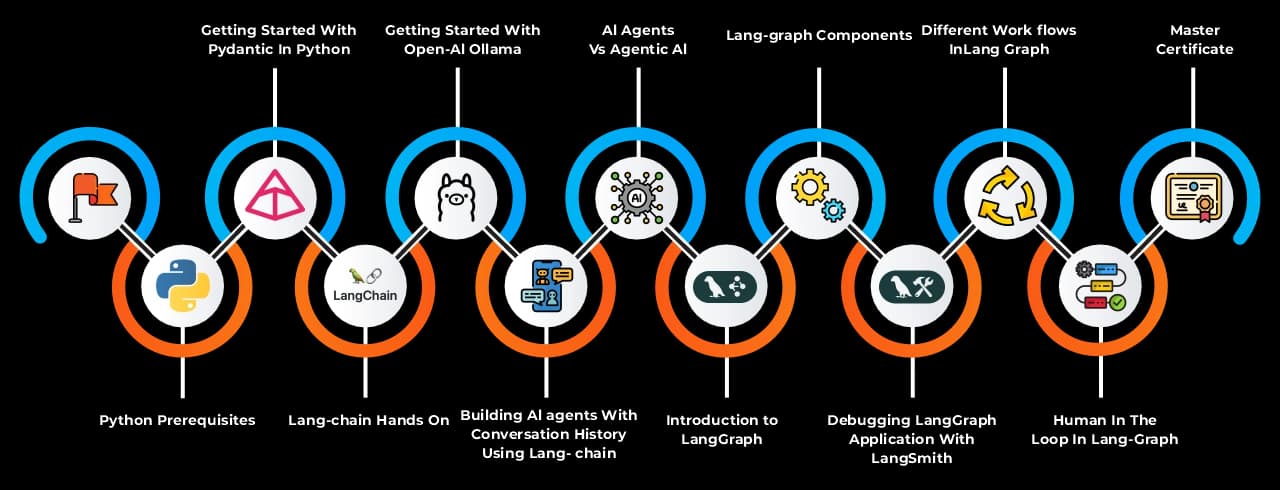
 Python A versatile, high-level programming language widely used for web development, automation, data science, and AI.
 Getting Started With Pydantic In PythonIntroduction to using Pydantic for data validation and settings management using Python type annotations.
 Lang-chainA framework designed to build applications powered by large language models with modular, chainable components.
 Open-Al OllamaA tool for running and managing open-source large language models locally with optimized performance
 Building Al agents With Conversation Lang-chain Developing interactive AI agents that utilize conversational workflows using the LangChain framework.
 Al Agents Vs Agentic AlA comparison between traditional AI agents and the emerging paradigm of agentic AI with autonomous capabilities.
 LangGraph A graph-based extension to LangChain for designing stateful and branching AI workflows.
 Lang-graph Components The individual elements that compose a LangGraph, including nodes, edges, states, and transitions
 Debugging LangGraph Application With LangSmith Using LangSmith tools to trace, monitor, and debug LangGraph-based applications efficiently.
 Different Workflows InLang GraphExploration of various patterns and structures for implementing workflows within LangGraph.
 Human In The Loop In Lang-GraphIntegrating human feedback or decision-making checkpoints into LangGraph AI workflows.
 RAG With LangGraphImplementing Retrieval-Augmented Generation (RAG) techniques within a LangGraph-powered application.