Prepare for tech interviews with the Top 15 Basic Python Interview Questions. Master essential Python concepts and boost your chances of landing your dream job.
1. What is Python? What are its key features?
Answer:
Python is an interpreted, high-level, general-purpose programming language. It was created by Guido van Rossum and released in 1991. Key features of Python include:
• Easy to learn and use
• Interpreted and dynamically typed
• Extensive standard library
• Open-source with strong community support
• Supports multiple programming paradigms (OOP, procedural, functional)
2. What are Python's data types?
Answer:
Python supports the following data types:
• Numeric types: int, float, complex
• Sequence types: list, tuple, range
• Text type: str
• Set types: set, frozenset
• Mapping type: dict
• Boolean type: bool
• Binary types: bytes, bytearray, memoryview
3. What is the difference between a list and a tuple?
Answer:
• Lists are mutable (can be modified), while tuples are immutable.
• Lists consume more memory, while tuples are faster due to immutability. • Syntax: list = [1, 2, 3], tuple = (1, 2, 3)
4. What is PEP 8?
Answer:
PEP 8 is the Python Enhancement Proposal that provides guidelines and best practices on how to write Python code. It promotes code readability and consistency across Python projects.
5. What are Python functions?
Answer:
A function in Python is a reusable block of code that performs a specific task. It is defined using the def keyword.

Intermediate Python Interview Questions
6. What are *args and kwargs in Python?
Answer:
• *args: Used to pass a variable number of non-keyword arguments.
• **kwargs: Used to pass a variable number of keyword arguments.

7. Explain list comprehension with an example.
Answer:
List comprehension offers a concise way to create lists.

This creates a list of squares from 0 to 9 in a single line.
8. What is the difference between is and ==?
Answer:
• == compares the values of two objects.
• is checks whether two references point to the same object in memory.

9. What is the difference between shallow copy and deep copy? Answer:
• Shallow Copy: Copies the object but not nested objects (shared references). • Deep Copy: Copies the object and all nested objects recursively.

10. What is a lambda function?
Answer:
A lambda function is an anonymous function defined using the lambda keyword.

Advanced Python Interview Questions
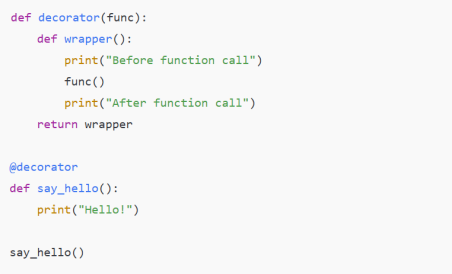
11. What are Python decorators?
Answer:
Decorators are functions that modify the behavior of another function. They are often used for logging, access control, or instrumentation.
12. Explain Python generators and yield.
Answer:
Generators are iterators that yield items one at a time using the yield keyword. They are memory-efficient and used to handle large data sets.

13. What is the Global Interpreter Lock (GIL)?
Answer:
The GIL is a mutex that protects access to Python objects, preventing multiple native threads from executing Python bytecodes at once. It limits the concurrency of Python threads.
14. How is exception handling done in Python?
Answer:
Python uses try, except, else, and finally blocks for exception handling.

15. What are metaclasses in Python?
Answer:
A metaclass is a class of a class. It defines how a class behaves. A class is an instance of a metaclass. They are often used for class customization and dynamic class generation.

Bonus Tips for Python Interviews
• Understand Python's memory model: Know how variables and objects are managed.
• Read and write code daily: Practice on platforms like LeetCode, HackerRank, or Codewars.
• Review source code of Python libraries: It deepens your understanding of best practices.
• Know Python 3.x differences from Python 2.x: Most interviews now focus on Python 3.
Final Thoughts
Whether you're aiming for a role in web development, data science, or backend engineering, Python is a versatile tool in your toolkit. Being well-prepared with these common interview questions and answers can make a significant difference. Beyond memorizing answers, aim to understand the concepts so you can confidently apply them in real-world scenarios.
Good luck with your Python interview!
Do visit our channel to learn More: SevenMentor
Author:-
Pooja Kulkarni
Pooja Kulkarni
Expert trainer and consultant at SevenMentor with years of industry experience. Passionate about sharing knowledge and empowering the next generation of tech leaders.