Certified DevSecOps Engineer Course in Pune

feature-iconBridge the Gap Between Development & Operations with Hands-On Training

feature-icon Learn To Master DevOps Tools and Automation for Seamless IT Operations

feature-iconUnlock High-Paying DevOps Roles with Industry-Focused Course at SevenMentor

020 71177392

Start Today!

CONSULT WITH OUR ADVISORS

  • Course & Curriculum Details
  • Flexible Learning Options
  • Affordable Learning
  • Enrollment Process
  • Career Guidance
  • Internship Opportunities
  • General Communication
  • Certification Benefits

Request Call Back

Loading...

Learning Curve for Certified DevSecOps Engineer
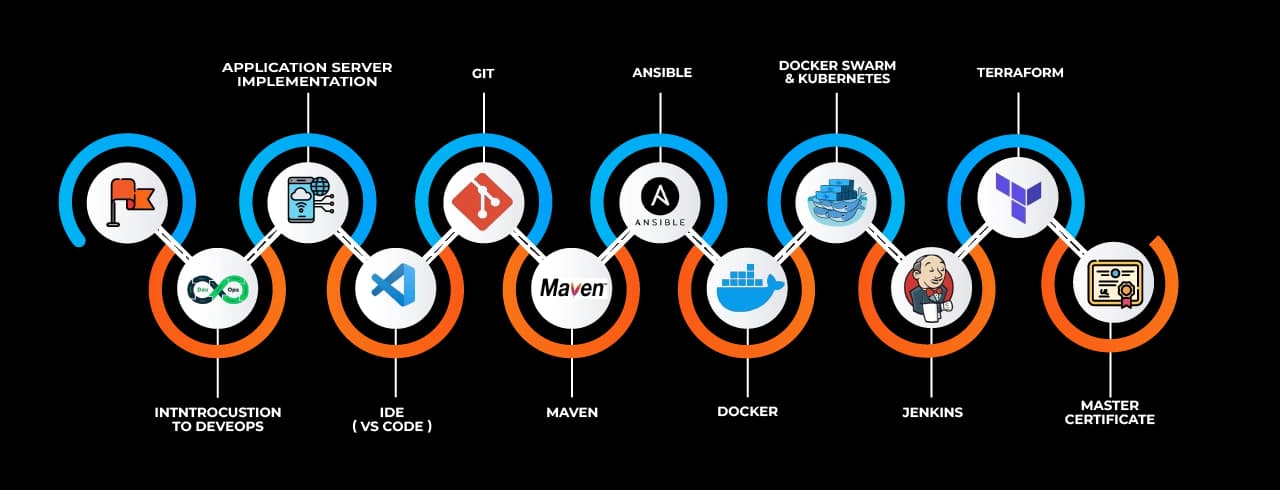
Learning curve for Certified DevSecOps Engineer

Master In Certified DevSecOps Engineer Course

OneCourseMultipleRoles

Empower your career with in-demand data skills and open doors to top-tier opportunities.

DevOps Architect
Release Manager
DevOps Engineer
Security Engineer
Software Developer
Automation engineering
Software Testing
DevOps specialist
DevSecOps Engineer
Integration Specialist
Systems engineering
Automation Expert
Quality Assurance
Reliability engineering

Skills & Tools You'll Learn -

DevOps  iconDevOps A culture and practice that integrates software development and IT operations for faster and more reliable releases.
CI/CD iconCI/CDA methodology for automating code integration, testing, and deployment to improve software delivery speed.
Continuous Integration iconContinuous IntegrationThe process of automatically integrating code changes into a shared repository multiple times a day.
Continuous Delivery/Deployment iconContinuous Delivery/DeploymentAutomating software releases to ensure reliable updates with minimal manual intervention.
Git iconGit A distributed version control system used for tracking code changes and collaboration.
Jenkins  iconJenkins An open-source automation tool for implementing CI/CD pipelines.
Maven  iconMaven A build automation tool primarily used for Java projects, managing dependencies and builds.
Ant  iconAnt A Java-based build tool for automating software compilation, testing, and deployment.
Ansible  iconAnsible A configuration management tool for automating IT infrastructure and application deployment.
Terraform  iconTerraform An IaC tool used to define and provision cloud infrastructure using declarative configuration files.
Container  iconContainer A lightweight, portable, and consistent runtime environment for applications.
Docker  iconDocker A containerization platform that enables developers to package, distribute, and run applications in isolated environments.
Podman  iconPodman A daemonless container engine that provides a secure alternative to Docker.
Kubernetes  iconKubernetes A container orchestration system for automating deployment, scaling, and management of containerized applications.
Docker Swarm iconDocker SwarmA native clustering tool for managing and orchestrating Docker containers.
SDLC  iconSDLC The Software Development Life Cycle, outlining stages from planning to maintenance in software development.
Tomcat  iconTomcat An open-source Java application server used for deploying Java-based web applications.
Apache HTTPD iconApache HTTPDA widely used open-source web server for hosting and serving web applications.
VSCode  iconVSCode A lightweight yet powerful code editor with support for debugging, Git, and extensions.
IaC (Infrastructure as Code) iconIaC (Infrastructure as Code)Managing and provisioning infrastructure using machine-readable scripts instead of manual processes.

Why Choose SevenMentor Certified DevSecOps Engineer

Empowering Careers with Industry-Ready Skills.

Specialized Pocket Friendly Programs as per your requirements

Specialized Pocket Friendly Programs as per your requirements

Live Projects With Hands-on Experience

Live Projects With Hands-on Experience

Corporate Soft-skills & Personality Building Sessions

Corporate Soft-skills & Personality Building Sessions

Digital Online, Classroom, Hybrid Batches

Digital Online, Classroom, Hybrid Batches

Interview Calls Assistance & Mock Sessions

Interview Calls Assistance & Mock Sessions

1:1 Mentorship when required

1:1 Mentorship when required

Industry Experienced Trainers

Industry Experienced Trainers

Class Recordings for Missed Classes

Class Recordings for Missed Classes

1 Year FREE Repeat Option

1 Year FREE Repeat Option

Bonus Resources

Bonus Resources

Curriculum For Certified DevSecOps Engineer

BATCH SCHEDULE

Certified DevSecOps Engineer Course

Find Your Perfect Training Session

Sep 6 - Sep 12

1 session
12
Sat
Classroom/ Online
Weekend Batch

Sep 13 - Sep 19

2 sessions
13
Sun
Classroom/ Online
Weekend Batch
14
Mon
Classroom/ Online
Regular Batch

Sep 20 - Sep 26

1 session
21
Mon
Classroom/ Online
Regular Batch

Learning Comes Alive Through Hands-On PROJECTS!

Comprehensive Training Programs Designed to Elevate Your Career

Simple DevOps Project for CI/CD using Jenkins
Simple DevOps Project for CI/CD using Jenkins

CI/CD Pipeline using Git, Jenkins, Ansible, and Docker Swarm/Kubernetes
CI/CD Pipeline using Git, Jenkins, Ansible, and Docker Swarm/Kubernetes

AWS Infrastructure Management using Terraform
AWS Infrastructure Management using Terraform

Continuous Integration and Continuous Deployment without Downtime

Continuous Integration and Continuous Deployment without Downtime

Terraform and Ansible Smart Combination for Managing Infrastructure & Software Configuration

Terraform and Ansible Smart Combination for Managing Infrastructure & Software Configuration

No active project selected.

Transform Your Future with Elite Certification

Add Our Training Certificate In Your LinkedIn ProfileLinkedIn

Our industry-relevant certification equips you with essential skills required to succeed in a highly dynamic job market.

Join us and be part of over 50,000 successful certified graduates.

Student 1
Student 2
Student 3
Student 4
Student 5
Join 15,258 others learning today
Certificate Preview

KEY Features that Makes Us Better and Best FIT For You

Expert Trainers

Industry professionals with extensive experience to guide your learning journey.

Comprehensive Curriculum

In-depth courses designed to meet current industry standards and trends.

Hands-on Training

Real-world projects and practical sessions to enhance learning outcomes.

Flexible Schedules

Options for weekday, weekend, and online batches to suit your convenience.

Industry-Recognized Certifications

Globally accepted credentials to boost your career prospects.

State-of-the-Art Infrastructure

Modern facilities and tools for an engaging learning experience.

100% Placement Assistance

Dedicated support to help you secure your dream job.

Affordable Fees

Quality training at competitive prices with flexible payment options.

Lifetime Access to Learning Materials

Revisit course content anytime for continuous learning.

Personalized Attention

Small batch sizes for individualized mentoring and guidance.

Diverse Course Offerings

A wide range of programs in IT, business, design, and more.

Course Content

Why is DevSecOps critical for cloud architects today?

You pushed code to production at 2 AM. Then you noticed an API key sitting in the repository. That kind of mistake gets expensive fast. In traditional IT workflows, security often arrived near the end of the release process. Developers built the application and cloud architects handled infrastructure while security teams rushed through manual checks before deployment. That approach becomes difficult to manage when workloads span AWS, Microsoft Azure and Google Cloud Platform.

Cloud security now needs to sit inside the engineering workflow. You are not at atrll expectedx to squeeze into a huge classroom where getting a mentor's attention becomes difficult. 

Batches for any course must stay around 20 learners so there is enough room to work through labs and ask questions when something breaks. Even sometimes the Senior mentors can guide you for tougher problems and then you can choose weekday or weekend sessions as well as online-offline options that are at your disposal if you're already working. 


+-------------------------------------------------------+

| TRADITIONAL DEVELOPMENT LIFECYCLE |

| Code ---> Build ---> Deploy ---> [ Security ] |

| (Bottleneck) |

+-------------------------------------------------------+

+-------------------------------------------------------+

| DEVSECOPS INTEGRATED PIPELINE |

| Code ---> Build ---> Deploy ---> Monitor |

| | | | | |

| v v v v |

| [ SAST ] [ DAST ] [ IaC Scan ] [ RASP / Cloud ] |

+-------------------------------------------------------+

This shift has increased demand for engineers who understand both multi-cloud infrastructure and proactive security. The Certified DevSecOps Engineer Course Global at SevenMentor Institute focuses on that overlap between infrastructure automation and cloud threat defense.

For professionals working toward a multi cloud solutions architect role the program covers enterprise-scale infrastructure along with security automation. Learners can join a DevSecOps Course in Pune or attend live interactive sessions online.

How does SevenMentor compare to online bootcamps?

Video courses can teach syntax and concepts. The harder part starts when you open a real cloud console and something refuses to work.

Generic online bootcamps often depend on recorded lessons and pre-configured sandboxes. That works for basic learning but real incidents usually involve IAM mistakes, subnet routing conflicts, container vulnerabilities or Infrastructure as Code state problems.

SevenMentor focuses more heavily on live-console practice. Students get time inside actual cloud environments where they can put together security-focused CI/CD workflows across AWS and Azure as well as GCP. The toolset goes beyond the usual introductory stack too. Training includes Terraform and HashiCorp Vault along with Trivy as well as SonarQube or Aqua Security and Kyverno so learners can see how these tools fit into an actual workflow rather than studying each one in isolation. 


In India’s technology hubs you will find large IT companies such as Infosys and Cognizant along with Persistent and smaller firms that are growing fast. That mix is creating more room for architects who can work across cloud platforms and understand how everything connects. It matters even more when companies are running systems where poor architecture can lead to serious performance issues or unexpected cloud costs. 


What does the course curriculum actually cover?

You will not just read about Kubernetes. You will work with it and troubleshoot the problems that appear when systems stop behaving as expected. The multi cloud solutions architect course combines architecture concepts with practical cloud console work.

+-------------------------------------------------------+

| DEVSECOPS CURRICULUM ARCHITECTURE |

| |

| Module 1: Enterprise Multi-Cloud Architecture |

| | |

| v |

| Module 2: DevSecOps CI/CD Pipeline Automation |

| | |

| v |

| Module 3: Infrastructure as Code (IaC) Security |

| | |

| v |

| Module 4: Container & Kubernetes Security |

| | |

| v |

| Module 5: Cloud Security, Compliance & SIEM |

+-------------------------------------------------------+

1. Enterprise Multi-Cloud Infrastructure & Architecture

Work across AWSor Azure and Google Cloud Platform. The module covers AWS VPC Peering and Azure VNet Peering and Transit Gatewaysor Direct Connect and VPN tunnels. Identity topics include OAuth2, SAML, OpenID Connect and AWS IAM Identity Center.

The curriculum also aligns infrastructure concepts with AWS Training standards.

2. DevSecOps Automation in CI/CD

Build deployment workflows with Jenkins along with GitLab CI and GitHub Actions. Security checks use SonarQube for SASTor OWASP ZAP for DAST and Snyk for SCA.

3. IaC Security and Secret Management

Terraform and Ansible are used for multi-cloud provisioning. Checkov and TFSec and OPA help identify unsafe infrastructure configurations while HashiCorp Vault replaces hardcoded credentials with managed secrets.

4. Container and Kubernetes Security

The training covers Docker security and Kubernetes environments including EKS, AKS and GKE. Students work with Trivy and Clair for container scanning along with network policiesor Istio and runtime security tools such as Falco and Kyverno.

The security concepts also connect with the practical areas covered in the Ethical Hacking Course.

5. Cloud Governance, Compliance and SIEM

AWS Configor Azure Policy and Cloud Custodian are used for compliance automation covering PCI-DSS and SOC 2, ISO 27001 and HIPAA. Logging can be centralized through AWS CloudTrailor Fluentd and Elasticsearch and Kibana and Prometheus before being connected to SIEM platforms such as Splunk and Microsoft Sentinel.


How are these security tools used in practice?

Memorizing the OWASP Top 10 is one thing. Troubleshooting a failing container at 2 AM is another.

That is why the practical work focuses on realistic security failures instead of tool demonstrations alone.

+-------------------------------------------------------+

| REAL-WORLD LAB WORKFLOW SCENARIO |

| |

| 1. Developer pushes code with security flaws |

| (Hardcoded AWS keys & vulnerable packages) |

| | |

| v |

| 2. Jenkins / GitLab triggers SAST & SCA |

| (SonarQube & Snyk scan automatically) |

| | |

| v |

| 3. Pipeline blocks deployment |

| (Security alert with remediation details) |

| | |

| v |

| 4. Developer fixes code and updates Terraform |

| (Checkov validates configuration) |

| | |

| v |

| 5. Release moves to production |

| (Falco monitors runtime activity) |

+-------------------------------------------------------+

Real world Industry Scenario Of Kubernetes Runtime Defense:

A microservices application runs on Amazon EKS while Falco watches for suspicious activity such as unauthorized shell access or changes to restricted system files. Kubernetes Network Policies can then help isolate affected workloads.

Enrolling in this DevSecOps Training in Pune or joining the global online format gives learners project work based around these enterprise-style scenarios.


How does DevSecOps affect salary growth?

For anyone who is comparing the career differenc between each other, the career difference becomes clearer when you compare basic infrastructure work with security-focused cloud architecture in some fields. Many of the companies running hybrid and multi-cloud environments often need people who can handle deployment automation all the while also dealing with security controls and compliance for the whole workflow.


To move toward the higher end of these roles, the important skills include:

  • Infrastructure as Code Security: Terraform along with OPA and Checkov
  • Cloud-Native Container Defense: Kubernetes security and admission control and service mesh encryption
  • Zero-Trust Security: IAM, RBAC and dynamic secrets
  • Compliance Automation: Cloud Custodian along with AWS Config and policy mapping

SevenMentor also provides 100% job placement assistance and maintains a network of 500+ Hiring Partners.


Ready to launch your cloud security career?

If your current role is limited to basic DevOps or system administration, adding security automation and multi-cloud architecture can open a different set of technical roles.

The enrollment process is simple:

Step 1: Consultation → Step 2: Batch Selection → Step 3: Console Setup → Step 4: Live Training

  1. Speak with a Career Advisor: Discuss your current background and learning goals.
  2. Choose Your Format: Select weekday or weekend batches in Pune or Mumbai or join the live global online format.
  3. Get Learning Access: Receive course materials along with cloud lab credentials and community access.
  4. Build Your Portfolio: Complete practical labs and projects while preparing for technical interviews.

For companies that want to train cloud infrastructure teams, the Corporate Training Division provides customized DevSecOps and cloud security programs.

Head Office: Shivaji Nagar, Pune — 020-71173071

Mumbai Branch: 022-48904395

Email: support@sevenmentor.com

Website: SevenMentor Institute


What Do Students Usually Ask About Multi Cloud Training?

Do I need AWS or Azure certifications before I join?

No. You can start without an existing cloud certification. The early part covers networking and identity along with storage concepts before moving into advanced labs.

How do students access the live cloud hands-on labs?

You get sandbox access to AWS and Azure along with Google Cloud during training. The lab resources are managed for you so there is no need to worry about unexpected cloud charges.

What does the dual certification setup actually give me?

You receive a Multi-Cloud Solutions Architect certification from SevenMentor Institute along with preparation for a provider credential such as AWS Solutions Architect Associate or Azure Administrator. So you have the course credential and a vendor-focused certification path.

How does the placement guarantee program work in practice?

The support focuses on interview opportunities through the hiring network rather than simply sending job links. Your resume and GitHub and LinkedIn profiles can also be reviewed and mock interviews help you prepare for technical rounds.

Can I switch between weekend and weekday batches?

Yes. You can move between weekday evening sessions and weekend classes if your work schedule changes. Parallel batches at Shivajinagar and Hinjewadi along with Pimpri give you some flexibility.

What if I miss a live lecture comedy will I have opportunity to ;earn things again?

No dont worry as you don't have to fall behind because you missed one class. Most of our classes have recorded sessions that are available through the student portal which you can also message the trainer and then they can help you remotely as well.

How does the partnership with SevenMentor Institute help my career progression really fast?

The collaboration gives learners access to senior enterprise architects through guest sessions and project reviews. It can also provide another route into the wider SevenMentor hiring network across India.


Frequently Asked Questions

Everything you need to know about our revolutionary job platform

1

What topics are covered in the DevOps Course?

Ans:
The course includes cloud architecture, virtualization, networking, security, DevOps integration, serverless computing, cloud automation, and hands-on training with AWS, Azure, and GCP.
2

Why choose SevenMentor Institute for DevOps training?

Ans:
SevenMentor offers industry-focused training with expert instructors, real-world projects, hands-on labs, flexible batches, and 100% placement assistance for career growth.
3

What tools and technologies will I learn in the DevOps Classes?

Ans:
You'll work with AWS, Microsoft Azure, Google Cloud, Terraform, Kubernetes, Docker, Jenkins, CI/CD pipelines, Ansible, and cloud security tools.
4

Does the DevOps Certification include real-world projects?

Ans:
Yes, students gain hands-on experience through real-world cloud deployment projects, infrastructure automation, security management, and performance optimization.
5

How long is the DevOps Course ?

Ans:
The duration varies between 2 to 6 months, with weekday and weekend batches available for both beginners and professionals.
6

What career opportunities are available after completing the DevOps Classes?

Ans:
After completion, you can explore roles like Cloud Engineer, Solutions Architect, DevOps Engineer, Site Reliability Engineer (SRE), and Cloud Security Specialist.
7

Is this DevOps Course suitable for beginners?

Ans:
Yes, the course is designed for both freshers and IT professionals, starting from the basics and progressing to advanced cloud concepts.
8

How does DevOps Certification add value to my career?

Ans:
A certification validates your cloud expertise, making you a strong candidate for high-paying IT roles in cloud infrastructure and services.
9

Can I take DevOps Classes online?

Ans:
Yes, SevenMentor offers both classroom and online training, providing flexibility for learners across different locations.
10

What makes SevenMentor the best institute for DevOps training?

Ans:
SevenMentor stands out due to expert trainers, hands-on training, industry-aligned syllabus, real-world projects, and a strong placement network.
11

Will I receive study materials during the DevOps Certification program?

Ans:
Yes, students receive comprehensive study materials, including notes, assignments, practical exercises, and recorded sessions.
12

Does the DevOps Course cover advanced topics like DevOps and automation?

Ans:
Absolutely! The course includes Infrastructure as Code (IaC), CI/CD pipelines, Kubernetes, cloud security, and cloud automation techniques.
13

Can I take DevOps Classes online?

Ans:
Yes, SevenMentor offers both classroom and online training, providing flexibility for learners across different locations.