How To Become A Certified Cloud DevOps Architect In 2026 And Why?
Until very recently in many companies their software engineers used to write code in one silo while the ops team managed hardware in a completely separate one. That model broke down completely under the weight of modern rapid-release cycles. Now, companies need engineers who can bridge both worlds—without sacrificing production stability or cloud security. If you have been wondering whether a dedicated cloud architect devops course is the missing piece in your engineering career, the answer usually comes down to how quickly you want to move into high-impact infrastructure roles. Indian enterprises in 2026 now are not just hiring basic sysadmins anymore but rather they are looking out for specialists that are capable of write + automation scripts and can orchestrate multi-region deployments all in one go. All along when they build resilient cloud environments from scratch.
SevenMentor Institute delivers a practical Cloud & DevOps Architect training track built specifically around these industry demands. Headquartered in Pune with a strong presence across Maharashtra including Mumbai, SevenMentor brings over 15 years of technical training history, a track record of 60,000+ trained students, and established hiring relationships with 500+ corporate partners. The core program runs in strategic collaboration with IT Education Centre — Pune's premier tech training provider known for setting a strict maximum limit of 20 students per batch. This joint delivery structure means you wont be stuck sitting in a packed classroom where your questions get drowned out. Instead, you get dedicated instructor time inside advanced, air-conditioned computer labs fitted with real-time server environments and enterprise routing hardware.
Learning cloud architecture requires sitting across from someone who actually handles production failures for a living. That's why SevenMentor taps working corporate pros with 8+ years of active industry experience as lead trainers. Online live streams or hands-on classroom sessions at Pune hubs—Shivaji Nagar, Hinjewadi, Deccan, Pimpri—either way, you skip dry textbook memorization. You receive dual certification upon completion, backing up your resume with credential weight recognized across top IT service firms and product startups alike. SevenMentor has very high ratings and is the top IT training provider in many Indian cities with thousands of verified alumni and dedicated placement cell and hands-on laboratory model for all students.
Why Choose SevenMentor For Practical DevOps Training?
Most tech courses fail for a very simple reason: they teach students how to click through web interfaces instead of teaching them how production systems break. When you enter an enterprise cloud team, nobody asks you to manually set up servers through a cloud dashboard interface; they expect you to provision infrastructure using automated scripts and manage state files cleanly. SevenMentor's devops cloud architect classes focus on raw practical implementation from week one. Through the dual partnership with IT Education Centre along with every student gets direct access to sandboxed cloud environments where you can write code, spin up resources, break configurations, alongside figure out how to fix them before pushing changes live.
The batch cap of 20 participants is a crucial operational detail here. In large 100-person lecture halls, trainers cant stop to review an individual student's broken Docker build or resolve an obscure network gateway routing error. Smaller cohorts at SevenMentor mean your instructor reviews your code syntax live during lab hours. Foundational concepts get paired with live project work throughout, simple CI loops early on, working up to full blue-green cloud deployments by the later modules. Mock technical screenings, personality development modules, and resume-building sessions all sit inside the weekly schedule too, so the hiring process itself isn't something you're figuring out cold, later, on your own.
SEVENMENTOR PRACTICAL LEARNING MODEL
[Small Cohorts: Max 20] --> [Live Lab Sandboxes]
|
v
[Dual Certification] <-- [Production Scenarios & Mock Drives]
Sitting across from someone who's actually lived through a 2 AM production incident changes what you take away from a lesson entirely. When learning about container management or configuration automation, you aren't just learning ideal scenarios; you hear about trade-offs that happen during actual midnight maintenance windows. For example, using automated infrastructure tools sounds simple on paper, but managing state files across distributed engineering teams creates nasty merge conflicts if you don't implement remote locking mechanisms correctly. These practical realities form the core of SevenMentor's practical teaching approach. By the time you complete your project assignments, you have accumulated actual build experience rather than just a collection of memorized definitions.
What Core Tools Will You Master In This Program?
To land a modern infrastructure role, you must prove hands-on fluency across a broad toolchain spanning version control, deployment pipelines, as well as container engines, along with cloud platforms. SevenMentor's comprehensive aws devops architect training integrates the exact open-source software and cloud services currently required by top MNCs and high-growth engineering firms.
Mastering these tools isn't done in isolation. You start by writing version-controlled application code using Git along with wrapping that code inside a Docker container and setting up automated Jenkins pipelines to test it. From there, you provision cloud compute instances on AWS using Terraform scripts, together with deploy your containerized software into a Kubernetes cluster and monitor cluster performance through Grafana dashboards. This unified toolchain workflow gives you a holistic view of modern system design.
[ Git / GitHub ] ---> Source Code & Version Control
|
v
[ Jenkins Pipeline ] ---> Automated Build & Integration Testing
|
v
[ Docker / Kubernetes ] -> Container Packaging & Cluster Deployment
|
v
[ Terraform + AWS ] ---> Cloud Infrastructure Provisioning
|
v
[ Prometheus / Grafana ] -> Monitoring, Log Aggregation & Alerts
The course structure also aligns cleanly with standard industry certifications, particularly the AWS DevOps Certification track. Specific assessment objectives get walked through directly, scenario-based exam questions included, hands-on lab challenges that mirror the actual testing pattern rather than a loose approximation of it. You walk away with a balanced portfolio: verified theoretical knowledge plus real code repos showing live project deployments.
How Does The Syllabus Cover Real World Scenarios?
Static textbooks are useless for learning cloud infrastructure because live production environments never behave like clean textbook diagrams. A single missing network rule or an unhandled server timeout can break an entire release pipeline. SevenMentor structures its Cloud & DevOps Architect curriculum around real-world incident handling and production design patterns. Every major module starts with an explicit problem statement drawn directly from recent corporate engineering projects.
Instead of generic lectures on cloud instances, you are given a practical challenge: migrate a legacy monolithic web application to AWS with zero service downtime while ensuring high availability across distinct availability zones. You write the migration scripts along with configure load balancers, plus manage database replication and handle SSL certificate installation yourself. During deployment modules, trainers routinely introduce deliberate syntax errors or configuration breaks into your lab setup. A Kubernetes pod stuck mid crash-loop. An Ansible playbook failing on a permissions error nobody flagged in advance. Reading the logs, tracing the failure back to its actual source, fixing it under a trainer's eye, that repetition is where the real resilience comes from.
- Zero-Downtime Rollouts — blue-green and canary deployment patterns get implemented using Jenkins, AWS Target Groups, and Nginx reverse proxies.
- Infrastructure Drift Prevention: Detecting and fixing unauthorized manual changes in cloud accounts using Terraform state drift analysis.
- Automated Disaster Recovery — cross-region database backups and failover scripts get automated through AWS Lambda and CloudWatch, set up once and tested until they actually trigger correctly.
- Secrets Management — API keys as well as database credentials and SSL certificates all need to be secured inside production pipelines without leakages and none of it is hardcoded and dumped into a Git repo where it doesn't belong.
- Cluster Auto-Scaling: Configuring Kubernetes for the horizontal pod autoscalers as well as running AWS auto-scaling groups can help you handle sudden traffic spikes gracefully which is what we cover.
Trade-offs are emphasized throughout every module. For instance, you will analyze when it makes sense to run managed Kubernetes through AWS EKS versus setting up self-managed control planes on EC2 instances to save costs. You learn that canary releases offer safer deployment testing but add extra overhead to dynamic DNS routing. Understanding these subtle engineering trade-offs is what separates junior operators from genuine system architects.
What Are The Salary Prospects After Cloud Certification?
Salary growth in the tech sector tracks technical complexity, and cloud infrastructure management remains one of the highest-paying engineering domains in India. As organizations move core operations to distributed cloud platforms, the demand for qualified engineers who can automate infrastructure safely continues to outpace available talent. According to recent placement data tracked by SevenMentor's recruitment team across Mumbai and Pune, candidates transitioning into specialized cloud roles regularly see significant salary increases compared to traditional development or tech support roles.
Pay scales vary based on prior domain knowledge, project experience, and how well you handle technical interviews, but the overall trajectory remains clear. Fresh engineering graduates entering as junior DevOps engineers usually start with competitive base packages. Three to five years of relevant systems experience tends to land someone squarely in that mid-tier software engineering pay bracket once they've made the cloud transition. Push further into managing distributed multi-cloud architectures at a senior level, and that's genuinely one of the better-paid specialist tracks in corporate tech right now.
Role Level
Typical Industry Range (LPA)*
Junior Cloud DevOps Engineer
₹4.5 LPA – ₹7.5 LPA
Mid-Level DevOps Specialist
₹8.0 LPA – ₹14.5 LPA
Senior Cloud DevOps Architect
₹16.0 LPA – ₹28.0+ LPA
*Actual compensation depends on prior experience, interview performance, and individual company pay bands.
SevenMentor's dedicated placement team actively connects course graduates with open aws devops architect jobs across a wide network of corporate partners. The team assists with resume rewriting, LinkedIn optimization, together with portfolio curation and technical interview prep. Students receive targeted question banks covering actual aws devops architect interview questions reported by recent candidates, ranging from deep-dive networking scenarios to tricky Docker file optimizations. This hands-on interview preparation ensures you can explain your project portfolio clearly when sitting in front of corporate hiring panels.
Are You Ready To Launch Your Cloud Career?
The demand for skilled cloud engineers isn't going to wait around while you decide whether to upskill. Every quarter and more enterprise workflows shift into automated cloud infrastructure, as well as companies want team members who can jump in without needing months of basic hand-holding. Enrolling in the cloud architect devops course at SevenMentor Institute provides you with a direct, structured path from foundational computing concepts to advanced system architecture. Between working corporate trainers, hands-on lab environments, small batch limits via IT Education Centre, and dedicated placement support, you get all the tools necessary to make a permanent leap in your technical career.
Next steps are straightforward. Choose flexible weekend schedules if you're working full-time, or weekday fast-track options to finish faster. Offline batches run continuously across physical learning centers in Pune —including Shivaji Nagar along with Hinjewadi, plus Deccan and Pimpri— alongside structured online options for learners living across India or abroad. Reach out to SevenMentor's admissions counseling team to discuss course schedules, review lab facilities, plus sit in on an introductory demo session. Your transition into cloud architecture starts with a single step — reach out today to get started.
Explore Related Programs at SevenMentor
If you are looking to build a wider set of software engineering skills alongside cloud automation, SevenMentor offers several complementary technical tracks. Explore the Full Stack Python Course to build backend chops, or the Data Science Course to add big data analytics to your infrastructure skillset. If system defense is your focus, the Cyber Security Course dives deep into network security and vulnerability testing. Want dedicated cloud platform training? The AWS Training Institute track preps you for core AWS certifications. QA pros moving into automated testing pipelines can check out the Software Testing Automation Classes program.
Got Questions? We've Got Answers.
Do I need a CS degree to enroll? No formal CS degree required. Basic comfort with computers, logical thinking, and the command line helps, but the curriculum starts from the ground up—fundamental networking and Linux commands. Non-IT professionals and recent graduates from various academic backgrounds regularly complete the training, provided they put in the required lab practice hours outside of class time.
How does the IT Education Centre partnership work in practice? The partnership brings together SevenMentor's corporate training infrastructure with IT Education Centre's specialized small-batch learning setup. Batches are strictly capped at a maximum of 20 students. This cap ensures every student receives individual code reviews, direct instructor guidance during lab exercises, as well as as well as dual certification upon graduation, and even even combined placement support from both placement networks.
What happens if I miss a live lecture or a lab session? Work emergencies and personal stuff come up, and none of it should cost you the course. Missed sessions get backed up as recordings on the student portal, and catching up on the actual practical work happens either through your instructor during regular weekend lab slots or in a dedicated doubt-clearing session built for exactly this.
Are the classroom centers fully equipped for practical hands-on work? Yes, all SevenMentor training branches across Pune —including Shivaji Nagar along with Hinjewadi, plus Deccan and Pimpri—feature air-conditioned computer labs fitted with high-speed internet, dedicated server access, plus local sandbox environments. You can practice directly on center hardware during lab hours or connect your personal laptop to the institute's network.
Does SevenMentor guarantee job placements upon course completion? SevenMentor provides 100% placement support rather than unrealistic job guarantees that depend entirely on external corporate hiring panels. The placement cell arranges direct campus drives, shares candidate profiles with 500+ corporate hiring partners and conducts mock technical interviews, as well as helps optimize your resume. Final hiring decisions ultimately rest on how well you demonstrate your practical skills during employer technical evaluations.
How does this course prepare me for official cloud certification exams? Certification prep is woven directly into the daily curriculum. Trainers map lab assignments to official exam domains along with walk through scenario questions and provide practice tests that mirror real test formats. This integrated approach ensures you build real project deployment experience while simultaneously preparing to clear official certification exams.
 Bridge the Gap Between Development & Operations with Hands-On Training
 Learn To Master DevOps Tools and Automation for Seamless IT Operations
 Unlock High-Paying DevOps Roles with Industry-Focused Course at SevenMentor
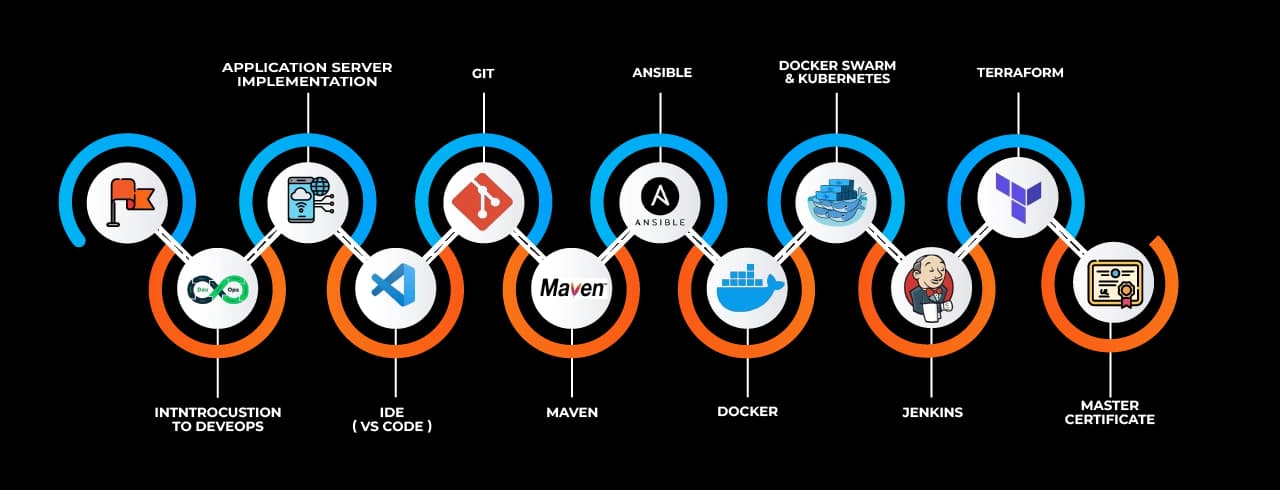
 DevOps A culture and practice that integrates software development and IT operations for faster and more reliable releases.
 CI/CDA methodology for automating code integration, testing, and deployment to improve software delivery speed.
 Continuous IntegrationThe process of automatically integrating code changes into a shared repository multiple times a day.
 Continuous Delivery/DeploymentAutomating software releases to ensure reliable updates with minimal manual intervention.
 Git A distributed version control system used for tracking code changes and collaboration.
 Jenkins An open-source automation tool for implementing CI/CD pipelines.
 Maven A build automation tool primarily used for Java projects, managing dependencies and builds.
 Ant A Java-based build tool for automating software compilation, testing, and deployment.
 Ansible A configuration management tool for automating IT infrastructure and application deployment.
 Terraform An IaC tool used to define and provision cloud infrastructure using declarative configuration files.
 Container A lightweight, portable, and consistent runtime environment for applications.
 Docker A containerization platform that enables developers to package, distribute, and run applications in isolated environments.
 Podman A daemonless container engine that provides a secure alternative to Docker.
 Kubernetes A container orchestration system for automating deployment, scaling, and management of containerized applications.
 Docker SwarmA native clustering tool for managing and orchestrating Docker containers.
 SDLC The Software Development Life Cycle, outlining stages from planning to maintenance in software development.
 Tomcat An open-source Java application server used for deploying Java-based web applications.
 Apache HTTPDA widely used open-source web server for hosting and serving web applications.
 VSCode A lightweight yet powerful code editor with support for debugging, Git, and extensions.
 IaC (Infrastructure as Code)Managing and provisioning infrastructure using machine-readable scripts instead of manual processes.