Have you been watching the DevOps-Security convergence and wondering how to position yourself for the opportunities it creates? That instinct is worth following. Security now sits inside the development process rather than waiting at the very end. The shift happened fast. Many professionals are still catching up, which means certified practitioners with hands-on pipeline experience are commanding serious attention from hiring managers right now.
SevenMentor Institute delivers this program alongside IT Education Centre—Pune's premier tech training institute known for max 20 students/batch, dual certification, and 100% placement support. Together, they've architected a curriculum that addresses the complexities of securing multi cloud solutions architect in Nagpur environments. You'll work across AWS, Azure, and GCP simultaneously, implementing guardrails that function across all three. The training moves quickly from theory into real execution—you'll embed SAST, DAST, as well as as well as SCA, and even container scanning into actual CI/CD workflows. No simulations for the sake of demonstrating concepts. The labs use production-grade infrastructure, and the scenarios mirror what enterprise security teams actually face.
Who benefits most from this path? System Administrators looking to pivot find the automation layers familiar yet elevated. Developers aiming to own the full stack lifecycle gain the security vocabulary they were never taught in bootcamps. Security Analysts wanting to automate remediation discover that coding skills compound their existing threat knowledge. The main shift is learning to catch security issues while code is still moving through the pipeline. You start looking for vulnerabilities at commit instead of waiting for a live incident to expose them. By the end you have practical projects covering secure pipelines along with IaC hardening and policy-as-code that you can actually walk a recruiter through. That gives you something concrete to discuss during technical rounds rather than another line on a cover letter.
Why go with SevenMentor's hands-on training style?
What turns a routine training course into a true career leap, rather than just another paper certificate on your wall? The answer is straightforward. It comes down to course design:who leads the sessions along with how closely exercises reflect actual workplace tasks and whether you still remember the concepts six months down the line.
- SevenMentor brings over 15 years of industry experience, 60,000-plus trained graduates, alongside active hiring links with 500+ companies. Those numbers actually count—they represent real relationships with teams hiring right now. Our trainers aren't career academics. They're working professionals with 8+years of real-time corporate experience who still code along with still troubleshooting production incidents and still carry the scars of learning expensive lessons. That context shapes every explanation and every lab exercise.
- Small batch sizes capped at 20 students change the learning dynamic significantly. When a Jenkins pipeline fails or HashiCorp Vault policy settings throw errors, you need fast, direct help from someone looking at your actual setup. That level of personal guidance simply breaks down in massive, 80-student lecture halls.
- Our commitment to this intimate format means you receive personalized code reviews, instant doubt resolution, plus guidance calibrated to your existing skill level. You're not competing for attention.
- The dual certification framework provides credentials recognized by both the training alliance and global vendors. Recruiters see dual verification and understand the commitment it represents.
Remote participants from Nagpur join via a live-online platform that replicates the interactive classroom environment completely. Either path leads to the same capstone project along with the same mock interview series and access to the same placement cell that maintains our 4.9 Google rating.
What Core Tools Will You Master Here?
Tool proficiency sets your operational ceiling in DevSecOps. You can have the right mindset, understand the security philosophy perfectly—but without hands-on time with the actual platforms enterprises deploy, you'll struggle when interviewed or assigned real tasks. This curriculum covers the complete CNCF landscape alongside enterprise staples, ensuring you emerge platform-agnostic and immediately useful.
- Git, GitHub, together with GitLab and ArgoCD form the source control and GitOps foundation.
- You'll build out declarative Jenkins pipelines, secure Docker container runtimes, plus harden Kubernetes clusters against standard misconfiguration exploits.
- Using Terraform along with Ansible, you'll automate infrastructure—writing clean, compliant code that scales cleanly across setups without manual fixes.
- Dedicated security tools serve as the operational core throughout this program. SonarQube manages static code analysis.
- OWASP ZAP and Burp Suite handle dynamic security testing workflows along with while Trivy, plus Clair and Anchore check container images for flaws prior to deployment.
- For Software Composition Analysis, Snyk along with Dependency-Check help flag open-source security risks.
- Managing secrets means using HashiCorp Vault along with AWS Secrets Manager for dynamic key injection and automated rotation. Policy enforcement uses OPA with Rego along with Kyverno for Kubernetes admission control and runtime safety relies on Prometheus along with Grafana and Falco for anomaly detection.
Category
Primary Tools Covered
Key Skill Outcome
CI/CD & Source Control
GitLab CI Jenkins GitHub Actions ArgoCD
Pipeline-as-Code GitOps Deployment
Container & Orchestration
Docker Kubernetes (K8s) Helm K3s
Image Hardening Runtime Security Admission Control
IaC & Config Mgmt
Terraform Ansible Packer
Immutable Infra Drift Detection Policy Compliance
Security Scanning (Shift Left)
SonarQube Trivy Snyk OWASP ZAP Checkov
SAST DAST SCA IaC Scanning Automation
Secrets & Policy
HashiCorp Vault OPA/Gatekeeper Kyverno
Zero-Trust Secrets Policy-as-Code Enforcement
Cloud & Multi-Cloud
AWS (Security Hub GuardDuty) Azure (Defender) GCP (SCC)
Multi Cloud Solutions Architect Course in Nagpur Alignment
The useful part is seeing how configuration choices connect to actual attack techniques. Each lesson links the setting back to relevant things like the MITRE ATT&CK techniques so that you as a student can understand what it changes and what kind of attack it is meant to stop.
How does the syllabus tackle actual real-world scenarios?
Syllabi often sound impressive in bullet lists and then disappoint when actual enterprise work begins. This one was reverse-engineered from SevenMentor's corporate training engagements—actual sessions where they upskill employees at major MNCs. The gap between academic exercises and production chaos informed every module decision.
The learning journey progresses as a series of simulations. You begin with a vulnerable monolithic application and refactor it incrementally into a secure cloud-native microservices architecture deployed across a multi cloud solutions architect course in Nagpur environment. Every module targets a specific threat—like supply chain risks container escapes, as well as IAM flaws, and even secrets leaks—and challenges you to automate both detection and fixes.
- Scenario A tasks you with building a "Break Glass" emergency access procedure using Vault and OPA that satisfies SOC2 audit requirements while maintaining zero-standing privileges. No shortcuts allowed. The solution must pass a compliance audit simulation.
- Scenario B requires designing a GitOps workflow with ArgoCD where image promotion gates enforce Trivy critical/high vulnerability thresholds and Syft SBOM generation, as well as Cosign signature verification before production deployment proceeds. Fail any gate, and the deployment stops. Pass all gates, and you understand how secure supply chains actually function.
- Scenario C automates remediation for a publicly exposed S3 bucket detected by AWS Config.You configure the Systems Manager Automation runbook that enforces encryption along with blocks public access and sends notifications via Slack or Teams. The system must work without manual intervention.
Kubernetes CIS Benchmark hardening through kube-bench and Kyverno policies prevents privileged containers, hostPath mounts, plus default namespace usage. Chaos Engineering experiments using LitmusChaos validate whether your security controls survive failure conditions they weren't designed to handle. The capstone project demands a complete DevSecOps Reference Architecture:multi-account AWS/Azure landing zone, centralized logging through ELK/EFK, centralized security hub, as well as cross-account CI/CD roles, along with automated compliance reporting mapped to NIST 800-53 and PCI-DSS requirements. This capstone becomes your portfolio centerpiece, demonstrating end-to-end ownership of the secure software delivery lifecycle.
What Are the Salary Prospects After Certification?
Numbers vary.Location along with specific industry, plus negotiation skill and timing all influence where any individual lands. DevSecOps roles tend to pay well because companies need people who are comfortable on both sides of the development and security work. Finding real world engineers that are able to move between pipeline automation as well as security tasks without getting stuck on one side is still a challenge for many teams and thus highly appreciated for many.
Entry-level certified engineers with 0-2 years experience generally get paid in the range of Rs. 6 to between 10 LPA for all and every company has similar pay structures in 2026. Pay structures vary by company type: startups lean toward equity packages, whereas MNCs offer structured base raises. Mid-level engineers with 3 to 5 years—especially candidates carrying CKS or AWS Security credentials—regularly earn ₹14 LPA to ₹22 LPA. The jump comes from demonstrated pipeline automation experience and multi-cloud posture management—you're no longer learning, you're contributing from week one. Senior architects and leads designing multi cloud solutions architect in Nagpur strategies for global capability centers and product companies regularly breach ₹30 LPA to ₹45 LPA+.
Experience Level
Role Title
Estimated Annual CTC (INR)
Key Competencies Valued
0 - 2 Years
Junior DevSecOps Engineer / Security Analyst
₹6 LPA – ₹10 LPA
CI/CD Security and Basic K8s Linux Hardening Scripting
3 - 5 Years
DevSecOps Engineer / Cloud Security Engineer
₹14 LPA – ₹22 LPA
IaC Security as well as Multi-Cloud Posture and Policy-as-Code plus Threat Modeling
6 - 9 Years
Senior DevSecOps Architect / Platform Security Lead
₹25 LPA – ₹38 LPA
Enterprise Governance Supply Chain Security Zero Trust Architecture
10+ Years
Principal Security Architect / Head of DevSecOps
₹40 LPA – ₹60 LPA+
Strategy Culture Transformation, Regulatory Compliance, Vendor Mgmt
SevenMentor's placement cell maintains active mappings to these benchmarks. Their 500+placement network spans product platforms along with fintech outfits and major GCC hubs across Pune, Bangalore, and Hyderabad, plus remote-first teams hiring across the country. The DevSecOps certification in Nagpur can help show employers that you have worked through the required concepts and practical tasks and the placement desk also shares salary benchmarks and helps with offer negotiations while preparing you for the deep technical questions high-paying roles require. The placement team keeps working with you throughout the job search.
Ready to launch your DevSecOps career?
Cloud migration along with strict mandates like DPDP and GDPR and the rapid spread of AI-written code are making DevSecOps skills increasingly necessary for modern engineering teams. Companies that once hesitated to integrate pipeline security are now competing to hire professionals who can actually execute it. The timing for entering this space is genuinely favorable.
SevenMentor Institute, with the academic rigor of IT Education Centre, offers the most direct practical route to this expertise. Flexible training schedules that are suitable for full-time workers and ones which also include weekday and weekend along with fast-track options are available. Lifetime LMS access will help you keep your course materials current as well as updated even when the tools change so that you can go back to review lessons whenever you need a quick refresher. Career and learning support continues well past your graduation date.
Your next step takes five minutes:connect with career counselors for a free demo session where you can experience the teaching approach directly and explore the cloud lab environment, as well as review the capstone project scope.Choose between the campus experience at Pune locations in Shivaji Nagar along with Deccan, Pimpri, or Hinjewadi, alongside the interactive live-online format accessible from Nagpur.The curriculum, trainers, plus placement commitment remain identical across both paths.
DevSecOps Training in Nagpur batches stay at SevenMentor institute very small so that the instructors can spend more time looking at each learner's actual lab work.
Frequently Asked Questions
1. I live in Nagpur so do you think I have to travel to Pune to attend the Certified DevSecOps Engineer Course?
Not unless you want to. SevenMentor runs a high-fidelity live online delivery mode that recreates the classroom experience completely.You get real-time instructor interaction along with shared screen debugging for pipeline issues, plus as well as access to the same cloud lab environments across AWS/Azure/GCP and even group project participation through breakout rooms. The recordings upload within two hours of each session if you need to revisit concepts.
Some Nagpur students do prefer the campus environment and opt for weekend batches at Pune locations, finding the commute manageable for intensive learning periods.The certification along with placement support and LMS access stay identical regardless of which format you choose.
2. What background is actually required before starting DevSecOps classes in Nagpur?
Basic comfort with the Linux terminal, core networking basics (TCP/IP, DNS, HTTP/S),plus light scripting knowledge in Python and Bash, as well as Go will give you a great start. Since early modules walk through tools like Docker, Kubernetes, Jenkins, and GitLab from the ground up, existing knowledge can help you move faster but not having it won't stop you from learning the material.
System admins along with developers and QA testers as well as network engineers and security analysts usually adjust to the material quickest. Complete beginners should plan to complete a preparatory Linux/Python module available free with enrollment—it ensures you're productive from day one rather than struggling with basics while learning advanced concepts.
3. How does this training prepare me specifically for a Multi Cloud Solutions Architect role?
The Certified DevSecOps Engineer certification emphasizes Cloud-Agnostic Security Architecture throughout. You work with Terraform modules deployable to AWS, Azure,and GCP, configure cross-cloud CI/CD pipelines, implement centralized policy enforcement spanning EKS, AKS, as well as and GKE simultaneously, along with manage secrets via Vault across cloud boundaries without vendor lock-in.
The capstone project explicitly requires a multi cloud solutions architect in Nagpur design pattern—securing a distributed application running across multiple cloud providers. This portfolio piece demonstrates exactly the cross-cloud thinking that Solutions Architect interviews evaluate. These practical security posture management skills apply straight to architect positions, no matter which specific title appears on your certificate.
4. Which certifications do I earn, and do global companies accept them?
Finishing the program earns you SevenMentor Institute's 'Certified DevSecOps Engineer' credential, plus an official completion certificate issued by IT Education Centre. This dual credentialing carries weight with the 500+ hiring partners who understand what both names represent.
The curriculum maps directly to vendor certifications including CKS (Certified Kubernetes Security Specialist), HashiCorp Vault Associate, and AWS Certified Security – Specialty.SevenMentor includes exam preparation guidance along with practice tests and voucher discounts for these global certifications as part of the placement support package.
5. What exactly does "100% Placement Support" mean in practice?
It means structured, persistent assistance—not a guarantee of employment, because no ethical institute makes that promise. The support includes unlimited mock interviews (both technical and HR rounds) with industry professionals until you're placed. Resume engineering by technical writers who understand how to highlight DevSecOps projects effectively. Direct profile marketing to hiring partners through dedicated placement drives. LinkedIn and GitHub optimization workshops. Salary negotiation coaching as well as lifetime access to the placement portal and then alumni network are all available for each and every student.
6. What happens if I miss live sessions due to work or personal commitments?
It happens regularly for working professionals. Every session records in high definition and uploads to the Learning Management System within two hours. You access lifetime playback at any speed (1.5x, 2x, or normal),download recordings for offline viewing, and reference all code repositories, together with Terraform state files and Kubernetes manifests used during instruction.
Timestamped doubts posted to the LMS forum receive trainer responses within 24 hours. If you miss a critical module, you can attend the same topic in a parallel batch running on a different schedule at no additional cost.
7. Does the course cover AI security and MLSecOps emerging threats?
Yes. A dedicated "Emerging Threats & MLSecOps" module addresses how the industry is shifting.It covers securing the ML model supply chain through MLflow and DVC scanning, detecting adversarial attacks in ML pipelines, defending against prompt injection in LLM-integrated applications, as well as checking for data poisoning in training data pipelines, along with governing AI-generated code from tools like Copilot and CodeWhisperer through SAST and SCA gates.
This module updates quarterly as threats evolve. The multi cloud solutions architect course in Nagpur designation requires staying current with 2025 and beyond demands, and this content ensures your skillset doesn't become obsolete as AI integration accelerates across enterprise environments.
 Bridge the Gap Between Development & Operations with Hands-On Training
 Learn To Master DevOps Tools and Automation for Seamless IT Operations
 Unlock High-Paying DevOps Roles with Industry-Focused Course at SevenMentor
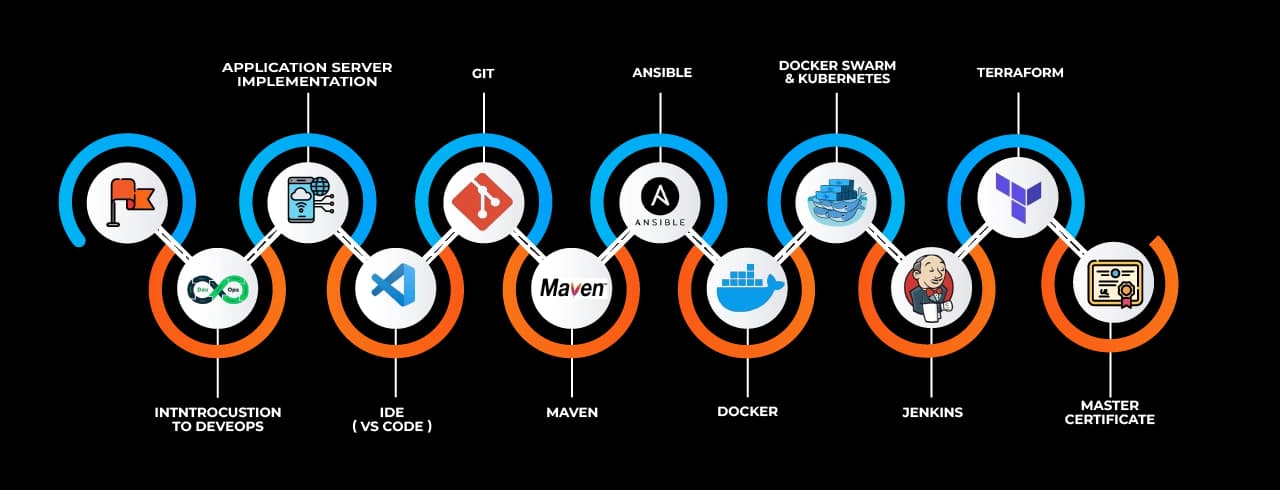
 DevOps A culture and practice that integrates software development and IT operations for faster and more reliable releases.
 CI/CDA methodology for automating code integration, testing, and deployment to improve software delivery speed.
 Continuous IntegrationThe process of automatically integrating code changes into a shared repository multiple times a day.
 Continuous Delivery/DeploymentAutomating software releases to ensure reliable updates with minimal manual intervention.
 Git A distributed version control system used for tracking code changes and collaboration.
 Jenkins An open-source automation tool for implementing CI/CD pipelines.
 Maven A build automation tool primarily used for Java projects, managing dependencies and builds.
 Ant A Java-based build tool for automating software compilation, testing, and deployment.
 Ansible A configuration management tool for automating IT infrastructure and application deployment.
 Terraform An IaC tool used to define and provision cloud infrastructure using declarative configuration files.
 Container A lightweight, portable, and consistent runtime environment for applications.
 Docker A containerization platform that enables developers to package, distribute, and run applications in isolated environments.
 Podman A daemonless container engine that provides a secure alternative to Docker.
 Kubernetes A container orchestration system for automating deployment, scaling, and management of containerized applications.
 Docker SwarmA native clustering tool for managing and orchestrating Docker containers.
 SDLC The Software Development Life Cycle, outlining stages from planning to maintenance in software development.
 Tomcat An open-source Java application server used for deploying Java-based web applications.
 Apache HTTPDA widely used open-source web server for hosting and serving web applications.
 VSCode A lightweight yet powerful code editor with support for debugging, Git, and extensions.
 IaC (Infrastructure as Code)Managing and provisioning infrastructure using machine-readable scripts instead of manual processes.