Cloud Security Architect Course

feature-iconA comprehensive cybersecurity strategy has numerous layers of protection.
feature-iconPrevention of cyber attacks is the primary goal of a Cyber expert.
feature-iconAn organization's people, processes, and technology must complement one another to effectively defend against cyber threats.
020-71172515

Start Today!

CONSULT WITH OUR ADVISORS

  • Course & Curriculum Details
  • Flexible Learning Options
  • Affordable Learning
  • Enrollment Process
  • Career Guidance
  • Internship Opportunities
  • General Communication
  • Certification Benefits

Request Call Back

Loading...

Learning Curve for Cloud Security Architect
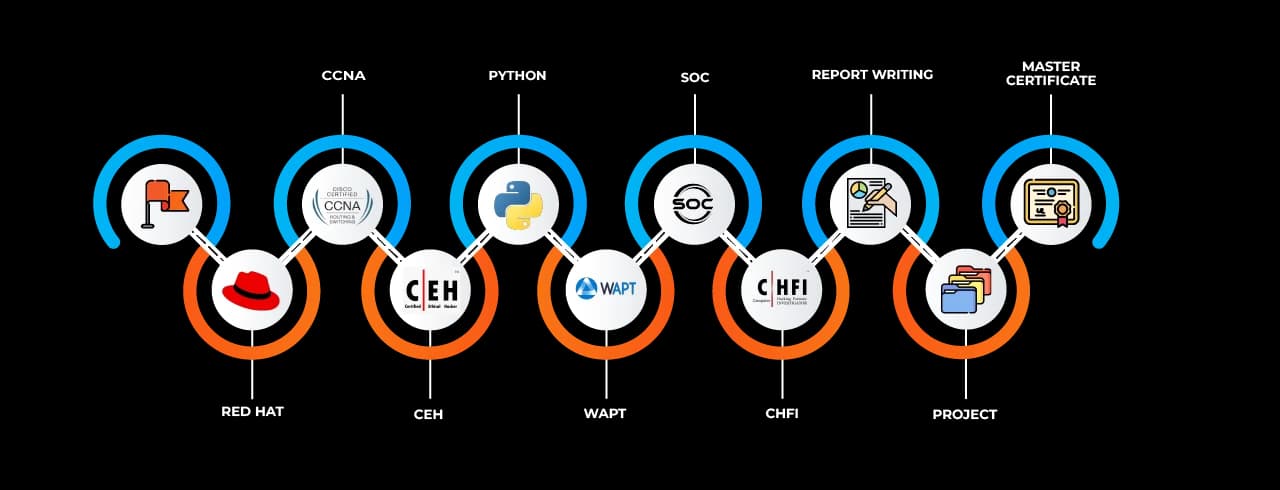
Learning curve for Cloud Security Architect

Master In Cloud Security Architect Course

OneCourseMultipleRoles

Empower your career with in-demand data skills and open doors to top-tier opportunities.

Cyber Security Analyst
Malware Analysis
information security
SOC
Risk Analyst
cyber forensics & DFIR
Threat Intelligence Analyst
Compliance and Risk Analyst
Cloud Security Specialist
Cyber Security Consultant
Incident Response Specialist

Skills & Tools You'll Learn -

Kali Linux iconKali LinuxA Debian-based penetration testing and ethical hacking operating system, pre-loaded with security tools.
Nmap (Network Mapper) iconNmap (Network Mapper)A powerful network scanning tool for discovering hosts and services.
Zenmap  iconZenmap A graphical front-end for Nmap that simplifies network scanning and analysis.
Wireshark  iconWireshark A network protocol analyzer used for packet sniffing and traffic monitoring.
Angry IP Scanner iconAngry IP ScannerA fast and lightweight tool for scanning IP addresses and ports.
NetworkMiner  iconNetworkMiner A network forensic analysis tool for extracting and analyzing packets.
Burp Suite iconBurp SuiteA web vulnerability scanner and penetration testing tool.
Nessus  iconNessus A vulnerability scanner that helps identify security issues in systems and networks.
Acunetix  iconAcunetix A web security scanner used to detect vulnerabilities like SQL injection and XSS.
Metasploit Framework iconMetasploit FrameworkA powerful exploitation framework for ethical hacking and penetration testing.
Social-Engineer Toolkit (SET) iconSocial-Engineer Toolkit (SET) A tool for simulating social engineering attacks and phishing campaigns.
Ettercap  iconEttercap A network security tool used for man-in-the-middle (MITM) attacks and traffic manipulation.
Hydra  iconHydra A fast brute-force password cracking tool for network authentication protocols.
Hashcat  iconHashcat A password recovery tool used for cracking hashes with GPU acceleration.
Wifite  iconWifite An automated wireless auditing tool for testing WiFi network security.
Wi-Fi Hacking Tools iconWi-Fi Hacking ToolsVarious tools in Kali Linux for capturing and cracking Wi-Fi passwords.
Mobile Hacking iconMobile HackingTechniques and tools used to test and exploit vulnerabilities in mobile devices.
FTK (Forensic Toolkit) iconFTK (Forensic Toolkit)A digital forensics tool for evidence collection and analysis
Recuva  iconRecuva A data recovery tool for restoring deleted files.
WinHex  iconWinHex A hex editor used for forensic investigations and data recovery.
Splunk  iconSplunk A security information and event management (SIEM) tool used for log analysis and threat detection.
Autopsy  iconAutopsy Perform digital forensics to recover and analyze deleted or hidden files.

Why Choose SevenMentor Cloud Security Architect

Empowering Careers with Industry-Ready Skills.

Specialized Pocket Friendly Programs as per your requirements

Specialized Pocket Friendly Programs as per your requirements

Live Projects With Hands-on Experience

Live Projects With Hands-on Experience

Corporate Soft-skills & Personality Building Sessions

Corporate Soft-skills & Personality Building Sessions

Digital Online, Classroom, Hybrid Batches

Digital Online, Classroom, Hybrid Batches

Interview Calls Assistance & Mock Sessions

Interview Calls Assistance & Mock Sessions

1:1 Mentorship when required

1:1 Mentorship when required

Industry Experienced Trainers

Industry Experienced Trainers

Class Recordings for Missed Classes

Class Recordings for Missed Classes

1 Year FREE Repeat Option

1 Year FREE Repeat Option

Bonus Resources

Bonus Resources

Curriculum For Cloud Security Architect

BATCH SCHEDULE

Cloud Security Architect Course

Find Your Perfect Training Session

Aug 9 - Aug 15

1 session
15
Sat
Classroom/ Online
Weekend Batch

Aug 16 - Aug 22

2 sessions
16
Sun
Classroom/ Online
Weekend Batch
17
Mon
Classroom/ Online
Regular Batch

Aug 23 - Aug 29

1 session
24
Mon
Classroom/ Online
Regular Batch

Learning Comes Alive Through Hands-On PROJECTS!

Comprehensive Training Programs Designed to Elevate Your Career

DATA RECOVERY

DATA RECOVERY

MOBILE FORENSICS

MOBILE FORENSICS

Create a SOC environment

Create a SOC environment

Implement WEB application on SOC environment and monitor it & find a vulnerability on the website and report it

Implement WEB application on SOC environment and monitor it & find a vulnerability on the website and report it

No active project selected.

Transform Your Future with Elite Certification

Add Our Training Certificate In Your LinkedIn ProfileLinkedIn

Our industry-relevant certification equips you with essential skills required to succeed in a highly dynamic job market.

Join us and be part of over 50,000 successful certified graduates.

Student 1
Student 2
Student 3
Student 4
Student 5
Join 15,258 others learning today
Certificate Preview

KEY Features that Makes Us Better and Best FIT For You

Expert Trainers

Industry professionals with extensive experience to guide your learning journey.

Comprehensive Curriculum

In-depth courses designed to meet current industry standards and trends.

Hands-on Training

Real-world projects and practical sessions to enhance learning outcomes.

Flexible Schedules

Options for weekday, weekend, and online batches to suit your convenience.

Industry-Recognized Certifications

Globally accepted credentials to boost your career prospects.

State-of-the-Art Infrastructure

Modern facilities and tools for an engaging learning experience.

100% Placement Assistance

Dedicated support to help you secure your dream job.

Affordable Fees

Quality training at competitive prices with flexible payment options.

Lifetime Access to Learning Materials

Revisit course content anytime for continuous learning.

Personalized Attention

Small batch sizes for individualized mentoring and guidance.

Diverse Course Offerings

A wide range of programs in IT, business, design, and more.

Course Content

What Does a Cloud Security Architect Actually Do, and Why Does the Role Pay So Well?

Every bank moving to AWS, every hospital chain shifting records to Azure, every fintech app running on GCP, all of that needs somebody deciding how it stays secure while it scales, and that's basically the whole job here. Cloud security architecture sits right at that intersection, less about reacting to a breach after it happens and more about designing systems so a breach becomes a lot harder to pull off in the first place.

Pay numbers across different sources land in a fairly wide range, somewhere between ₹22-50 LPA for architects with real experience, and principal-level professionals at bigger GCCs or Big-4 consulting firms are crossing ₹65-90 LPA in some cases. Freshers coming in with a foundational cloud security credential typically start around ₹5-9 LPA, and that climbs steadily once someone's got two or three years of dual-cloud work under them. Bangalore tends to command a real premium too, commonly 15-20% above other Indian metros, given how many product companies and BFSI institutions have set up dedicated cloud security teams there.

None of this growth is random either. RBI's cloud outsourcing guidelines, the DPDP Act, and SEBI's cybersecurity framework have all pushed Indian enterprises to take security architecture in cloud computing seriously rather than treating it as an afterthought bolted onto a DevOps team's workload. This shortage isn't just a talking point either, ISC2's own numbers put the global cybersecurity gap at well over 4 million professionals, and cloud-specific roles happen to sit right at the widest part of it. That is a real reason why a structured cloud security architect certification carries genuine weight in the job market especially when you're job hunting in 2026. 


Why Companies Are Aggressively Hiring Cloud Security Architects in 2026?

Companies are now rushing to move everything to the cloud over the last few years due to obvious benefits. And since a lot of them are only now dealing with the security gaps that speed left behind in abyss. Bangalore alone had close to 9,800 cloud security postings open as of mid-2026 and this is just half a year. Most wanted candidates holding AWS SCS-C02 or AZ-500 specifically, not just years of general IT experience, which says a lot about how seriously employers are treating formal credentials right now 

Razorpay, Cred, Meesho, Zepto, along with a long list of BFSI institutions, have all been actively building out dedicated cloud security teams rather than folding this responsibility into a general IT security group. That shift matters because security architecture design in cloud computing has been genuinely different work from traditional on-premise security, the attack surface, the identity models, the shared responsibility split between provider and customer, none of it maps cleanly onto old-school network security thinking.

Azure specifically has its own growing demand pocket here too. Companies running enterprise workloads on Microsoft's ecosystem are hiring hard for people who can hold an azure security architect certification and actually apply it, not just pass the exam and move on. An azure cloud security architect certification combined with genuine hands-on project work tends to be the difference between landing a ₹20 LPA offer and a ₹35+ LPA one, since companies are screening far more for proof of applied skill than for certificates alone at this point.


What Skills and Tools Does This Program Actually Cover?

Plenty of security courses still teach network security concepts and slap "cloud" onto the title without really rebuilding the curriculum around how cloud environments actually get attacked. That gap is exactly what this program tries to close, since defending a cloud environment properly needs a genuinely different mental model than defending an on-prem network ever did.

Training starts with the shared responsibility model, understanding precisely where a cloud provider's security obligations end and where a company's own team takes over, since that confusion alone causes a huge share of real-world breaches. From there onwards our cloud security architecture curriculum splits into a few of core strategies:

  • Identity and access management — deep work with IAM policies as well as role-based access and least-privilege design to be done across AWS and Azure both
  • Zero Trust architecture — building systems that verify every request rather than trusting anything inside a network perimeter by default
  • Threat detection tooling — hands-on time with GuardDuty, Security Hub and Azure Sentinel for catching problems before they escalate
  • Compliance frameworks — working through what DPDP, SEBI's cybersecurity requirements and RBI's outsourcing guidelines actually mean for how a system gets designed
  • DevSecOps integration — folding security checks directly into CI/CD pipelines instead of testing for vulnerabilities only after deployment
  • Multi-cloud security design — since a growing number of enterprises now run workloads across two or more providers at once, and securing that setup takes its own specific skill set

A good part of the course goes into building full security architectures, an access control system for a fintech app, say, or a compliance-ready setup for a healthcare platform, instead of working through disconnected quiz-style questions the whole time. Most students finish with real architecture documentation and an actual deployed environment sitting behind it, which tends to hold up a lot better in a technical interview than talking through theory alone.


Who Should Take This Course, and What Does the Salary Path Actually Look Like?

This isn't really an entry point into tech. It's built for people who already have some security or cloud engineering background and want to move specifically into the architecture side of the field.

Security engineers with a few years of hands-on experience, IT professionals already comfortable with AWS or Azure looking to specialize further, and general cloud engineers who keep running into security gaps in their own projects all tend to do well here. What matters more than someone's exact job title walking in is a working understanding of at least one major cloud platform, since the course builds directly on that instead of teaching cloud basics from scratch.

Career Stage

Experience

Approximate Salary (India, Annual)

Entry-Level (with foundational cert)

0-2 years

₹5-9 LPA

Mid-Level (dual-cloud certified)

3-5 years

₹12-22 LPA

Senior Cloud Security Architect

6-10 years

₹22-45 LPA

Principal Architect

10-12+ years

₹45-65 LPA

Distinguished / Fellow (top GCCs)

Varies

₹65-90 LPA

A few things shape where someone actually lands in that range. ISC2's CCSP tends to be the single highest-paying certification in this space, often adding ₹6-12 LPA on top of a mid or senior package on its own. Multi-cloud experience matters more than most people expect too, someone who's worked across AWS and Azure both tends to out-earn a single-platform specialist even at similar experience levels. A genuine cloud security architecture certification, paired with real deployment work rather than exam prep alone, tends to be what actually moves someone from the entry tier into the mid-level bracket faster than years of general IT experience would on its own.


How Do You Actually Get Started in Cloud Security Architecture?

A lot of people get confused trying to break into this field simply because nobody agrees on where to start. Some say jump straight into Zero Trust concepts, others insist a general security background has to come first, and plenty of self-taught learners end up drifting between certification guides without ever actually building anything hands-on. 

A steadier route usually means getting properly comfortable on one platform first, AWS or Azure, before even attempting to work across both. Jump into multi-cloud security work too early and the gaps tend to show up later, often right in the middle of an interview when a design decision needs explaining and the reasoning just isn't there yet. Once that foundation feels solid, moving into identity management, threat detection tooling and compliance frameworks makes a lot more sense, since each of those builds directly on understanding how the underlying platform actually works.

This is roughly where a structured program fits in for anyone trying to get this right without piecing it together from scattered certification blogs. An instructor catches design mistakes early, well before they turn into bad habits carried into an actual job, and students get exposed to real deployment work rather than only memorizing exam-style questions.

A handful of things tend to genuinely help no matter where someone trains:

  • Building at least one full security architecture from scratch instead of only studying diagrams other people made
  • Getting a second opinion on design choices, since blind spots are hard to catch in work you did entirely alone
  • Practicing explaining a compliance decision out loud, since interviews for this role increasingly test judgment, not just tool familiarity
  • Pursuing a recognized credential like CCSP or an Azure-specific certification alongside project work rather than treating the exam as the finish line


Why SevenMentor Is a Strong Choice for This Training

A lot of institutes have quickly rebranded general cybersecurity courses as "cloud security" without meaningfully changing what's actually taught. SevenMentor built this program from the ground up around cloud-native attack patterns instead of retrofitting an old syllabus.

  1. Trainers with genuine cloud security backgrounds, people who've actually designed access control systems and responded to real incidents, not just certified professionals reading from a manual
  2. A curriculum built around compliance realities Indian companies actually face, including DPDP, RBI and SEBI requirements, not just generic international frameworks
  3. Hands-on multi-cloud labs, covering both AWS and Azure environments so students aren't limited to a single-platform skill set
  4. Small batch sizes, so a genuine question about a Zero Trust design decision gets proper discussion time rather than getting rushed past
  5. Training available across India and fully online, so it doesn't matter whether someone's based in Pune, Bangalore, Hyderabad or joining remotely from anywhere else
  6. Placement support built into the final stretch of the course, with direct introductions to hiring contacts at companies actively building out cloud security teams right now

None of this is about sounding impressive in a brochure. It's about making sure students walk out able to actually design a secure cloud environment under real constraints, not just pass a certification exam and hope the rest works itself out on the job.


Ready to Build a Career in Cloud Security Architecture?

Demand for this role isn't slowing down anytime soon, RBI's cloud guidelines, the DPDP Act and SEBI's cybersecurity framework are all pushing Indian companies to take cloud security seriously, and there simply aren't enough qualified architects to fill the roles opening up because of it. Getting in early, with the right training behind you, puts you well ahead of the curve.

Seats for the upcoming batches are filling up quickly, and there's a fee discount currently running that's worth locking in before it ends. A few hiring partners across Bangalore, Pune and Hyderabad have interview drives lined up in the coming months too, so finishing certification before those rounds open puts you ahead of anyone still waiting on the next cycle.

If you want to strengthen a specific area before committing to the full course, a couple of related options pair well alongside it:

  • Azure Administrator Course — useful if Azure fundamentals still feel shaky before diving into security specifically
  • Cyber Security Course — a solid starting point if general security concepts need strengthening first
  • Data Science – For data-driven web applications
  • Data Analytics – To analyze user behavior and performance
  • Python – Popular for backend development
  • Cloud Computing – For deploying scalable applications
  • Cyber Security – To secure web applications
  • SAP – For enterprise-level solutions
  • Generative AI & AI Course – To build intelligent applications
  • ChatGPT Course – For AI-powered chatbot integration
  • DevOps – For continuous integration and deployment
  • Power BI – For data visualization dashboards
  • Salesforce – For CRM-based web solutions
  • Java – Widely used for enterprise web applications


Reach out to your nearest SevenMentor branch or even try to book a free demo session, to check seat availability and lock in the discounted fee before the next batch fills up.


FAQS:

What is the actual difference between cloud security architecture and general cybersecurity?

General cybersecurity covers a much wider range, networks, endpoints, physical security, all of it. Cloud security architecture narrows in specifically on how systems get designed and defended inside AWS, Azure or GCP, which honestly needs a different way of thinking since the attack surface and the shared responsibility model work nothing like a traditional on-prem setup.


Do I need to know AWS or Azure before starting this course?

Some working knowledge of one platform helps going in. Complete beginners tend to do better picking up cloud basics first before jumping into security specifically.


Does a certification matter more than experience here?

Both matter, honestly. Certifications like AWS SCS-C02 or AZ-500 get you past resume filters, but real project work is usually what pushes an offer from mid-level to senior.


How is Azure security architecture different from AWS security architecture?

The core ideas line up more than people expect, identity management, threat detection, compliance, that sort of thing. Tools and terminology differ enough though that companies usually want depth on at least one platform rather than someone who's only touched both at a surface level. Plenty of senior architects end up learning both eventually anyway since multi-cloud setups have become pretty common now.


Can someone from general IT move into cloud security architecture?

Yes, though it works better in two steps. Solid cloud fundamentals first, security training after, rather than trying to learn both together.


Are companies in India actually hiring for this role right now, or is it still a niche specialization?

Hiring, and hiring fast at that. Bangalore alone has thousands of open postings asking for exactly this skill set, and BFSI firms, fintech startups and major GCCs are all building out dedicated cloud security teams now instead of treating it as something one person handles on the side.


Frequently Asked Questions

Everything you need to know about our revolutionary job platform

1

What is the highest-paid security job?

Ans:
Chief information security officers. The highest-paying security occupations are typically found in cybersecurity roles such as Chief Information Security Officers (CISOs), Cloud Security Engineers, and Security Architects.
2

Is a cyber security course easy to complete?

Ans:
Although degrees in cyber security are normally less difficult than those in research- or lab-intensive subjects such as physics and engineering, they are more difficult than non-research degrees such as those in humanities or business.
3

How to Become a Cybersecurity Engineer by 2025?

Ans:
Generally, a cybersecurity engineer must have the following qualifications: A degree in computer science, information technology, systems engineering, or a closely related subject. Two years of experience in cybersecurity-related roles such as incident detection, response, and forensics.
4

What credentials do I take to work in cybersecurity?

Ans:
The Level 3 Certificate in Cyber Security Practices is intended for individuals seeking entry-level Cyber Security positions. Alternatively, consider pursuing a Level 4 qualification or degree. The Level 3 Certificate in Cyber Security Practices is intended for individuals seeking entry-level Cyber Security positions.
5

What purpose does cyber security serve?

Ans:
Cybersecurity is the process by which individuals and organizations limit their vulnerability to cyberattacks. The primary goal of cyber security is to secure the devices we all use (smartphones, laptops, tablets, and computers) as well as the services we access, both online and at work, from theft or damage.
6

Where is cyber security most commonly used?

Ans:
Endpoint devices, such as PCs, smart devices, routers, networks, and the cloud, are the three main entities that must be safeguarded. Next-generation firewalls, Domain Name System (DNS) filtering, malware protection, antivirus software, and email security solutions are examples of common technologies used to safeguard these companies.
7

How is cyber security employed nowadays?

Ans:
Cybersecurity safeguards digital systems, networks, and data from unauthorized access, theft, or damage. It entails implementing a variety of methods and technologies.
8

What is a cyber security professional's career?

Ans:
Cybersecurity specialists serve as frontline warriors in the fight against cybercrime. To keep our data and systems secure, they construct defenses against attacks (such as firewalls), monitor for risks, and respond to breaches (such as data leaks).
9

Is cyber security a nine-to-five job?

Ans:
These employees are not necessarily on a 9-to-5 schedule. Cybersecurity specialists may be required to work extra hours to respond to security threats or track vulnerabilities discovered through testing or analytics. Professional training may also take place outside of regular working hours.
10

How does cyber security affect business?

Ans:
Safeguarding sensitive data One of the key reasons firms must invest in cybersecurity is to secure sensitive data. This includes client data, financial records, and confidential intellectual property.
11

What is the best industry for cyber security?

Ans:
Financial services are especially vulnerable because of the huge value of the financial data and transactions they handle on a daily basis. Patient data, which is both important and sensitive, poses enormous threats to the healthcare industry. To secure national security information, the government sectors require robust cybersecurity.
12

What are the Five C's of Cyber Security?

Ans:
What are the five C's of cyber security? - Creative Networks In an age where cyberattacks are growing more common and sophisticated, the 5 C's of Cybersecurity—Change, Compliance, Cost, Continuity, and Coverage—provide a complete framework for enterprises to defend their operations.
13

Is it possible for artificial intelligence to replace cybersecurity?

Ans:
The quick answer is that artificial intelligence is not likely to replace or take over cybersecurity positions. However, it will improve cybersecurity by introducing new tools, approaches, and frameworks.
14

Should I pursue AI or cybersecurity?

Ans:
Artificial intelligence is for those interested in robotics or computer-controlled robots. It's a field that has a lot to offer but also requires a lot from pupils.
15

What are the three major cybersecurity criteria?

Ans:
The relevance of the security model speaks for itself. Confidentiality, integrity, and availability are regarded as the three most critical notions in information security. The formulation of organizational security policies is guided by taking these three elements into account within the triad framework.