Cyber Security Analyst Course in Pashan

feature-iconA cybersecurity analyst safeguards an organization's networks, hardware, and software from cyberattacks while also ensuring the security of the organization's information systems.

feature-iconAn information security analyst would also think about the security of data housed elsewhere, such as records in an archive or insider information held by some employees.
feature-iconThe SevenMentor Cyber Security Analyst Course has classes that explain cyber attacks, malware, and hackers' behaviours.

02071173331

Start Today!

CONSULT WITH OUR ADVISORS

  • Course & Curriculum Details
  • Flexible Learning Options
  • Affordable Learning
  • Enrollment Process
  • Career Guidance
  • Internship Opportunities
  • General Communication
  • Certification Benefits

Request Call Back

Loading...

Learning Curve for Cyber Security Analyst Program in Wakad
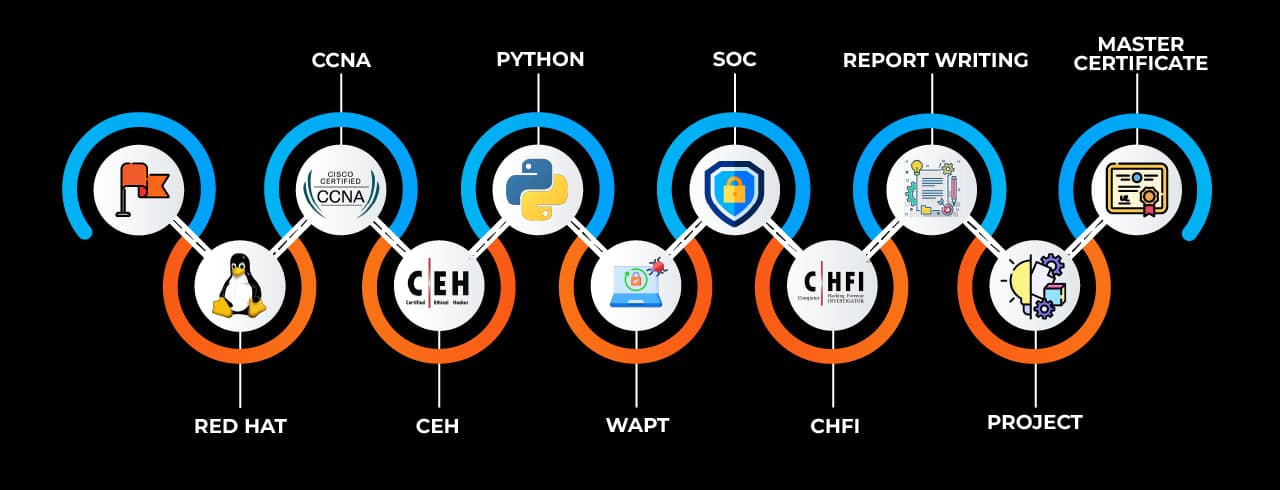
Learning curve for Cyber Security Analyst Program in Wakad

Master In Cyber Security Analyst Program in Wakad Course

OneCourseMultipleRoles

Empower your career with in-demand data skills and open doors to top-tier opportunities.

Security Administrator
Penetration Tester
CyberSecurity Consultant
Security analyst
Security engineer
Security architect

Skills & Tools You'll Learn -

Nmap  iconNmap A network scanning tool used for discovering hosts and services on a network.
Zenmap  iconZenmap If Nmap feels too technical, Zenmap gives a user-friendly interface to make network scanning way easier.
WiFi Hacking Tool iconWiFi Hacking ToolSoftware used for auditing and testing wireless network security.
Metasploit  iconMetasploit A widely used penetration testing framework for exploiting system vulnerabilities.
Ettercap  iconEttercap Want to eavesdrop on a network? Ettercap is great for sniffing traffic and performing man-in-the-middle attacks.
Angry IP Scanner iconAngry IP ScannerA fast and lightweight tool for scanning IP addresses and ports.
NetworkMiner  iconNetworkMiner A network forensic analysis tool for extracting and analyzing packets.
Nessus  iconNessus A vulnerability scanner that helps identify security issues in systems and networks.
Social-Engineer Toolkit (SET) iconSocial-Engineer Toolkit (SET) A tool for simulating social engineering attacks and phishing campaigns.
Hydra  iconHydra A fast brute-force password cracking tool for network authentication protocols.
Hashcat  iconHashcat A password recovery tool used for cracking hashes with GPU acceleration.
Wifite  iconWifite An automated wireless auditing tool for testing WiFi network security.
Mobile Hacking iconMobile HackingTechniques and tools used to test and exploit vulnerabilities in mobile devices.
Kali Linux iconKali LinuxA powerful Linux distribution designed for penetration testing and cybersecurity research.
Burp Suite  iconBurp Suite A web vulnerability scanner and penetration testing toolkit for web applications.
Wireshark  iconWireshark A network protocol analyzer used for capturing and inspecting network traffic.

Why Choose SevenMentor Cyber Security Analyst Program in Wakad

Empowering Careers with Industry-Ready Skills.

Specialized Pocket Friendly Programs as per your requirements

Specialized Pocket Friendly Programs as per your requirements

Live Projects With Hands-on Experience

Live Projects With Hands-on Experience

Corporate Soft-skills & Personality Building Sessions

Corporate Soft-skills & Personality Building Sessions

Digital Online, Classroom, Hybrid Batches

Digital Online, Classroom, Hybrid Batches

Interview Calls Assistance & Mock Sessions

Interview Calls Assistance & Mock Sessions

1:1 Mentorship when required

1:1 Mentorship when required

Industry Experienced Trainers

Industry Experienced Trainers

Class Recordings for Missed Classes

Class Recordings for Missed Classes

1 Year FREE Repeat Option

1 Year FREE Repeat Option

Bonus Resources

Bonus Resources

Curriculum For Cyber Security Analyst Program in Wakad

BATCH SCHEDULE

Cyber Security Analyst Program in Wakad Course

Find Your Perfect Training Session

Nov 8 - Nov 14

1 session
14
Sat
Classroom/ Online
Weekend Batch

Nov 15 - Nov 21

2 sessions
15
Sun
Classroom/ Online
Weekend Batch
16
Mon
Classroom/ Online
Regular Batch

Nov 22 - Nov 28

1 session
23
Mon
Classroom/ Online
Regular Batch

Learning Comes Alive Through Hands-On PROJECTS!

Comprehensive Training Programs Designed to Elevate Your Career

Making a payload for system hacking

Making a payload for system hacking

Setting up a Hacking Lab

Setting up a Hacking Lab

Lab on TryHackMe

Lab on TryHackMe

Set up a networking LAB

Set up a networking LAB

Vulnerability Assessment & Penetration Testing

Vulnerability Assessment & Penetration Testing

No active project selected.

Transform Your Future with Elite Certification

Add Our Training Certificate In Your LinkedIn ProfileLinkedIn

Our industry-relevant certification equips you with essential skills required to succeed in a highly dynamic job market.

Join us and be part of over 50,000 successful certified graduates.

Student 1
Student 2
Student 3
Student 4
Student 5
Join 15,258 others learning today
Certificate Preview

KEY Features that Makes Us Better and Best FIT For You

Expert Trainers

Industry professionals with extensive experience to guide your learning journey.

Comprehensive Curriculum

In-depth courses designed to meet current industry standards and trends.

Hands-on Training

Real-world projects and practical sessions to enhance learning outcomes.

Flexible Schedules

Options for weekday, weekend, and online batches to suit your convenience.

Industry-Recognized Certifications

Globally accepted credentials to boost your career prospects.

State-of-the-Art Infrastructure

Modern facilities and tools for an engaging learning experience.

100% Placement Assistance

Dedicated support to help you secure your dream job.

Affordable Fees

Quality training at competitive prices with flexible payment options.

Lifetime Access to Learning Materials

Revisit course content anytime for continuous learning.

Personalized Attention

Small batch sizes for individualized mentoring and guidance.

Diverse Course Offerings

A wide range of programs in IT, business, design, and more.

Course Content

What Does a Cybersecurity Analyst Actually Do?

Cybersecurity analysts must ensure that all network activities in their organizations are monitored, and any abnormal behavior should be acted upon accordingly. This includes assessment of alerts, investigation of system and network log data, endpoint analysis, identification of vulnerabilities, and incident analysis until an alert is resolved.

Three words that are commonly confused with each other are:

Cybersecurity is the area dealing with the protection of systems, data, and networks.

Ethical hacking is about legally hacking into systems to identify their vulnerabilities before hackers do. SevenMentor provides a distinct ethical hacking course for those interested in following the route.

Security analysis is a defensive and continuous process involving identification, prioritization, and investigation of activities.

The AI-Powered Cyber Security Analyst course in Pashan is the third course. AI is becoming very effective in security operations to prioritize alerts, identify any anomalies in huge volumes of data, perform analysis on threat intelligence, and conduct investigations. Yet, they claim that they do not make any decisions. Any pattern can be used to detect an anomaly in a system login. It is up to a trained cybersecurity analyst to decide if it is the case of a breached user or an employee using the hotel network.

What Technical Skills Will Be Acquired from This Course?

A  cybersecurity analyst training in Pashan is structured into layers, and each layer supports the previous one. The following are the core areas normally involved in this career; you should, however, confirm the current modules from SevenMentor.

The above issues are related to one another in a direct manner. Information about networking will tell you if an influx in traffic is a result of backup operations or data transfer out of the network. Logging will allow you to see all unsuccessful tries to log into the account before you actually manage to log in.

Why Is It Important to Study the Practical Cases of Cybersecurity?

Just the fact that you have learned about the existence of the phishing email does not mean you have analyzed it. This is precisely why SevenMentor focuses on live console lab work, realistic security situations, and troubleshooting instead of focusing solely on the presentation.

Examples of exercises in this training course can be:

  • Analyzing network traffic captured in a safe environment
  • Analyzing suspicious logins
  • Analyzing Windows/Linux system logs
  • Analyzing an insecure configuration
  • Analyzing firewall alerts
  • Analyzing suspicious files/activities
  • Analysis of a potential phishing event

Some of the common tools include Wireshark, Nmap, Kali Linux, Splunk, or Windows Event Viewer etc, but please consult SevenMentor about the tools currently being used by the current batch.

Now, consider how an incident is managed. First, an alert comes in. Next, you gather evidence, which may include logs, timestamps, and the user and device that were affected. You look for certain indicators—perhaps suspicious IP addresses or processes—and determine whether what happened was malicious.

In practice, incidents don't usually fit perfectly into the process. The alert turns out to be a false positive. There are gaps in the logs. The strange behavior of the user can be explained easily. The security product is just incorrectly configured. Tools based on AI can help accelerate the process of triage, but the results have to be verified.

All the practical security tests during this course are conducted in controlled environments.

Who Should Consider Joining Cyber Security Analyst Training?

This program is designed for various people,such as:e

  • College-going students and fresh graduates
  • Newbies interested in cybersecurity
  • IT professionals transitioning into information security
  • Networking professionals and system administrators
  • Technical support engineers
  • Software professionals aspiring to get into security
  • Professional individuals planning a career transition
  • Beginners interested in SOC & security operations

Basic knowledge of computers, networking, and operating systems would ease the initial weeks. Nothing from above needs to be expert level. Beginners can grow progressively from one stage to another: Networking → Linux/Windows → Security concepts → Investigation.

Programming is compulsory? No, it is not necessary to know programming when you are starting an analyst career. But some amount of programming later helps in saving time when performing tasks that require frequent repetitions. So it is a good thing to have, but not a must to begin with. You can seek clarification on your eligibility from SevenMentor.

Students from Pashan, Baner, Aundh, Bavdhan, Sus, University Road, and Kothrud usually look out for the option available in the west part of Pune. Seven mentor-verified centers are located in Shivaji Nagar (head center), Deccan, Pimpri Chinchwad, Akurdi, Hadapsar, Nanded, and Mumbai. Contact us to know more about our centers and batches.

What career options are there following this course?

 Cyber Security Analyst classes in Pashan entry-level jobs start off in the alerting phase and move up from there. These include the following:

  • SOC Analyst (Level 1): The alerts would be monitored, and the initial triaging and escalation of any suspicious activity would be done.
  • Security Monitoring/Security Operations Analyst: Would work at the security operations center monitoring the events and tuning the detection process.
  • Role of Information Security Analyst: The role involves monitoring oecurity controls, adherence to policies, and handling of incidents.
  • Role of Vulnerability Assessment Analyst: Scans, results verification, and prioritization of mitigation actions.
  • Network Security Analyst: Would focus on firewall issues.
  • Incident Response Analyst: works on handling incidents and mitigating their effects.
  • Junior Threat Analyst: performs analysis of the actions and indicators of attacks.
  • Junior Security Consultant: helps perform assessments and recommendations for clients.

Difference between potential candidates is not only about a certificate. Companies want candidates who have practical knowledge, know how to analyze logs, have good networking skills, good report writing skills, and the ability to learn more and more. Normally, one's career starts with monitoring and later expands into threat analysis and incident handling, among other things.

What Salary Can Cybersecurity Professionals Receive in India?

There is a significant variance in salaries. Consequently, consider the numbers mentioned below only as rough estimates, which should be confirmed with existing salary databases.

Role / Experience

Indicative Annual Salary

Fresher / Junior Cyber Security Analyst

₹3–5 LPA

SOC Analyst Level 1

₹3–6 LPA

Cyber Security Analyst (2–4 years)

₹5–9 LPA

Security Operations Analyst

₹5–10 LPA

Experienced Security Analyst (5+ years)

₹8–15+ LPA

Many things affect all of these figures: technical skills and experience, networking and OS knowledge, SIEM experience and monitoring skills, certifications and projects, the organization and the city itself, and your ability to analyze and describe the incident.

Placement assistance at SevenMentor

The placement services offered by SevenMentor include help with placement, mock interviews, interview preparation, practical project exposure, relevant opening guidance, and partner hire introductions. At the institute level, the institute works with over 500 partners in recruitment, but that figure is for the whole institute and not just the cybersecurity domain.

It is more of an assistive role than any sort of guarantee of a placement. In the end, it is going to be up to you to prepare yourself: lab work, experience with projects, explaining the situation, and learning.

Why Choose SevenMentor for Cyber Security Analyst Training in Pashan?

Any individual who looks at a cybersecurity institute located in Pashan or the surrounding areas will realize that most of the  cybersecurity analyst courses in Pashan have similarities. However, the main distinction is in terms of how much of your time is spent doing the practical.

The analyst must be able to describe any abnormal network activity, understand the security message, evaluate any suspicious login activity, and document all the results in such a way that they can be used by another person. This requires practice and not classwork.


Learners can anticipate the following:

  • Training by trainers who have worked in the industry before
  • Live-console sessions
  • Project-oriented teaching
  • Placements, mock interviews, and interview preparations
  • Help for certification
  • Lifetime access to courses
  • Weekday and weekend batches, as per schedule
  • Offline and online facilities, depending on availability at present

SevenMentor, having over 15 years’ experience in IT training and with 100+ courses taught by experts and students being placed in Infosys, Wipro, Tech Mahindra, Bajaj, and ITC through partner firms, has been around for a long time. The institution also pays attention to student feedback and incorporates technological changes in its syllabus accordingly.

Related learning paths include the AWS course for cloud foundations and the Data Analytics course for working with data. Visit the SevenMentor homepage for more.

Frequently Asked Questions

What topics are taught in a cybersecurity analyst course?

Networking, TCP/IP, Linux and Windows Security, Principles of Information Security, Firewalls, Vulnerability Assessment, Threats Detection, Introduction to SOC & SIEM, Endpoint Security, Incident Response, Risk and Policy Management, Cloud Security, and AI-Assisted Security are some topics that are taught in a course like this. You may ask SevenMentor for an updated syllabus as the modules might be different.

Is it possible for a fresher to learn cybersecurity without any IT knowledge?

Yes, although you'll have tobuilde a foundation. Learn about computing and network fundamentals first and then about the operating system and its security fundamentals. Practicing helps in understanding the concept better. Freshers should be good at practice than attending classes.

Is programming required for a cybersecurity analyst?

No. In order to become an analyst, all one needs to do is understand logs and use the security platforms. Programming can come in handy afterwards in order to automate certain tasks.

What tools should be known by the SOC/Security Analyst?

SIEM Platforms, packet analyzers, vulnerability analyzers, and the in-built loggers in Windows and Linux are some of the common ones in the industry. Depending upon your course, different tools may be taught in class. So, please clarify with SevenMentor.

What is the difference between a SOC analyst and a Cyber Security analyst?

SOC Analyst typically takes care of real-time monitoring; alerts, triages, escalations of problems.  The cybersecurity analyst’s job scope might be larger with tasks including investigation, vulnerability analysis, policies creation, and building defenses. Both roles might converge in case of small firms.

What would be the expected salary of a fresher after getting trained in cybersecurity in India?

As an indicative figure, freshers usually expect to get about ₹3–5 LPA, with SOC Level 1 jobs at ₹3–6 LPA. It all depends on your abilities, practical experience, certifications, employer, location, and nothing is assured.

Is Placement Assistance and Certification Assistance Offered by SevenMentor?

Yes, SevenMentor provides placement assistance, mock interviews, and certification assistance. Please contact our team for more information about certifications that you might require for your batch.

Are you ready to kick-start your career in Cyber Security in Pune?

Feel free to reach out to SevenMentor for further details regarding the course contents, schedule of classes, practical training, certifications, placement services, etc. You will also be able to decide if the training should be done offline or online and where your nearest branch is located.

Contact: 020-71173071

Email: support@sevenmentor.com


Frequently Asked Questions

Everything you need to know about our revolutionary job platform

1

Who is qualified for the cyber security course?

Ans:
Eligibility requirements A bachelor's degree in science, engineering, or technology in any discipline with at least 55% in the qualifying tests.
2

What qualifications do cyber security analysts have?

Ans:
Education. A bachelor's degree in computer and information technology, engineering, or math is often required for information security analysts. Some individuals, however, join the workforce with a high school education as well as essential industry training and certificates.
3

Is being a cybersecurity analyst a viable career option?

Ans:
Some jobs have median earnings that reach six figures, and companies are aggressively seeking competent individuals. According to the US Department of Labor, there were over 700,000 vacant cybersecurity positions in the US as of August 2022, and the industry is predicted to rise 32% by 2032.
4

Is cybersecurity a high-paying field?

Ans:
Yes, cybersecurity is a lucrative field. Entry-level jobs might start at $50,000, and wages can rise rapidly with expertise. The highest-paying cybersecurity jobs include Chief Information Security Officer (CISO), cybersecurity manager, security architect, and cloud security specialist.
5

Do you think cybersecurity has a future?

Ans:
The future of cybersecurity is notoriously unpredictable. After all, everything in the sector is always changing. Cyber dangers vary, and the tools that protect against them do as well, changing to better defend increasingly complex networks.
6

Will artificial intelligence (AI) take over cybersecurity?

Ans:
AI is going to become an important component of any organization's cybersecurity activities. It can improve existing security measures and adapt to rapidly changing cyber threats in seconds if it knows what to look for.
7

What exactly are the 5 C's of Cybersecurity - Innovative Networks?

Ans:
In a time when cyberattacks are becoming more frequent and sophisticated, the 5 C's of Cybersecurity—Change, Compliance, Cost, Continuity, and Coverage—offer a complete framework for enterprises to defend their operations.
8

What exactly is the objective of cyber security?

Ans:
A cybersecurity analyst defends an organization's computer systems and networks from threats. They scan networks for security flaws, identify risks, and devise ways to safeguard the organization's data and systems.
9

What is the role of cyber security?

Ans:
Cyber Security Professionals' Roles and Responsibilities At a high level, cybersecurity specialists are in charge of protecting IT infrastructure, edge devices, networks, and data. They are more specifically in charge of avoiding data breaches, as well as monitoring and responding to attacks.
10

What constitutes the four rules governing cyber security?

Ans:
To solve these difficulties, we created the Cybersecurity 4P Framework, a holistic approach to cybersecurity thatfocusess on Planning, Prevention, Protection, and Privacy.
11

Is it premature to switch to safety if you're in your thirties or older?

Ans:
Changing careers in your 30s or later can be scary, but cybersecurity is one field where age does not matter.
12

What is the typical job path for a cyber security analyst?

Ans:
Beginning with security foundations, network protocols, and system monitoring, they advance to intrusion detection, malware analysis, and the use of Security Information and Event Management (SIEM) solutions. Advanced jobs include incident response planning, forensic analysis, and security architecture project management.
13

Is there a strong demand for cybersecurity professionals? Demand is high.

Ans:
As organisations confront more cyber threats and attempt to preserve their precious data, the need for cybersecurity professionals increases.
14

Will artificial intelligence (AI) replace cybersecurity workers?

Ans:
No, AI is not likely to replace cybersecurity workers, but it will alter the nature of their employment. Instead, AI will become a tool for cybersecurity professionals to improve their skills.
15

What elements distinguish cyber security?

Ans:
Enterprise-level cybersecurity features 7 Key Cybersecurity Features to Understand in the New Normal. 1) External threat coverage:... 2) Internal threat defence:... 3) Security regulatory compliance; 4) Cloud-based security services:... 5) Threat identification, prevention, and response:... 6) Consolidated solutions... 7) Proper security analytics.