Introduction
The digital world is rapidly growing, and everybody, including businesses, governments, and people, depends on technology for completing their regular work. From banking to cloud computing to social networking, from digital payments to everything else, there is something to do with the internet. However, although the digital era is very useful for mankind, it does come with a risk of becoming a victim of cyber criminals.
This risk is known as cybersecurity, and nowadays it has become one of the most sought-after fields in the IT industry. Businesses are continuously looking for people who will be able to protect their networks, applications, servers, and any other private data of theirs.
However, cybersecurity is a field that offers countless opportunities to the learners, graduates, IT professionals, and even people who want to change their careers. But starting the journey can prove to be tough due to many different certificates, trainings, and career paths to choose from.
A cybersecurity certificate is a great option through which you will be able to learn some basics and fundamentals of cybersecurity and demonstrate your expertise to employers. In this blog we will discuss the best cybersecurity certifications for beginners and ways to select one.
1. What Are Cybersecurity Certifications?
Cybersecurity certifications are given to people after they have completed some training requirements or taken an examination.
Some of the skills covered in these certifications include:
- Network Security and Infrastructure Protection.
- Ethical Hacking and Penetration Testing.
- Security Monitoring and Threat Detection.
- Risk Management and Information Security.
- Cloud Security and Data Protection.
- Incident Response and Vulnerability Management.
These certifications will help in demonstrating an understanding of basic cyber security concepts. They are also useful to people who want to enter into the cyber security field.
These certifications, however, do not assure a job automatically. Other factors such as experience, expertise, communication, and problem-solving skills are also necessary.
2. Why Are Cybersecurity Certifications Important for Beginners?
To kickstart your career in the field of cybersecurity, you need to acquaint yourself with various technologies and security techniques.
Some of the significant advantages include:
1. Develop Your Technical Skills
The certification programs provide knowledge on all key concepts of cybersecurity, such as firewalls, encryption, authentication, malware, network security, and vulnerability testing.
2. Boost Career Prospects
Most companies take into account industry certification when recruiting people for entry-level cybersecurity jobs.
3. Acquire Practical Skills
Many of the certifications offered have practical activities, simulation settings, and security labs, which help learners comprehend real-life situations.
4. Show Professional Dedication
Getting a certification shows that a candidate is committed to the field of cybersecurity.
5. Develop a Learning Roadmap
Certifications have a structured learning process that helps newbies learn from basics to more complex issues within cybersecurity.
3. Cybersecurity Certifications For Beginners
Several certifications can be earned by people starting their careers in cybersecurity. Some good certifications include.
A. CompTIA Security+
Well-known basic level certificate
- Offered by: CompTIA
- CompTIA Security+ is a well-known certification in the field of cybersecurity which serves as proof of basic cybersecurity knowledge.
- It will suit those people who know something about computers, networks and IT management.
- Major areas of interest include:
- Threats, vulnerabilities and attacks.
- Network security and architecture.
- Identity and access management.
- Cryptography and data protection.
- Security operations and incident response.
- Risk management and security governance.
Who should choose it?
Students, network administrators, system administrators, and IT support professionals who want to move into cybersecurity.
Official website: CompTIA Security+ certification
B. ISC2 Certified in Cybersecurity (CC)
Company: ISC2
ISC2 Certified in Cybersecurity certification is meant specifically for individuals who have recently entered into the cybersecurity field.
Its one major benefit is that there is no prerequisite experience in cybersecurity or cybersecurity degree required.
Topics discussed include:
- Principles of security.
- Risk management and business continuity.
- Access control and identity management.
- Security of networks and clouds.
- Incident response and security operations.
Who should choose it?
For students, new graduates, people who are switching careers, and those who would like to grasp some basics of cybersecurity before obtaining advanced certification.
Official website: ISC2 Certified in Cybersecurity
C. Google Cybersecurity Professional Certificate
Vendor: Google on Coursera
The Google Cybersecurity Professional Certificate is a course designed to teach beginners how to gain cybersecurity knowledge using lessons and hands-on practices.
Topics discussed include:
- Cybersecurity basics.
- Linux operating system.
- Python programming language.
- SQL basics.
- Security Information and Event Management (SIEM).
- Intrusion detection systems.
- Investigations and incident response.
Who should choose it?
Beginners who require online learning under supervision and desire to learn practical skills along with theory.
Official website: Google Cybersecurity Certificate
D. Cisco Certified Support Technician (CCST) Cybersecurity
Vendor: Cisco
Cisco CCST Cybersecurity is a beginner level certification and serves as an introduction to cybersecurity, security operations, and threat protection.
This is especially helpful for those who are inclined towards networking and security operations.
Topics discussed include:
- Subject areas include:
- Security concepts.
- Cybersecurity risks.
- Network security basics.
- Endpoint security.
- Vulnerability analysis.
- Security monitoring and response.
Who should choose it?
Target audience: Students, networking learners, and novices who want to become junior cybersecurity analysts or security operations personnel.
Official website: Cisco CCST Cybersecurity
E. Certified Ethical Hacker (CEH)
Certifying organization: EC-Council
The Certified Ethical Hacker (CEH) certification is among the most famous certifications in the area of ethical hacking and penetration testing. The certification is provided by EC-Council and covers the topics of how attackers detect and exploit the weaknesses in computer systems, networks, and applications.
The CEH certification aims at helping learners learn about hacking from a defensive and authorized security testing point of view.
Main Topics Addressed:
- Introduction to ethical hacking.
- Footprinting and reconnaissance.
- Network scanning and enumeration.
- Vulnerability assessment.
- Hacking systems.
- Malware attacks and assessment.
- Web applications.
- Wireless networks.
- Social engineering.
- Cryptography and penetration testing.
Who should choose it?
People who are students, working IT professionals, network administrators, and cybersecurity enthusiasts interested in ethical hacking, penetration testing, and vulnerability assessment.
Career options:
- Junior Penetration Tester.
- Ethical Hacking Associate.
- Vulnerability Assessment Analyst.
- Security Analyst.
- Information Security Specialist.
Important Note: Novice learners must acquire the basics of networking, Linux, operating systems, and cybersecurity concepts before taking CEH. The practical experience gained in the laboratory will help in making the learning process easier.
Official website: EC-Council Certified Ethical Hacker (CEH)
4. Comparison of Beginner Cybersecurity Certifications
The following table provides a quick comparison of the certifications discussed above.
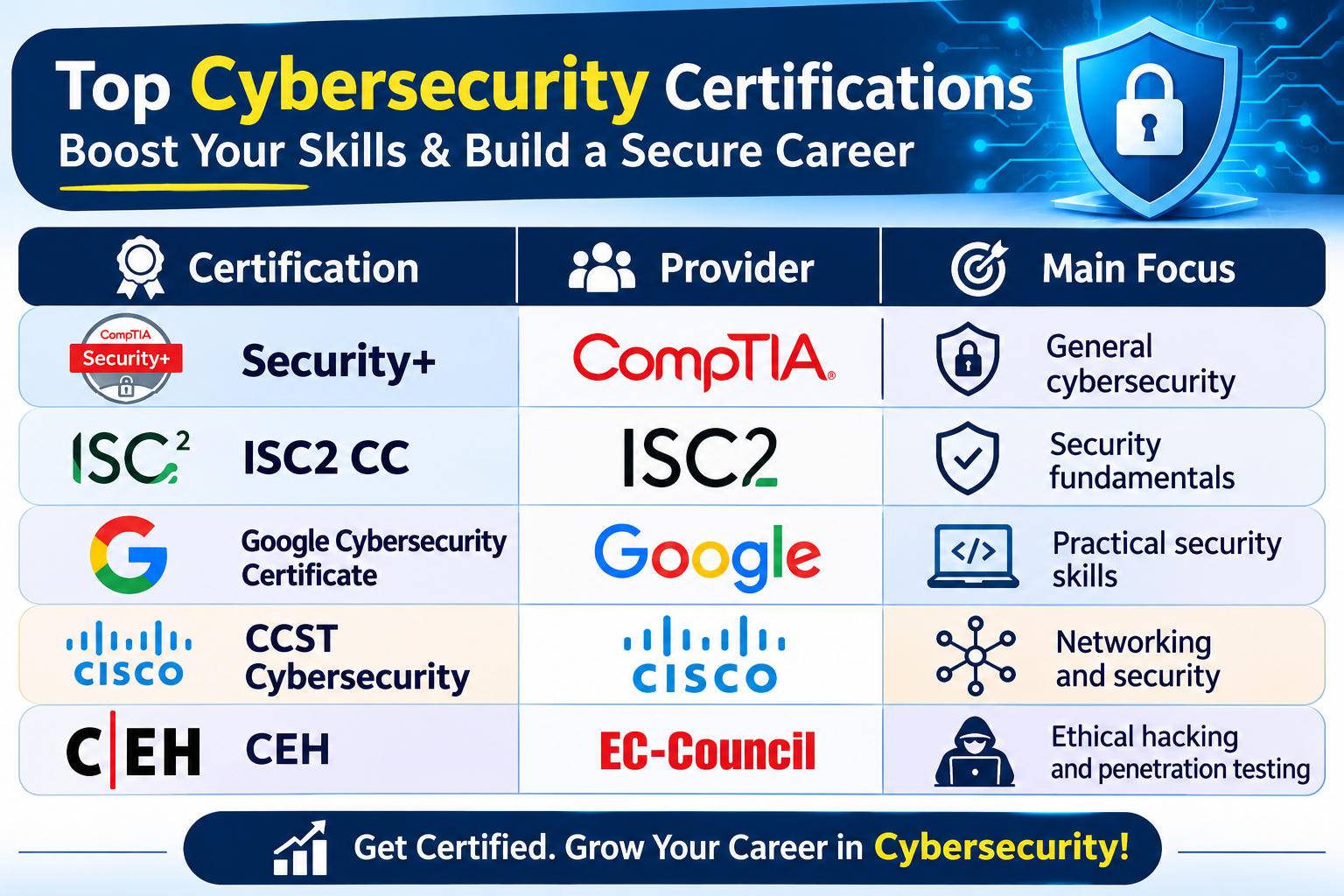
These costs, the tests themselves, and program requirements can vary. Make sure to visit the website of the organization itself before joining.
5. Technical Skills to Learn Before Starting Your Career in Cybersecurity
While certifications are useful, the basics in terms of technical knowledge are very important for beginners.
The following technical skills are some examples:
Networking: Have knowledge of IP address, DNS, DHCP, TCP/IP, ports, protocols, routing, and switching.
Linux Administration: Study Linux commands, Linux file permission, Linux users, Linux services, Linux processes, and Linux system logging.
Windows Administration: Learn about Windows users, basic Active Directory, Windows system management, and event logging in Windows.
Security Basics: Study firewalls, antivirus software, cryptography, authentication methods, access control, and common cyberattacks.
Cloud Computing: Study cloud computing systems like AWS, Microsoft Azure, and Google Cloud, along with their security offerings.
Security Tools: Learn about Wireshark, Nmap, Splunk, and other security tools.
Acquiring these skills will make the process of acquiring these certifications much easier and also help to gain an understanding of the real-world environment of cyber security.
6. Career Opportunities After Completing Cybersecurity Certifications
Once a person acquires basic knowledge and practical experience, there are several job opportunities in cyber security that he/she can pursue. Some of them are:
- SOC Analyst: Detects and analyzes security threats, evaluates and investigates any unusual activity, and detects cyber attacks.
- Junior Security Analyst: Supports in monitoring security, identifying vulnerabilities and securing.
- IT Security Support Technician: Supports in securing and troubleshooting security concerns.
- Network Security Technician: Supports in securing the network infrastructure using firewalls and access controls.
- Vulnerability Management Analyst: Identifies and manages security vulnerabilities.
Candidates should remember that individual job requirements vary. Some positions require prior IT experience, hands-on skills, or additional qualifications.
7. Recommended Learning Roadmap for Beginners
If you are not sure how to start, here is a learning road map for you.
Step 1: Learn IT Basics
Knowledge of computer hardware, operating system, networking, and basic troubleshooting skills.
Step 2: Learn Cybersecurity Basics
Study threats, vulnerabilities, malware, encryption, and cybersecurity basics.
Step 3: Choose Your First Certification
Select ISC2 CC, Google Cybersecurity Certificate, or Cisco CCST Cybersecurity based on your learning needs.
Step 4: Practice Using Security Tools
Utilize Wireshark, Nmap, Linux, and cybersecurity labs for beginners to practice.
Step 5: Engage in Hands-On Projects
Participate in small projects such as analysis of network traffic, log monitoring, vulnerability scanning, and incident response.
Step 6: Get Ready for Career Prospects
Create a technical resume, prepare yourself for interviews, and apply for relevant jobs.
8. Common Mistakes Beginners Should Avoid
- There are common mistakes committed by beginners in cybersecurity. They include:
- Too many certifications: The beginner should practice more rather than acquiring certifications without fully comprehending the concepts.
- Neglecting the importance of networking: This is critical in knowing the threat and attack methods.
- Avoiding practical labs: Books and video learning should be complemented by practical learning through use of approved tools.
- Expecting immediate employment: Although certifications help you to look good, it takes time to acquire experience.
- Advanced certifications: One should start with basic certifications first and then progress to more advanced ones like CISSP and OSCP.
Author: Abhijeet Dhole,
Related Links:
Mastering Python Dictionaries.
Python and SQL Interview Questions.
Do visit our channel: SevenMentor.
Abhijeet Dhole
Expert trainer and consultant at SevenMentor with years of industry experience. Passionate about sharing knowledge and empowering the next generation of tech leaders.