Introduction
Selecting the appropriate frontend framework is one of the major steps when building a Java full-stack application. The most common languages used for the back end are Java, often used in combination with Spring Boot. React and Angular are two frameworks that can be employed for building modern frontends.
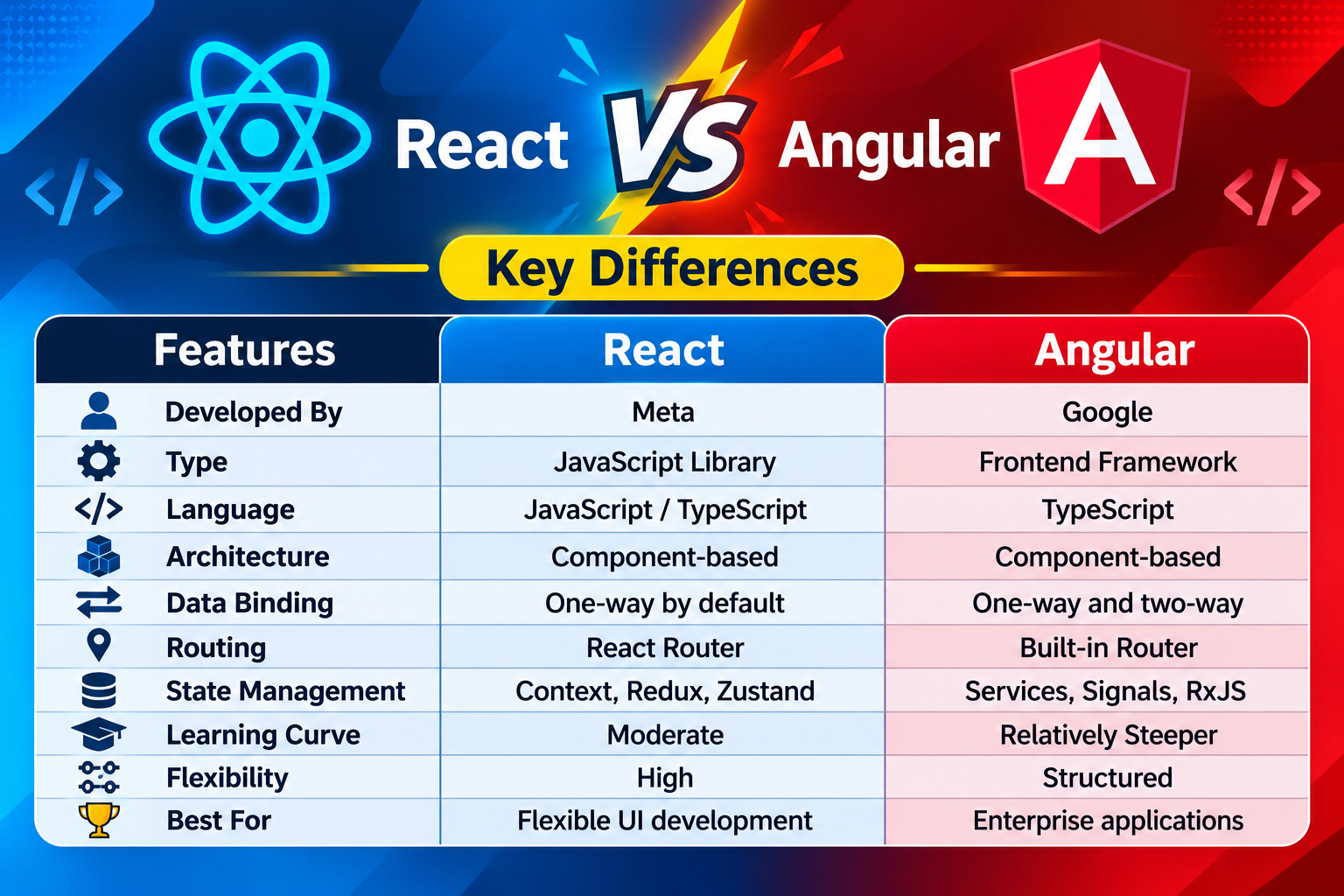
Though both React and Angular can coexist with the Java-based backends, there are significant differences between these frameworks regarding application development, project structure, performance, and maintenance.
This blog will help you to get to know React and Angular for Java full-stack development.
What is React?
React is a JavaScript library created by Meta that is used for creating user interfaces. It is predominantly used for developing interactive frontend applications.
React uses component architecture, enabling software engineers to break down their applications into components.
Key features of React are as follows:
- Component architecture
- Virtual DOM
- Reusable components
- Hooks
- React Router
- Vast third-party libraries ecosystem
React may be considered a suitable framework for applications where software engineers require flexibility in frontend architecture.
What is Angular?
Angular is an open-source JavaScript framework for developing frontend applications created by Google.
Angular offers lots of in-built functionalities as opposed to React, hence reducing the dependency on third-party libraries.
Key Features of Angular are:
- - Component Architecture
- - TypeScript
- - Dependency Injection
- - Angular Router
- - Reactive Forms
- - RxJS Asynchronous Programming
- - In-Built HTTP Client
- - and more.
Angular is popularly used in large applications with structured development.
Angular is popularly used in large applications with structured development.
React with Java Spring Boot Integration
React and Spring Boot can be used in combination to build full-stack applications.
In this case,
- React creates the front end/UI of the application.
- Spring Boot handles all the back-end functionality.
- MySQL/PostgreSQL stores the data related to the application.
- RESTful APIs are used to communicate between React and Spring Boot.
how does it work?
ReactJS + Spring Boot CRUD Full Stack Application - Free Course
- Take, for instance, the Student Management System.
- The data from the student is entered into a React application form.
- React passes the data to a Spring Boot REST API via Axios/Fetch.
- The Spring Boot captures the request by the REST Controller.
- The Service Layer processes the logic of the transaction.
- The Repository Layer interacts with the database.
- The Spring Boot provides the response in JSON format to React.
- React then renders the response to the user.
Example: React API Integration
import axios from "axios";
import { useEffect, useState } from "react";
function Students() {
const [students, setStudents] = useState([]);
useEffect(() => {
axios
.get("http://localhost:8080/api/students")
.then((response) => {
setStudents(response.data);
})
.catch((error) => {
console.log(error);
});
}, []);
return (
<div>
<h2>Student List</h2>
{students.map((student) => (
<p key={student.id}>{student.name}</p>
))}
</div>
);
}
export default Students;
Here, React sends a GET request to the Spring Boot backend and displays the student data received from the API.
Angular with Java Spring Boot Integration
Angular can also integrate with Spring Boot using REST APIs.
The overall architecture is similar to React, but Angular provides built-in tools such as HttpClient, services, and dependency injection.
Angular 12 + Spring Boot CRUD Example
How does it work?
- The user interface is presented by Angular.
- The user inputs data via the Angular form.
- Angular's HttpClient sends an HTTP request to Spring Boot.
- Spring Boot uses the Controller, Service, and Repository components to process the request.
- Backend interacts with the database.
- Spring Boot provides JSON data.
- The response is shown to the user by Angular.
Example: Angular API Integration
First, create a service to communicate with the Spring Boot API.
import { Injectable } from '@angular/core';
import { HttpClient } from '@angular/common/http';
@Injectable({
providedIn: 'root'
})
export class StudentService {
private apiUrl = 'http://localhost:8080/api/students';
constructor(private http: HttpClient) {}
getStudents() {
return this.http.get(this.apiUrl);
}
}
Now, use this service inside an Angular component.
import { Component, OnInit } from '@angular/core';
import { StudentService } from './student.service';
@Component({
selector: 'app-students',
template: `
<h2>Student List</h2>
<p *ngFor="let student of students">
{{ student.name }}
</p>
})
export class StudentsComponent implements OnInit {
students: any[] = [];
constructor(private studentService: StudentService) {}
ngOnInit() {
this.studentService.getStudents().subscribe({
next: (data: any) => {
this.students = data;
},
error: (error) => {
console.log(error);
}
});
}
}
Here, Angular uses HttpClient to communicate with Spring Boot and displays the received student information.
Which One Is Better for Java Full-Stack Development?
There is no doubt that both React and Angular can be used for Java Full-Stack Development. However, the choice will depend on project needs, experience, and complexity of the application.
- Go for React if:
- Flexibility is needed in developing frontend.
- Reusability of components is important.
- Interactive dashboards and applications are to be created.
- Your team uses JavaScript/TypeScript.
- Libraries should be chosen depending on project needs.
Choose Angular when:
- You are building complex enterprise-level apps.
- You would like to adopt a structured development process.
- You want automatic routing, forms, and HTTP services.
- Your team is familiar with TypeScript.
- Your team needs consistent architecture in a big development team.
Career Possibilities in Java Full-Stack Development
Studying Java with React or Angular can provide you many possibilities in software engineering.
A Java full-stack developer must know the technologies used on both sides of the web app.
Key technologies to study are:
Front-end Development
- HTML, CSS, JavaScript
- React JS or Angular
- Bootstrap or Tailwind CSS
- API integration
Back-end Development
- Core Java
- Spring Boot
- Spring MVC
- Spring Security
- REST API development
- Hibernate & JPA
Database
- MySQL
- PostgreSQL
- MongoDB
Tools for Development
- Git and GitHub
- Postman
- Maven
- Docker
- Cloud or AWS Deployment
Author: Sagar Kshirsagar,
Related Links:
Mastering Python Dictionaries.
Python and SQL Interview Questions.
Do visit our channel: SevenMentor.
Sagar Kshirsagar
Expert trainer and consultant at SevenMentor with years of industry experience. Passionate about sharing knowledge and empowering the next generation of tech leaders.