AI Infrastructure and Operations Fundamentals Course
feature-iconMaster Machine Learning, Deep Learning, and AI-Powered Solutions for Real-World Applications
feature-icon Transform Your Future with Expert-Led AI Training at SevenMentor Institute
feature-iconLearn Artificial Intelligence from Industry Experts and Build Scalable AI Solutions

020-71173071

Start Today!

CONSULT WITH OUR ADVISORS

  • Course & Curriculum Details
  • Flexible Learning Options
  • Affordable Learning
  • Enrollment Process
  • Career Guidance
  • Internship Opportunities
  • General Communication
  • Certification Benefits

Request Call Back

Loading...

Learning Curve for AI Infrastructure and Operations Fundamentals
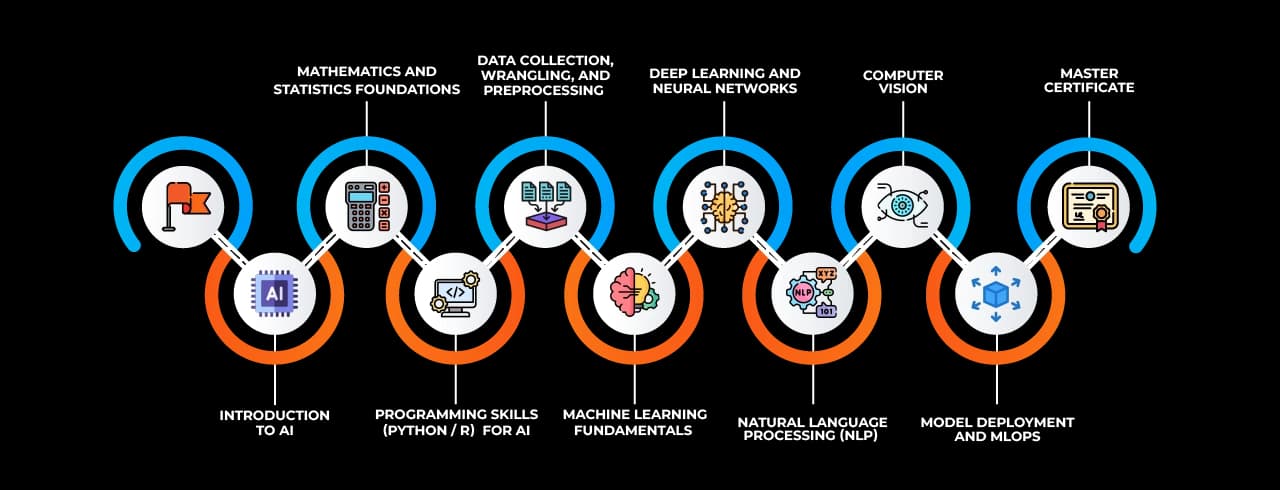
Learning curve for AI Infrastructure and Operations Fundamentals

Master In AI Infrastructure and Operations Fundamentals Course

OneCourseMultipleRoles

Empower your career with in-demand data skills and open doors to top-tier opportunities.

NLP Engineer
MLOps Engineer
DevOps Engineer
Cloud Engineer
AI Researcher
Software Engineer
Java Software Engineer
Machine Learning Engineer
Data Scientist
AI Engineer
Deep Learning Engineer
Business Intelligence Analyst
Data Analyst
Computer Vision Engineer

Skills & Tools You'll Learn -

Programming & Software Development Skills iconProgramming & Software Development SkillsMastering the coding essentials to build and deploy AI applications.
Mathematics and Data Science Foundations iconMathematics and Data Science Foundations Building a strong mathematical and statistical base for AI algorithms.
Data Analysis & Machine Learning   iconData Analysis & Machine Learning Learning to extract insights and build predictive models from data.
Tools for Visualization and Experimentation iconTools for Visualization and ExperimentationEffectively communicating findings and iterating on models.
Deep Learning and Neural Networks iconDeep Learning and Neural NetworksConstructing and training complex neural networks for advanced AI tasks.
NLP iconNLPProcessing and understanding human language for intelligent applications.
Model Deployment and Cloud Computing iconModel Deployment and Cloud ComputingImplementing AI solutions in real-world environments using cloud platforms.

Why Choose SevenMentor AI Infrastructure and Operations Fundamentals

Empowering Careers with Industry-Ready Skills.

Specialized Pocket Friendly Programs as per your requirements

Specialized Pocket Friendly Programs as per your requirements

Live Projects With Hands-on Experience

Live Projects With Hands-on Experience

Corporate Soft-skills & Personality Building Sessions

Corporate Soft-skills & Personality Building Sessions

Digital Online, Classroom, Hybrid Batches

Digital Online, Classroom, Hybrid Batches

Interview Calls Assistance & Mock Sessions

Interview Calls Assistance & Mock Sessions

1:1 Mentorship when required

1:1 Mentorship when required

Industry Experienced Trainers

Industry Experienced Trainers

Class Recordings for Missed Classes

Class Recordings for Missed Classes

1 Year FREE Repeat Option

1 Year FREE Repeat Option

Bonus Resources

Bonus Resources

Curriculum For AI Infrastructure and Operations Fundamentals

BATCH SCHEDULE

AI Infrastructure and Operations Fundamentals Course

Find Your Perfect Training Session

Aug 23 - Aug 29

1 session
29
Sat
Classroom/ Online
Weekend Batch

Aug 30 - Sep 5

2 sessions
30
Sun
Classroom/ Online
Weekend Batch
31
Mon
Classroom/ Online
Regular Batch

Sep 6 - Sep 12

1 session
07
Mon
Classroom/ Online
Regular Batch

Learning Comes Alive Through Hands-On PROJECTS!

Comprehensive Training Programs Designed to Elevate Your Career

Sentiment Analysis on Social Media Data

Sentiment Analysis on Social Media Data

 Image Classification with Convolutional Neural Networks (CNNs)

Image Classification with Convolutional Neural Networks (CNNs)

Customer Churn Prediction Model

Customer Churn Prediction Model

Movie Recommendation System

Movie Recommendation System

Object Detection with YOLO (You Only Look Once) The Object

Object Detection with YOLO (You Only Look Once) The Object

No active project selected.

Transform Your Future with Elite Certification

Add Our Training Certificate In Your LinkedIn ProfileLinkedIn

Our industry-relevant certification equips you with essential skills required to succeed in a highly dynamic job market.

Join us and be part of over 50,000 successful certified graduates.

Student 1
Student 2
Student 3
Student 4
Student 5
Join 15,258 others learning today
Certificate Preview

KEY Features that Makes Us Better and Best FIT For You

Expert Trainers

Industry professionals with extensive experience to guide your learning journey.

Comprehensive Curriculum

In-depth courses designed to meet current industry standards and trends.

Hands-on Training

Real-world projects and practical sessions to enhance learning outcomes.

Flexible Schedules

Options for weekday, weekend, and online batches to suit your convenience.

Industry-Recognized Certifications

Globally accepted credentials to boost your career prospects.

State-of-the-Art Infrastructure

Modern facilities and tools for an engaging learning experience.

100% Placement Assistance

Dedicated support to help you secure your dream job.

Affordable Fees

Quality training at competitive prices with flexible payment options.

Lifetime Access to Learning Materials

Revisit course content anytime for continuous learning.

Personalized Attention

Small batch sizes for individualized mentoring and guidance.

Diverse Course Offerings

A wide range of programs in IT, business, design, and more.

Course Content

What Is the New AI Infrastructure & Operations Ecosystem, and How Does It Become So Valuable So Fast?

We are transitioning to a high-performance AI deployment-focused technology. Large data centers, engineered for web services, standard microservices and static databases, must now support massive compute clusters, distribute computational load and manage specialized accelerators. To meet this challenge, the need for skilled software delivery engineers who also have a deep understanding of related hardware has never been greater. Structured courses in AI Infrastructure and Operations Fundamentals provide students with practical knowledge of high-performance workloads, GPU orchestration, storage and distributed systems.

This material equips students to effectively work between the very raw hardware and final software that runs on the hardware.

  • Compute Acceleration Systems: This topic looks at ways to harness the power of GPUs, TPUs and other specialized hardware that can be used for high-performance parallel deep learning computation.
  • High-Throughput Storage Architectures: Building very low-latency data path stacks for training clusters that feed on huge data sets for their workloads.
  • Distributed Training Clusters: Building multi-node server clusters to train very large language models.
  • Container Orchestration for AI: Learn to run and schedule AI applications in containers with support for data scientists' specific schedulers.
  • MLOps and Continuous Delivery: MLOps practices for automated training, testing, deployment and monitoring of AI models in production environments using CI/CD methods.
  • Cluster Monitoring and Observability: Monitoring of cluster resources, thermal limits, job preemptions and model latency in real time.
  • Cost and Efficiency Optimization on-premises as well as the utilization of cloud resources to minimize operational expenditures.


Why are companies paying top dollar to AI infrastructure specialists?

Just building AI models is hard enough. Running them in production, zero downtime, scale inference cost efficiently, and protecting the computer resources from attacks is an even harder task. Top companies are willing to pay premium rates to top engineering talent to prevent system downtime and to get the best out of their expensive GPU clusters. We provide professional AI infrastructure and operations fundamentals training that will equip you with the practical skills required to deal with these challenges in large enterprises.

There is a very small talent pool of IT engineers that have deep skills in cloud infrastructure, hardware acceleration and complex machine learning data pipelines, and by taking these specialized AI Infrastructure and Operations Fundamentals classes, candidates will be at the center of these high-paying jobs.

  • High Demand vs. Low Talent Supply: Companies are finding it difficult to find IT engineers with experience in cloud computing, hardware acceleration, and machine learning pipelines.
  • High Cost of Hardware Idle Time: If a system goes down or is not using hardware resources efficiently, then that can cost thousands of dollars per hour in idle compute power.
  • Mission-Critical Production Scaling: As companies move their applications to production and continue to run 24/7 for their customers, the skills of a specialized operational engineer are required to scale their applications to necessary levels of performance and availability in production.
  • Rapid Enterprise AI Adoption: Several large enterprises from industries such as healthcare, finance, automotive and retail have recently established dedicated in-house teams of AI infrastructure experts to support their enterprise production applications.
  • Lucrative Career Trajectories: Skills to transition into senior roles of MLOps Engineer, Cloud AI Architect and Systems Operations Director.
  • Future-Proof Skill Longevity: This foundational skill is constantly required, regardless of fluctuations in the use of popular software tools for end consumers.


Why SevenMentor Is the Preferred Choice for IT Career Advancement

SevenMentor Institute is an educational partner that can help learners convert emerging technological trends into high-paying IT jobs. SevenMentor Institute is the premier tech hub that provides learners with practical exposure to learn emerging technological trends through its comprehensive hands-on training program in AI Infrastructure and Operations Fundamentals, to name a few.

  • Industry-Aligned Curriculum: We have designed the curriculum to align with current enterprise requirements, teaching system architecture, MLOps, and containerized application deployment using current industry standards.
  • Dedicated Placement Assistance: Active career guidance for placement in top companies along with interview preparation (scheduling, resume building and practice for mock interviews).
  • High-Tech Laboratory Access: Utilize a cutting-edge high-tech lab consisting of state-of-the-art configured cloud environments and industry-grade high-performance lab configurations to work on hands-on projects without the expense of buying hardware.
  • Expert Mentorship: Expert IT trainers who currently work in enterprise IT deliver hands-on, practical training sessions, providing insights into real-life IT system debugging in enterprise IT environments.


What Technical Core Concepts Are Covered in Modern AI Operations Frameworks?

Managing production AI environments is all about bridging the gap between your hardware and your software for your AI production environment. Because machine learning is different from software in that your models are continuously evolving as you gather more data and fine-tune your models, the way you manage your hardware for your production environment for AI is very different from how you would manage traditional software for production. To get started with managing production AI environments, engineers enroll in top-notch AI Infrastructure and Operations Fundamentals training. They learn how to set up and manage cluster networks, manage model drift, and set up high-performance storage for optimal model performance. They also learn to manage trade-offs between needed computational power and cost to avoid surprise bills and downtime.

Incorporating the various layers of operation in AI infrastructure into the engineer’s skill set allows models that have been successfully tested in a researcher’s notebook to be moved into large-scale enterprise deployment.

  • GPU Virtualization and Partitioning: Virtualize your physical GPUs and run multiple models of smaller size on them at the same time, without wasting resources.
  • Storage Pipeline Architecture: Building high-performance storage and file systems that can deliver large amounts of data to compute nodes.
  • InfiniBand and High-Speed Networking: Support thousands of GPU cores distributed over many nodes and require low-latency and high-bandwidth communication between them.
  • Auto-Scaling Inference Endpoints: Auto-scaling serverless APIs for AI inference and corresponding infrastructure for such APIs on cloud providers.
  • Continuous Monitoring and Model Drift: Monitoring system health, GPU memory usage, latency, and model accuracy in real time via automated dashboards.
  • Security and Compliance Frameworks: This category covers the various security measures and compliance to regulatory requirements in AI computing environments.
  • Automated Recovery from Hardware Failure: Automatic state-checkpointing for long-running training jobs so that in the case of a node failure, the job can automatically and seamlessly restart from the last complete state.


How Does the Newly Launched AI Infrastructure & Operations Compare with DevOps and Cloud Engineering?

This training focuses on the Infrastructure Operations, a subset of DevOps that deals with high-volume data processing and large-scale parallel hardware. The web server handles requests and responses for web applications with very few computing resources required. On the other hand, a neural network pipeline can consist of very heavy data streaming, constant GPU optimization and large storage arrays. Specialized training in AI Infrastructure and Operations Fundamentals enables system administrators and cloud engineers to upscale to managing large AI compute clusters to solve problems at scale.

They gain significant value in being able to solve issues with high compute intensity that are not solved by basic DevOps and cloud management and become a highly valuable asset to any organization.

  • Compute Unit Dynamics: Engineering typically deals with CPU instances (and their utilization), while operating large-scale IT systems consists of managing multiple GPU instances, Tensor Cores, and memory bandwidth in parallel.
  • Resource Cost Scale: Basic web servers usually have a fixed base cost, whereas unmanaged machine learning compute can quickly scale to hundreds of thousands of dollars of operational expenditure.
  • Data Flow Architecture: Standard DevOps deployment pipelines for web applications typically pass static files. Deployment pipelines used to train large ML models will often require the capability to process large data sets (multi-gigabyte training batches) at low latency and high throughput.
  • Deployment Complexity: DevOps typically deploy pre-compiled software packages, whereas AI ops require complex deployment of dynamic model weights, hyperparameter jobs and inference engines.
  • System Testing Protocols: Typical setups are tested by running unit tests and integration tests; machine learning setups are continuously tested for data drift and bias.
  • Career Advancement: Through management of AI compute clusters, you can earn very high salaries (six-figure salary and above) as an Enterprise MLOps Architect and as a Senior Distributed Systems Engineer/Leader.


How does the AI Infrastructure & Operations ecosystem fit into the larger IT Technology ecosystem?

Enterprise technology today is a highly interdependent stack of specialized infrastructure, software engineering, and cloud and data frameworks. Understand how to use targeted AI infrastructure and operations. Fundamentals training to become a powerful compute cluster manager and a knowledgeable contributor to a multidisciplinary IT organization. See how parallel processing relates to backend application development, enterprise platform software and secure data pipelines, delivering real business value from your AI initiatives.

With the cross-functional knowledge of different technologies, a person can become a versatile architect and work with any modern data-driven organization.


Got Questions? Here Are Some FAQs

1. Who should enroll in the AI Infrastructure & Operations course?

This training course is very appropriate for newly graduated IT students, system administrators, DevOps engineers, cloud engineers, software developers, and other IT professionals.

2. Do you need any prerequisites before taking the AI Infrastructure and Operations Fundamentals training course?

The program assumes prior knowledge of Linux shell commands, basic concepts of Networking and Programming in Python. The course progresses from foundational to advanced topics of cluster management.

3. What practical hands-on experience will I gain during training?

Hands-on experience is provided in High-Performance Computing in Cloud and Lab environments including configuration of GPU Clusters, implementation of Containerization using Orchestration tools like Kubernetes, Building of End-to-End MLOps Pipelines, System Telemetry and much more in real-time.

4. How does completing AI Infrastructure and Operations Fundamentals training boost career prospects?

The major challenge in organizations today is to optimize expensive hardware and prevent hardware failures. Specialized knowledge of managing clusters of computers is in short supply. Completing this structured course provides the trained engineer with greater earning potential.

5. What placement support does SevenMentor provide after course completion?

SevenMentor’s team will support you in placements. Support will extend to conducting mock technical interviews with you, preparing of your resume, soft skills training and conducting interviews with hiring partners.

Related Links:

Anthropic AI Tool

What is Writesonic

Career Objectives For Fresher

Resume Tips For Software Developers

Do visit our channel to know more: SevenMentor 


Frequently Asked Questions

Everything you need to know about our revolutionary job platform

1

Will I receive study materials for my AI course?

Ans:
Yes, you will receive recorded sessions, coding assignments, AI projects, downloadable resources, and hands-on exercises to enhance your learning experience.
2

Does the AI course cover advanced topics in artificial intelligence?

Ans:
Absolutely yes, the course covers deep learning, neural networks, natural language processing, computer vision, reinforcement learning, and deploying AI models using TensorFlow and PyTorch.
3

How does SevenMentor Institute support career growth after the AI course?

Ans:
We offer assistance with resume building, interview preparation, networking opportunities, career guidance, and job referrals to help you land lucrative AI positions.
4

What are the eligibility criteria for enrolling in the AI course?

Ans:
The course is available to students, professionals, and tech enthusiasts who have a basic understanding of programming. While prior experience in Python or statistics is helpful, it is not a requirement.
5

What kinds of jobs are available to graduates of the AI course?

Ans:
AI Engineer, Data Scientist, Machine Learning Engineer, NLP Engineer, Computer Vision Specialist, and AI Researcher are just some of the positions for which you can apply.
6

How might obtaining an AI certification aid in advancing your career?

Ans:
Obtaining an AI certification increases your chances of securing well-paying positions in automation, data analysis, and artificial intelligence by proving your proficiency in the field.
7

Is online instruction available for SevenMentor's AI course?

Ans:
Yes, we offer instruction in artificial intelligence in both classroom and online formats, giving professionals and students around the world flexibility to learn.
8

What makes SevenMentor one of the best AI training centers?

Ans:
SevenMentor is renowned for its realistic case studies, industry-aligned curriculum, professional trainers, hands-on AI projects, and robust job placement assistance.
9

Does SevenMentor Institute offer placement assistance for the AI course?

Ans:
Yes, we provide an all-encompassing placement opportunity of 100%, directly associated with job placements, interview training, career counseling, and contacts with top companies in the AI domain.
10

What will the syllabus cover with regard to AI at SevenMentor Institute?

Ans:
Our training syllabus contains machine learning, deep learning, natural language processing, computer vision, reinforcement learning, ethics of AI, and AI deployment methods.
11

Why should I take up AI training at your institute?

Ans:
Learning through live projects, live coding sessions, industry case studies, flexibility in batches, and expert guidance set this institute apart.
12

What tools and technologies will AI students be proficient in?

Ans:
You would learn about the technologies and tools which include TensorFlow, PyTorch, OpenCV, NLTK, Scikit-learn, Pandas, NumPy, and cloud-based AI deployment tools like AWS and Google Cloud.
13

Will there be live projects included in this AI course?

Ans:
Yes, you will work on real-time projects which include image recognition, sentiment analysis, chatbot development, fraud detection, and AI-based automation systems.
14

What teaching methodology for AI training will be adopted at SevenMentor?

Ans:
The course will be taught via practical learning incorporating interactive sessions along with practical cases, coding exercises for coding, AI model making, and challenges on problem-solving.
15

How long does the AI course take?

Ans:
The duration is around 2-6 months, for both full-time and part-time, targeted at both beginners and working professionals.