AI Product Management Course

feature-iconGenerative AI (Generative Artificial Intelligence) refers to a class of AI models that can create new content, such as text, images, audio, video, and even code.
feature-iconUnlike traditional AI, which primarily analyzes and classifies data, generative AI learns patterns from large datasets and generates new, human-like outputs based on that learning.
feature-iconSevenMentor has specialized trainers who educate you on Generative AI
020-71177359

Start Today!

CONSULT WITH OUR ADVISORS

  • Course & Curriculum Details
  • Flexible Learning Options
  • Affordable Learning
  • Enrollment Process
  • Career Guidance
  • Internship Opportunities
  • General Communication
  • Certification Benefits

Request Call Back

Loading...

Learning Curve for AI Product Management
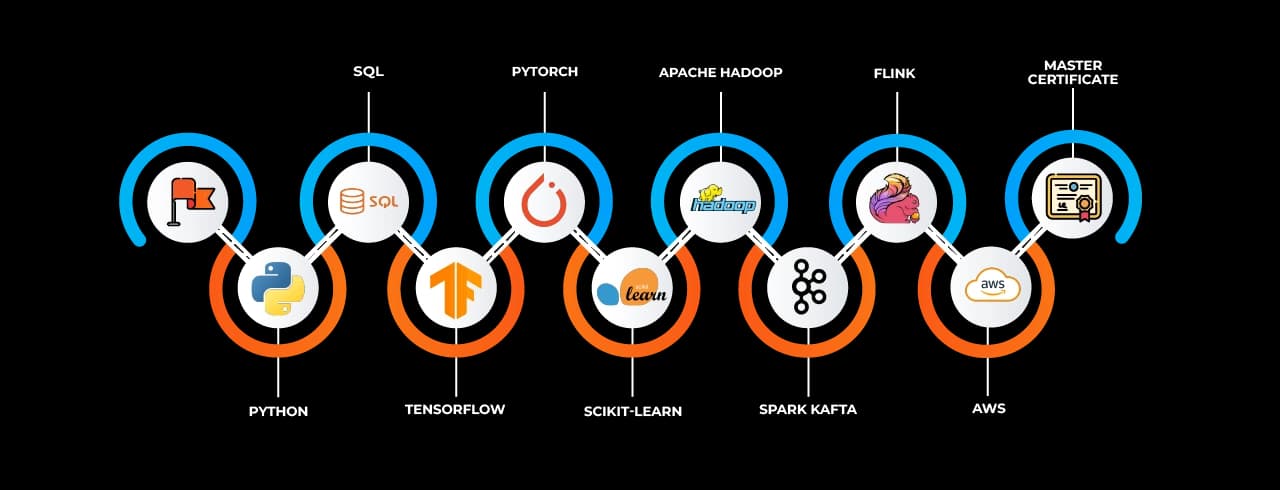
Learning curve for AI Product Management

Master In AI Product Management Course

OneCourseMultipleRoles

Empower your career with in-demand data skills and open doors to top-tier opportunities.

AI Research Scientist
AI Solutions Architect
Product Manager (AI/ML)
Deep Learning Specialist
AI Ethics Consultant
Data Scientist
Machine Learning Engineer
Computer Vision Engineer
NLP Engineer

Skills & Tools You'll Learn -

Pytorch iconPytorchA deep learning framework offering dynamic computation graphs and flexibility.
Microsoft Azure iconMicrosoft AzureExplore cloud computing with Microsoft Azure for hosting, deploying, and managing applications.
Flask iconFlaskFlask
Apache Spark iconApache SparkBig data processing engine for large-scale analytics and real-time processing.
Hadoop  iconHadoop Open-source framework for distributed storage and big data processing.
Docker  iconDocker A containerization platform that enables developers to package, distribute, and run applications in isolated environments.
Kubernetes  iconKubernetes A container orchestration system for automating deployment, scaling, and management of containerized applications.
AWS iconAWSAmazon Web Services, a cloud computing platform offering scalable infrastructure and services.
Kafka  iconKafka (Real-Time Data Streaming) – Enable real-time data ingestion, processing, and streaming with Apache Kafka.
Python  iconPython A versatile programming language widely used for data analysis and modeling.
SQL  iconSQL A database language for querying and managing structured data.
Matplotlib  iconMatplotlib A visualization library for creating charts and graphs.
Seaborn  iconSeaborn An advanced data visualization library built on Matplotlib.
Scikit-learn iconScikit-learnA machine learning library for predictive modeling and analysis.
TensorFlow  iconTensorFlow A framework for building and deploying deep learning models.
Power BI iconPower BIA business intelligence tool for data visualization and reporting.
Tableau  iconTableau A data visualization software for creating interactive dashboards.
FastAPI iconFastAPIA high-performance framework for building APIs in machine learning and AI applications.
Flink iconFlinkA framework for real-time stream and batch processing of data.
Google Cloud iconGoogle CloudA cloud platform providing computing, storage, and AI services.
Keras iconKerasA high-level deep learning API running on TensorFlow.
BERT iconBERTA transformer-based NLP model for contextual understanding of text.
GPT iconGPTA generative AI model for text-based applications like chatbots and content creation.
Hugging Face Transformers iconHugging Face TransformersA library for working with pre-trained NLP models like BERT and GPT.

Why Choose SevenMentor AI Product Management

Empowering Careers with Industry-Ready Skills.

Specialized Pocket Friendly Programs as per your requirements

Specialized Pocket Friendly Programs as per your requirements

Live Projects With Hands-on Experience

Live Projects With Hands-on Experience

Corporate Soft-skills & Personality Building Sessions

Corporate Soft-skills & Personality Building Sessions

Digital Online, Classroom, Hybrid Batches

Digital Online, Classroom, Hybrid Batches

Interview Calls Assistance & Mock Sessions

Interview Calls Assistance & Mock Sessions

1:1 Mentorship when required

1:1 Mentorship when required

Industry Experienced Trainers

Industry Experienced Trainers

Class Recordings for Missed Classes

Class Recordings for Missed Classes

1 Year FREE Repeat Option

1 Year FREE Repeat Option

Bonus Resources

Bonus Resources

Curriculum For AI Product Management

BATCH SCHEDULE

AI Product Management Course

Find Your Perfect Training Session

Aug 9 - Aug 15

1 session
15
Sat
Classroom/ Online
Weekend Batch

Aug 16 - Aug 22

2 sessions
16
Sun
Classroom/ Online
Weekend Batch
17
Mon
Classroom/ Online
Regular Batch

Aug 23 - Aug 29

1 session
24
Mon
Classroom/ Online
Regular Batch

Learning Comes Alive Through Hands-On PROJECTS!

Comprehensive Training Programs Designed to Elevate Your Career

Stock Price Prediction using LSTM:

Stock Price Prediction using LSTM:

Creating a Blog Writing Application (AI-Powered Blog Post)
Creating a Blog Writing Application (AI-Powered Blog Post)

Text Summarization Using NLP

Text Summarization Using NLP

Text Summarization Using LLM:

Text Summarization Using LLM:

Q&A Chatbot

Q&A Chatbot

No active project selected.

Transform Your Future with Elite Certification

Add Our Training Certificate In Your LinkedIn ProfileLinkedIn

Our industry-relevant certification equips you with essential skills required to succeed in a highly dynamic job market.

Join us and be part of over 50,000 successful certified graduates.

Student 1
Student 2
Student 3
Student 4
Student 5
Join 15,258 others learning today
Certificate Preview

KEY Features that Makes Us Better and Best FIT For You

Expert Trainers

Industry professionals with extensive experience to guide your learning journey.

Comprehensive Curriculum

In-depth courses designed to meet current industry standards and trends.

Hands-on Training

Real-world projects and practical sessions to enhance learning outcomes.

Flexible Schedules

Options for weekday, weekend, and online batches to suit your convenience.

Industry-Recognized Certifications

Globally accepted credentials to boost your career prospects.

State-of-the-Art Infrastructure

Modern facilities and tools for an engaging learning experience.

100% Placement Assistance

Dedicated support to help you secure your dream job.

Affordable Fees

Quality training at competitive prices with flexible payment options.

Lifetime Access to Learning Materials

Revisit course content anytime for continuous learning.

Personalized Attention

Small batch sizes for individualized mentoring and guidance.

Diverse Course Offerings

A wide range of programs in IT, business, design, and more.

Course Content

What Exactly is AI Product Management, and Why is the Demand Surging in 2026?

AI-based products create huge challenges for product managers. It used to be that people with a technical background (software development, design) would learn how to manage products. But nowadays, products are built by data scientists and engineers. What’s needed is someone who can bridge the gap between AI technology and customer value. Structured training programs for future AI product manager courses are therefore in high demand. The best AI product manager course  is therefore highly relevant and provides participants with the skills required to turn experimental machine learning models into successful digital products.

The Shift from Rule-Based Logic to Probabilistic Outcomes The way a product manager today creates user stories and defines features for an AI product is vastly different from that of a traditional software product. While a product manager for a traditional software product creates user stories that are based on a set of rules (e.g., if-then statements), a product manager for an AI product creates user stories that are based on probabilistic outcomes (e.g., a model will give a high confidence score to a certain set of input values).

  • Data as a Strategic Product Core: In software applications, data used to be a secondary artifact to the program, stored in a database after the fact. Now in AI-first products, data pipelines, training data and model fine-tuning form the core of the product and whether the end user experience succeeds or not.
  • Integration of Generative Capabilities: Software applications are increasingly incorporating generative AI into product management processes and corresponding workflows. This means that search, automation, and other user interaction features must be reimagined.
  • Unprecedented IT Salary Trajectories: The biggest Tech enterprises and the most Venture-funded startups are paying top dollar for people that can manage the entire lifecycle of an AI product (Collect data in a garage, run product in production, make money from it etc).
  • Ethical & Compliance Guardrails: Understand how to set up data privacy, algorithmic bias, copyright etc. for large enterprise products managed over the product lifecycle.

What Key Skills Are Required to Transition into an AI Product Manager Role?

This does not mean you have to become a Python coder that produces production-ready code for AI projects. However, as a product manager for AI, you will have to have sufficient technical knowledge to discuss with data scientists, ML engineers and architects of the infrastructure department topics that relate to AI projects. Therefore, taking a dedicated ai for product managers course will help you become able to analyze and decide on algorithm trade-offs, interpret results of evaluation of models, and formulate problems of business that can be solved by data science into actions.

  • Problem Formulation & Feasibility Assessment: As an AI PM, you need to determine whether a user problem can be solved with a complex machine learning model or if a simple heuristic or even standard software engineering is sufficient. This saves companies months of engineering effort.
  • Understanding Machine Learning Metrics: Product managers need to be familiar with the following technical evaluation metrics. They can be used to set meaningful performance thresholds for engineering teams. Read more about the following metrics and how they can be used as thresholds for evaluation. Precision, recall, F1-score, and ROC curves.
  • Data Strategy & Pipeline Evaluation: AI PM assesses the data required for new user problems, evaluates the data availability, the current labeling pipelines, feature store design and data governance policies to define a data strategy before writing the feature specifications for the corresponding software engineering tasks.
  • Prompt Engineering & Fine-Tuning Intuition: Know when to use a retrieve-and-generate (RAG) setup (e.g. a T5 + Large Language Model, e.g. LLM, like DALL-E or other specialized use case in a specific industry, e.g. insurance). In addition, understand basic prompt engineering as well as fine-tuning an existing model.
  • Strategic AI PM Career Transition: How to Make a Successful Transition to an AI PM Role by Building a Portfolio of Real-World Examples, PRDsPRDs and Functional Prototypes to Recruiters.
  • Get Industry Recognition: The globally recognized certification for an AI Product Manager allows him/her to prove his/her ability to handle end-to-end deployments of models to potential employers.

How Do Generative AI Models Impact Everyday Product Decisions?

Integrating generative models into applications (both for the end consumer as well as for the enterprise user) is far more complex than just calling an API with a prompt. Product managers must decide between using large foundational models or smaller specialized models. Product managers must also make decisions around cost-per-query as well as around designing interfaces to handle latency. There is a comprehensive ai product manager course that goes through all of these very high-stakes decisions without exhausting the product manager’s engineering budget. Generative AI in product management enables the design of user experiences that are proactive, including summarization, copilots and search that is instant and personal, all of which are accurate and secure.

  • Cost vs. Latency: Choosing between high-parameter models that your company can develop as proprietary software and less complex, open-source models.
  • Designing Failure-Tolerant User Interfaces: Building UIs that are guided by a generative model even when it produces an incomplete response by adding a set of fallbacks to your streaming UI components.
  • Mastering Retrieval-Augmented Generation (RAG): This skill in AI Product Management enables you to set up the data architectures for your enterprise to have the generative models retrieve context from your company knowledge bases only. This prevents the generative models from hallucinating.
  • Controlling Token Economics & Scalability: Estimate the cost of real-time queries at scale, write prompts for systems, and set rate limits to achieve profitable unit economics for millions of requests.

Establishing and maintaining evaluation frameworks that determine whether newly developed generative AI features are safe, private, guarded and compliant before release into the public marketplace.

Unlocking Premium IT Salaries: Why SevenMentor is Your Gateway to High-Growth AI Careers

The IT job market is shifting drastically, and therefore the corporate compensation for IT professionals is being redefined. In particular, very high salaries are being offered to AI experts as well as to product managers who are able to manage and direct the AI projects and also to bridge data science and business growth in order to launch products on the market quickly. The program at SevenMentor positions its participants in the middle of this development in order to give them the technical expertise and the strategic skills that are required by top employers in the IT field.

  • Seize Higher Salary Thresholds for Product Professionals: Rise to the surging market value of highly skilled product professionals who are very familiar with the lifecycle of artificial intelligence/machine learning projects as well as data pipeline construction and prompt framework design.
  • Direct Access to Hiring Corporate Networks: You get to tap into SevenMentor’s established hiring partners, corporate connections, and tech recruiters, all of whom are looking for job-ready product leaders to hire.
  • High-Impact Portfolio Building: Build a high-impact portfolio that helps you get placed in top companies. Your portfolio will be made of product requirements Documents (PRDs), A/B Testing Plans, and Prototype Frameworks that can be put into action quickly.
  • Accelerated Career Trajectory: With expert guidance, move from traditional software roles to highly paid and future-oriented AI leadership roles.

Tailored Career Coaching & Placement Assistance at SevenMentor

In addition to qualifying for your preferred job, thorough preparation, optimal positioning, and relevant network contacts are required to secure your ideal role. To support you in your job search, SevenMentor provides end-to-end placement support in order to enhance your professional profile and establish contacts with top employers. SevenMentor prepares you thoroughly and helps you to enter the job market with full confidence.

  • Personalized Resume & Portfolio Optimization: One-to-one coaching by senior career strategists to showcase your AI projects, skills and achievements as a future product manager effectively.
  • Simulated Product Leadership Interviews: Product Design Interviews, Technical Architecture Trade-off Interviews, Analytical Thinking Interviews, and Behavioral Interviews for Leadership Roles.
  • Dedicated Corporate Placement Cell: SevenMentor is proactive in referring jobs, arranging interviews and placing companies for recruitment drives.
  • Ongoing Career Guidance: Guidance and advice on your job search by your mentors until you get your ideal job as a product manager.

Integration with Other IT Courses

Web development skills can be enhanced by combining them with other in-demand technologies. Many training institutes, including SevenMentor, offer integrated learning paths with courses such as

Learning these technologies can complement your learning of web development and greatly enhance your career prospects.

Got Questions? Here Are Some FAQs

1. Do I need a coding or data science background to join this course?

No, prior knowledge of programming or data science is not required for this course.This course is meant for professionals, product managers, and other tech enthusiasts to learn to strategize, manage and develop AI products.

2. How does an AI product manager role differ from a traditional IT product manager role?

A traditional IT Product Manager role typically focuses on managing the release of fixed-logic, rule-based software products. In contrast, the role of an AI Product Manager is to manage the development and release of probabilistic systems that are used to make decisions with the aid of vast amounts of data.

3. What kind of certification will I receive after completing the training?

Upon completion of the AI Training Program and completion of the practical projects done by students as part of courseware, an Industry recognized Certification will be issued by SevenMentor to make the student Experts in Strategy for AI Product Lifecycles.

4. Are live online classes available for working professionals?

SevenMentor supports flexible learning, enabling working professionals to attend live interactive online sessions as well as attend weekend batches, in order to ensure that full-time students are also able to attend.

5. How does SevenMentor assist with job placements after course completion?

SevenMentor is dedicated to placement support for students. Support Services: 1-on-1 Resume support, Portfolio review and support, Mock interviews for technical and product roles, Career counseling for individual students and Job referrals through SevenMentor hiring network.

6. What real-world projects will I work on during the program?

This training includes doing practical capstone projects of writing comprehensive PRDs for generative AI features, designing search products using RAG, building model evaluation plans, and end to end data pipelines for Enterprise Software Applications.

Related Links:

Anthropic AI Tool

What is Writesonic

Career Objectives For Fresher

Resume Tips For Software Developers

Do visit our channel to know more: SevenMentor 

Frequently Asked Questions

Everything you need to know about our revolutionary job platform

1

What is an AI Architect Course and Who Should Take it?

Ans:
The AI Architect Course is a 6-month training program designed for tech professionals such as software developers, data scientists, cloud engineers, and technical team leads who wish to transition into solution architecture roles (sometimes referred to as enterprise architects) to earn higher salaries.
2

How does earning an ai architect certification boost my tech salary?

Ans:
The value of an AI Architect Certification lies in the fact that it proves that the certified holder is able to manage complex intelligent end-to-end systems. Hence, certified solution architects have much higher salaries than software developers, as they are major factors in determining company strategy and RoI in operations.
3

Do I need prior coding experience to take an ai in architecture course?

Ans:
B. Prior knowledge required for the course (Architectural Logic to Advanced AI Architectures)?
4

What tools and frameworks are covered in an ai solution architect certification program?

Ans:
Hands on experience with Industry leading Tools & Frameworks. We use Python, PyTorch, TensorFlow, LangChain, vector databases (Pinecone), Docker, Kubernetes and cloud AI infrastructure on AWS and Google Cloud platforms.
5

How does SevenMentor assist with job placements after completing the course?

Ans:
SevenMentor supports students to get placed in top MNCs and start-ups in the country through various placement activities like helping students in writing resumes and helping in communication grooming through mock interviews including technical round of White Board type in MNCs for job placements.
6

What sets SevenMentor apart from other training centers?

Ans:
SevenMentor training centers offer a highly interactive, corporate style, workshop style of training. Senior technology professionals with hands-on experience of managing live enterprise systems conduct classes. We have small batch sizes to ensure that each student receives one-to-one attention, has the opportunity to go through real-life projects and have aggressive placement drive in place to assist students in obtaining jobs of their choice.