Backend Engineering Course in Pune

feature-iconBecome a Job-Ready Data Engineer with Hands-On Projects
feature-iconMaster Data Engineering with Real-World Applications at SevenMentor Institute
feature-iconBuild Scalable, High-Performance Data Pipelines with Expert Training

020-71177359

Start Today!

CONSULT WITH OUR ADVISORS

  • Course & Curriculum Details
  • Flexible Learning Options
  • Affordable Learning
  • Enrollment Process
  • Career Guidance
  • Internship Opportunities
  • General Communication
  • Certification Benefits

Request Call Back

Loading...

Learning Curve for Backend Engineering
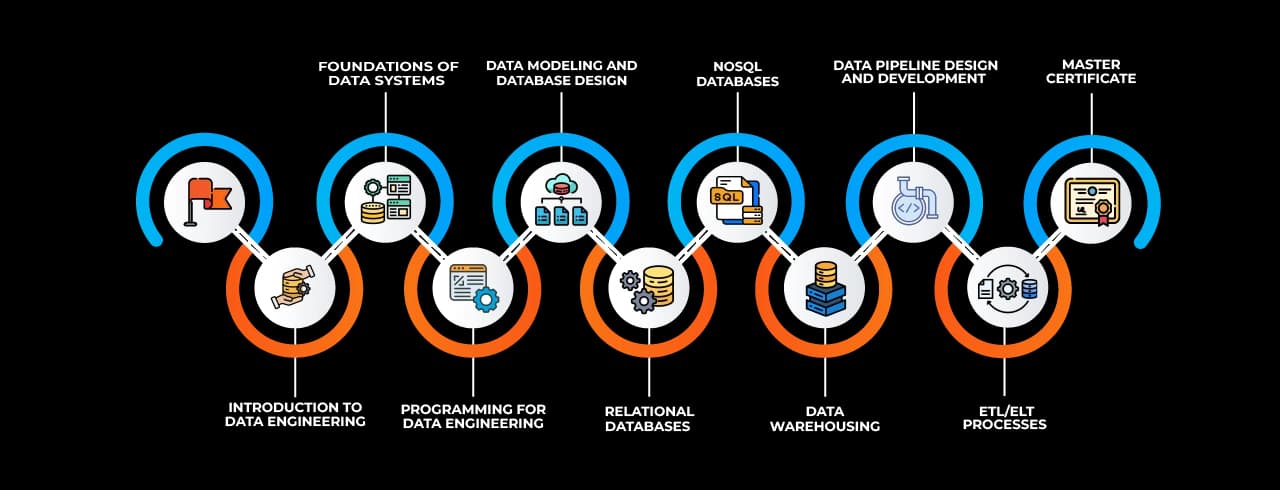
Learning curve for Backend Engineering

Master In Backend Engineering Course

OneCourseMultipleRoles

Empower your career with in-demand data skills and open doors to top-tier opportunities.

Data Engineer
Big Data Engineer
ETL Developer
Cloud Data Engineer
Machine Learning Engineer
Data Architect
Database Administrator (DBA)
Data Warehouse Engineer
Business Intelligence (BI) Engineer
Data Pipeline Engineer
Analytics Engineer
AI Data Engineer

Skills & Tools You'll Learn -

SQL & Database Management  iconSQL & Database Management (Relational & NoSQL Databases) – Design, manage, and optimize structured and unstructured databases for efficient data storage and retrieval.
Data Warehousing iconData Warehousing(ETL, ELT, Data Lakes) – Build scalable data warehouses and lakes using ETL/ELT pipelines to consolidate and analyze large datasets.
Big Data Processing (Hadoop, Spark) iconBig Data Processing (Hadoop, Spark)Process and analyze massive datasets efficiently with distributed computing frameworks like Hadoop and Apache Spark.
Cloud Platforms (AWS)  iconCloud Platforms (AWS) Leverage cloud-based services to store, process, and manage data at scale with AWS infrastructure.
Data Modeling & Schema Design iconData Modeling & Schema DesignDevelop optimized data models and schemas to ensure seamless data organization, integrity, and performance.
Programming Languages iconProgramming Languages(Python, Java, Scala) – Utilize programming languages for data manipulation, processing, and pipeline development.
Data Pipeline Orchestration iconData Pipeline Orchestration(Apache Airflow) – Automate, schedule, and monitor complex data workflows using Apache Airflow.
Data Governance & Security iconData Governance & Security (Data Privacy, Compliance) – Implement data security, privacy policies, and compliance measures to protect sensitive information.
Tools & Technologies iconTools & TechnologiesApache Spark (Batch & Stream Processing) – Perform high-speed batch and real-time data processing with Apache Spark.
Kafka  iconKafka (Real-Time Data Streaming) – Enable real-time data ingestion, processing, and streaming with Apache Kafka.
AWS Data Services  iconAWS Data Services (S3, Redshift, Glue, Kinesis) – Store, transform, and analyze large datasets using AWS cloud data services.
ETL Tools iconETL Tools(Informatica, Talend, dbt) – Automate and streamline data extraction, transformation, and loading processes for analytics.
Containerization & Orchestration (Docker) iconContainerization & Orchestration (Docker)Deploy and manage scalable, containerized data applications with Docker.
BI & Visualization Tools iconBI & Visualization Tools(Power BI, Tableau) – Create interactive dashboards and reports to extract insights from data visually.

Why Choose SevenMentor Backend Engineering

Empowering Careers with Industry-Ready Skills.

Specialized Pocket Friendly Programs as per your requirements

Specialized Pocket Friendly Programs as per your requirements

Live Projects With Hands-on Experience

Live Projects With Hands-on Experience

Corporate Soft-skills & Personality Building Sessions

Corporate Soft-skills & Personality Building Sessions

Digital Online, Classroom, Hybrid Batches

Digital Online, Classroom, Hybrid Batches

Interview Calls Assistance & Mock Sessions

Interview Calls Assistance & Mock Sessions

1:1 Mentorship when required

1:1 Mentorship when required

Industry Experienced Trainers

Industry Experienced Trainers

Class Recordings for Missed Classes

Class Recordings for Missed Classes

1 Year FREE Repeat Option

1 Year FREE Repeat Option

Bonus Resources

Bonus Resources

Curriculum For Backend Engineering

BATCH SCHEDULE

Backend Engineering Course

Find Your Perfect Training Session

Aug 23 - Aug 29

1 session
29
Sat
Classroom/ Online
Weekend Batch

Aug 30 - Sep 5

2 sessions
30
Sun
Classroom/ Online
Weekend Batch
31
Mon
Classroom/ Online
Regular Batch

Sep 6 - Sep 12

1 session
07
Mon
Classroom/ Online
Regular Batch

Learning Comes Alive Through Hands-On PROJECTS!

Comprehensive Training Programs Designed to Elevate Your Career

Data Pipeline for Sales Data Processing

Data Pipeline for Sales Data Processing

Real-Time Stock Price Data Ingestion

Real-Time Stock Price Data Ingestion

Customer Data Warehouse

Customer Data Warehouse

Log Data Processing System

Log Data Processing System

Cloud-Based ETL Pipeline for E-commerce Data

Cloud-Based ETL Pipeline for E-commerce Data

No active project selected.

Transform Your Future with Elite Certification

Add Our Training Certificate In Your LinkedIn ProfileLinkedIn

Our industry-relevant certification equips you with essential skills required to succeed in a highly dynamic job market.

Join us and be part of over 50,000 successful certified graduates.

Student 1
Student 2
Student 3
Student 4
Student 5
Join 15,258 others learning today
Certificate Preview

KEY Features that Makes Us Better and Best FIT For You

Expert Trainers

Industry professionals with extensive experience to guide your learning journey.

Comprehensive Curriculum

In-depth courses designed to meet current industry standards and trends.

Hands-on Training

Real-world projects and practical sessions to enhance learning outcomes.

Flexible Schedules

Options for weekday, weekend, and online batches to suit your convenience.

Industry-Recognized Certifications

Globally accepted credentials to boost your career prospects.

State-of-the-Art Infrastructure

Modern facilities and tools for an engaging learning experience.

100% Placement Assistance

Dedicated support to help you secure your dream job.

Affordable Fees

Quality training at competitive prices with flexible payment options.

Lifetime Access to Learning Materials

Revisit course content anytime for continuous learning.

Personalized Attention

Small batch sizes for individualized mentoring and guidance.

Diverse Course Offerings

A wide range of programs in IT, business, design, and more.

Course Content

What Does a Backend Engineer Actually Do, and Why Is the Role in High Demand?

Front-end developers design the user interface and user experience (UI/UX) of web or mobile applications, while back-end developers design the “engine” of an application in terms of data architecture, APIs, servers and security. As an example, when a customer places an order on an e-commerce website, processes an online transaction, or plays a high-definition online video, a complex back-end system deals with all database transactions, API calls and server load management.

For students and developers new to the field of server-side development, Fundamentals of Backend Engineering classes are a perfect starting point to learn how to design a robust backend. Backend engineering classes in Pune for students and working professionals can equip them with skills to write scripts that grow to become production-ready software that can handle a flood of traffic to your application. The curriculum for the backend engineering course in Pune is industry-centric and is designed to provide in-depth knowledge to students and working professionals to learn how to design a backend for any application.

Key technical responsibilities you master during professional backend training:

  • Programming Languages, Server-side Programming & API Structure: Developing the back-end server that would support the front-end application. The procedure is going to include programming through languages like Java, Python, and Node.js as well as developing APIs, including RESTful APIs and GraphQL APIs.
  • Databases and Schema Design: Schema design for relational databases like PostgreSQL and MySQL and non-relational databases like MongoDB and developing SQL queries for the above databases.
  • Designing of System and Scalability: Gaining skills on how to design scalable systems that can run effectively in case of high traffic and gaining knowledge of caching (Redis) and concurrency.
  • Security & Authentication: Protecting your web application from all kinds of threats using different kinds of security methods such as JSON Web Token authentication, OAuth, HTTPS Security, etc.
  • DevOps & Cloud Deployments: Executing your backend applications using containerization (Docker, Kubernetes) on cloud-based services like Amazon Web Services, Microsoft Azure, and more.


Which Key Skills and Technologies Will You Learn With a Backend Course?

Get familiar with the current state of the backend engineering ecosystem—including many frameworks, databases and design patterns. Learning about data flow in a complex infrastructure to build secure and efficient applications in production environments is key for modern industry roles. Fundamentals of Backend Engineering training in Pune help to break down layers of technical complexity in a systematic way.

We offer backend engineering training, which is a mix of hands-on lab and end-to-end learning experience delivered in a classroom setting or online. The backend engineering training is best suited for working professionals as well as remote students, as this interactive online training is conducted by experienced instructors who help participants develop and build enterprise-ready applications and projects in backend engineering.

Core skill domains covered in standard backend curricula:

  • Frameworks for Programming: You will be introduced to some of the most widely used frameworks that are used for developing robust server-side applications, such as Java Spring Boot, Node.js with the help of the Express framework, and Python along with the Django and FastAPI frameworks, and .NET Core framework.
  • Design of Databases: Database design using SQL and NoSQL with the help of document stores and Object Relation Mapping (ORM) such as Hibernate or Prisma for rapid development.
  • Code Versioning and CI/CD Pipeline: Code version control with the use of Git and GitHub flow.
  • Code Versioning and CI/CD Pipeline: Codebase management using Git and working with GitHub flows. Automated testing to keep your codebase clean.
  • API Development & Documentation: Know about the way to develop and test RESTful endpoint security. Know about the way to document your API specifications using Swagger/OpenAPI and how to test your APIs with Postman.
  • Cloud Computing and Containers: Get an idea about the basics of backend service containerization with Docker and backend application deployment in the cloud computing environment like AWS and Azure.


What Salary Packages and career opportunities can you Expect as a Backend Developer in Pune?

Pune is one of India’s leading IT cities, home to major IT hubs in Hinjewadi, Kharadi and Baner. A digital product needs a strong backend architecture to handle loads of traffic, hence, companies invest heavily in the skills of the backend developers. A Backend Engineering Course in Pune is a gateway to best product companies, SaaS companies, GCCs (Global Capability Centers), and many more tech startups in the city.

For freshers entering the workforce, they can expect competitive CTCs in the range of ₹4.5 LPA to ₹8 LPA, while mid-level professionals, who can design and architect systems to deploy in microservices architecture on the cloud, command premiums in the range of ₹10 LPA – ₹18 LPA. For senior backend engineers who can design, optimize, and manage complex systems and architectures for large enterprises, compensation can increase up to ₹35+ LPA. The Fundamentals of Backend Engineering training program in Pune is designed to impart the right set of skills to a candidate, which can be put to test during technical code reviews and system design interviews with hiring managers at product companies, startups, and SaaS firms. The online backend engineering training program in Pune is best suited for working professionals who can upskill and get promoted within their current organizations or switch to better-paying jobs within short durations.

Expected compensation benchmarks and career trajectories in the local market:

  • Backend Developer Entry Level (0-2 Years): Rs. 4.5 LPA - Rs. 8 LPA (average salary) / Rs. 12 LPA (maximum salary for excellent project experience).
  • Backend Developer Mid Level (3-5 Years): Salary is Rs.
  • 10 LPA – Rs. 18 LPA. At this level, you own the database performance, design microservices, and API optimization.
  • Backend Developer / Lead Developer (5-8 Years): The experienced backend engineers with the skills of working with distributed systems, load balancing and cloud deployment can get up to ₹20 LPA to ₹35+ LPA.
  • Architect/Engineering Manager (8+ Years): The senior backend developers who move on to become backend system architects will earn above ₹40 LPA.
  • Highest Paying Industries in Pune: Fintech platforms, enterprise SaaS, e-commerce platforms, Health-tech systems, and automotive IoT companies.


How Do You Build a Job-Ready Portfolio and Pass Tough Backend System Design Interviews?

To get into the backend development, one needs more than just knowledge about the backend in general; to get hired as a backend developer, one needs to prove that one can write functional code and solve problems. Fundamentals of Backend Engineering classes in Pune, for example, will give you the insight into what production bugs look like, how edge cases are dealt with, and what architecture trade-offs are made for. The proof of work, your portfolio, will always trump your resume, filled with words of your skills, and consist of active GitHub repositories, deployed APIs and optimized databases.

These Projects Help You Answer Hard Development & System Design Questions: Such questions deal with issues like thread safety, database indexing, and lots of other caching strategies. Also, some very hard development questions, dealing with hard-to-debug problems in large applications, i.e., problems that need to be solved in live coding rounds, and other problems that need to be solved on a whiteboard while describing in detail the designed architecture to a potential employer.

Key steps to creating a standout backend portfolio and clearing interviews:

  • Build Real-World Microservices Projects: Start creating projects like food delivery backend, payment gateway integration or real-time chat service with WebSockets.
  • Code Documentation & Containerization: Make sure your clean code is properly documented and kept in GitHub repositories, include API testing in the Postman API collection, and write Dockerfiles to make development environment setup faster.
  • Develop Skills in Systems Design: Get better at systems Design concepts, scale up and use Systems From Scratch to practice load balancers, database sharding, and message queues like Kafka & RabbitMQ and also Redis for caching.
  • Code Optimization and Edge Case Handling: In order to prove that you are an experienced programmer, try to write code that works fast and scales up easily. Focus on improving the queries that impact the speed of your database operations to work to their fullest potential. Moreover, try to reach the maximum capacity of your API requests without encountering any problem. Lastly, try to develop a highly safe authentication system that does not have any loophole, such as saving the token in an extremely unsafe location.
  • Prepare for Live Whiteboard Coding Assessment: Get ready to solve DSA problems in your programming language.


Why Should You Choose SevenMentor to Fast-Track Your Backend Career in Pune?

In order to switch to a tech job that pays well, it is very important to choose the right learning platform. I have chosen SevenMentor to help me become a backend engineer as it is one of the premier institutes that helps develop software developers into backend engineers through practical learning assisted by mentors.

  • Industry-Aligned Curriculum: Updated curriculum map aligning with current industry hiring standards for Java Spring Boot, Node.js, Python and cloud-native backend software applications.
  • 100% Practical Exposure: Students learn to develop large-scale enterprise-level backend applications in real-time dev environments rather than going through static slides and studying theory from non-practical books.
  • Expert Technical Mentors: SevenMentor has a team of expert technical mentors comprising software architects & senior backend engineers with vast experience working in large corporate environments.
  • Flexible Learning Formats: We offer the option of an immersive in-classroom bootcamp or a highly engaging online class, designed for students as well as working professionals.
  • End-to-End Career Coaching: SevenMentor’s dedicated placement teams take students through mock technical interviews and system design tests. They also help build resumes and help build a portfolio on GitHub.


What Complementary Tech Stack Skills Are Essential for Modern Backend Engineering Excellence?

While having skills in server-side programming is at the core of a backend engineer’s role, high performing backend engineers exist in a larger digital ecosystem. A modern web application is comprised of many services, including analytics services hosted on cloud servers, AI powered microservices and enterprise management frameworks, all working together as an integrated system. Having expertise in adjacent domains can make one highly versatile as a server-side engineer.


Got Questions? Here Are Some FAQs

Q1: What is the prerequisite for taking the Backend Engineering course in Pune?

Basics of programming knowledge are good to have, but nothing too advanced is necessary. We start with the basic concepts of the backend engineering course and then proceed to teaching API design, databases and system architecture.

Q2: Can non-IT graduates transition into backend development through this course? 

Yes. The course is well-structured and starts from scratch, moving from basic concepts of coding to backend application development, making it a perfect choice for people switching careers.

Q3: Is Online Class Good for Learning Backend Engineering to Teach Non-IT Persons? 

 Yes, we have delivered backend engineering classes to many non IT persons in remote locations across world using online classes. Online class at SevenMentor for backend engineering is Live, Interactive, Hands-on with screen share and labs and doubt clearing session in real time.

Q4: What tools and frameworks I will learn in Backend Engineering training in Pune?

 Ans: We have hands-on training using tools like Node.js, Java Spring Boot, Python, SQL/NoSQL databases, Git, Docker, Postman and also learn to host application on cloud hosting platforms.

Q5: How will SevenMentor assist with placement after the Backend Engineering training? 

SevenMentor will assist students with finding Backend Engineering jobs by helping to optimize resumes, creating a portfolio of work, running through mock technical interviews as well as scheduling real interviews with hiring companies.

Related Links:

Anthropic AI Tool

What is Writesonic

Career Objectives For Fresher

Resume Tips For Software Developers

Do visit our channel to know more: SevenMentor 

Frequently Asked Questions

Everything you need to know about our revolutionary job platform

1

What are the prerequisites for enrolling in this course?

Ans:
While there are no strict prerequisites, having a basic understanding of programming, SQL, and databases can be helpful. However, even beginners can join, as we cover everything from the ground up.
2

Why should I take Data Engineering training at SevenMentor instead of learning on my own?

Ans:
Self-learning can be overwhelming due to the wide range of tools and technologies involved. At SevenMentor, you benefit from structured learning, expert guidance, hands-on projects, and job placement support—all in one place.
3

What tools and technologies will I learn in this course?

Ans:
You will gain expertise in SQL, Python, Apache Spark, Hadoop, AWS (S3, Redshift, Glue, Kinesis), Kafka, Airflow, Data Warehousing, ETL processes, and BI tools like Power BI and Tableau.
4

What teaching approach does SevenMentor follow for Data Engineering training?

Ans:
Our training includes instructor-led sessions, hands-on labs, real-world case studies, project-based learning, and practical exercises to help you master data engineering concepts effectively.
5

Does this course include cloud-based data engineering training?

Ans:
Yes! You’ll learn how to work with cloud platforms like AWS, focusing on data storage, processing, and pipeline orchestration using cloud-native tools.
6

What makes SevenMentor one of the best training institutes for Data Engineering?

Ans:
We offer an industry-focused curriculum, hands-on practical training, expert mentors, real-world projects, flexible learning options, and strong job placement assistance.
7

How long does it take to complete the Data Engineering training?

Ans:
The program typically takes 3 to 6 months, depending on whether you choose a full-time or part-time learning schedule.
8

Does SevenMentor provide placement assistance for this course?

Ans:
Yes, we offer 100% placement assistance, including resume building, interview preparation, career guidance, and job referrals to top tech companies.
9

Will I work on real-world projects during the training?

Ans:
Absolutely! You will develop end-to-end data pipelines, work with big data processing frameworks, implement ETL workflows, and gain hands-on experience with cloud-based data engineering.
10

Is this training available online, or do I have to attend classroom sessions?

Ans:
We provide both online and classroom training options, allowing you to choose the mode that best fits your schedule and learning preferences.
11

What career opportunities are available after completing this Data Engineering course?

Ans:
You can apply for roles such as Data Engineer, Big Data Engineer, Cloud Data Engineer, ETL Developer, Data Architect, and Machine Learning Engineer in leading tech companies.
12

Will I receive course-related study materials?

Ans:
Yes! You’ll get access to video lectures, study materials, coding exercises, project resources, and hands-on assignments to enhance your learning experience.
13

Is this Data Engineering course suitable for beginners, or does it cover advanced topics?

Ans:
The course starts with foundational concepts and gradually moves to advanced topics like Big Data Processing, Cloud Data Pipelines, Streaming Data, Data Warehousing, and Security Best Practices to ensure comprehensive learning.