Why Is Blockchain Technology Becoming a Top Career Choice for Students and Tech Enthusiasts?
Technology for Distributed Networks of Transparent Data (TDN) has been emerging as a distributed ledger technology (DLT), which has become one of the highest-paying fields in the technology industry. For students and professionals with technological expertise who are eager to switch to promising fields and future-proof their careers, learning about blockchain opens up a broad spectrum of high-impact jobs and activities. As enterprises and organizations around the world move from using centralized databases for their core data to using cryptographic frameworks for secure distributed data, there is immense demand for highly qualified personnel with expertise in distributed systems who can help set up and manage blockchain frameworks. And to this end, a comprehensive blockchain developer course is just what major recruiting firms are looking for in a candidate. This allows the aspiring Web3 developer to transition smoothly to a high-growth job.
Unparalleled Salary Growth and Industry Demand The demand for tech enterprises, financial services companies and start-up companies to employ skilled personnel in the sector is extremely high. By completing a study program for blockchain development, engineers can expect to receive a starting compensation package that is significantly higher than that of conventional software developers.
- Growing Job Opportunities within Different Industries: The field of blockchain is no longer limited to cryptocurrencies like Bitcoin. A multitude of companies from the healthcare sector, over global supply chains, automotive, gaming, real estate up to the area of cloud security, are increasingly introducing decentralized solutions.
- All to Build Decoupled and Trustless Architectures Once you get to understand distributed ledgers, you get to build systems where security and immutability are guaranteed by design.
- DeFi >> Rising Web3 and DeFi: As Web3 apps and Distributed Finance (DeFi) apps are continually being improved, those who have learned blockchain earlier will have the upper hand over traditional finance as it transitions to automated protocols.
- Global Remote Work Opportunities: Projects in the blockchain space are fundamentally global in nature. Thus, therefore, top developers in this space work remotely from around the world. Typical projects are able to be staffed by developers worldwide to find the absolute best talent and pay the equivalent of the top salary in the world for that talent.
- High ROI on Targeted Technical Up-Skilling: Compared to standard software engineering degrees, dedicated best blockchain courses focus heavily on practical tools, making learners enterprise-ready in a remarkably short timeframe.
- Genuine Industry Validation via Invested Time to Earn Verified Credits: Really respected, global, industry recognized Blockchain courses get to grant awarded accreditations, by having pursued them while enrolled in the course for successful completion.
What Core Skills and Frameworks Do You Learn in a Professional Blockchain Courses?
Learning about blockchain and decentralization requires more than basic coding knowledge. There are also concepts like cryptography, distributed networks and consensus, as well as Decentralized Applications (dApps) that need to be understood. A well-structured blockchain development course first explains the fundamental concepts of a blockchain and then applies them in a practical way. By taking the Learn Blockchain course, you will get a well-structured curriculum that also explains the practical application of the theoretical concepts in your daily work as a software engineer.
A complete, job-oriented curriculum for learning how to create blockchain applications would cover the following fundamental technical areas.
- Here’s what you can expect to learn from a study of cryptographic fundamentals and network hashing: A study of the SHA-256 hashing algorithm and the cryptographic methods of public-private key pairs, digital signatures, and other aspects of asymmetric cryptography, to ensure that you have sufficient knowledge to enable the design and implementation of very secure decentralized ledgers and databases.
- Consensus Algorithms and Node Mechanics: In this module you will learn how to set up and manage a distributed system of nodes. The nodes will form a consensus in the absence of a server. In addition to those already covered, several other methods for achieving a consensus will be studied, including Proof of Work (PoW), Proof of Stake (PoS), Practical Byzantine Fault Tolerance (PBFT), etc.
- Smart Contract Development with Solidity: Learn how to write smart contracts, test smart contracts and optimize smart contracts written in Solidity for the Ethereum Ecosystem.
- Ethereum Development and EVM Mechanics: We go in-depth on how to develop applications on the Ethereum platform. Here we dive deep into the Ethereum Virtual Machine (EVM) and learn to process transactions, manage gas, and make changes to the current state on a fully decentralized system.
- Enterprise Ledgers with Hyperledger Fabric: Learning of the permissioned blockchain networks for the corporate infrastructure, supply chains, and other private enterprise applications with the Hyperledger Fabric framework.
- Decentralized Application (dApp) Integration: Use of Web3.js and Ethers.js on the frontend to interact with Smart Contracts on the backend in a Decentralized Application (dApp).
- Architecting Blockchain Systems: Learn to design end-to-end blockchain systems. Also learn how to scale out a blockchain system using Layer-2 solutions, state channels, and cross-chain solutions for interoperability.
- Smart Contract Auditing and Vulnerability Security: Learn to detect and fix reentrancy attacks, integer overflow attacks, front-running attacks and more.
- Building Live Projects in Blockchain Developer Course: By the end of this Blockchain Developer Course, participants will have built their own real-world decentralized applications such as Decentralized Exchange, NFT Minting dApps, Identity Verification dApps and more. These projects will act as a portfolio of work that demonstrates their capability as a blockchain developer.
What kind of career can I expect as a professional in blockchain?
The increasing pace of Enterprise Web3 adoption is creating a huge shortage of skilled software developers able to deal with the complexities of issues such as distributed cryptographic ledgers and smart contracts. In addition to finding out about lucrative jobs for Web3 developers offered by leading courses, such professionals can also quickly get employed by fintech companies, logistics and healthtech startups and software development companies, to design robust node networks, audit and deploy different decentralized protocols, and implement interfaces of Web3 applications for end users.
Jobs in Blockchain and corresponding salaries for Smart Contract Engineers, Core Blockchain Developers, dApp Developers and Enterprise Blockchain Consultants working on Production-Grade Project Architecture.
- Smart Contract Engineer - The contract engineer writes contracts, as well as optimizes them for performance. Their compensation is on the mid-level scale; thus, average global compensation for Smart Contract Engineers can vary from $100,000/year to $160,000/year.
- Core Blockchain Developer: The blockchain developer is building the core architecture for new protocols. This can include the implementation of different types of consensus algorithms, the cryptography required for the core of a protocol and more.
- Decentralized Application (dApp) Developer: In this role the dApp Developer first loads Web3 libraries and in a second step a frontend framework, for example React or Next.js to create a user interface in order to interact with the backend of smart contracts.
- Enterprise Blockchain Consultant: In this role, the Blockchain consultant supports companies and their corresponding IT-departments by migrating so called client-server-applications (in a traditional sense) on a permissioned blockchain such as Hyperledger Fabric or even on enterprise-blockchain-land-scape-dotted lines like on the Corda-Network.
- Smart Contract Security Auditor: Identifies and solves problems, tests for exploits of vulnerability patterns, and audits smart contracts in financial applications.
- Cryptographic Systems Architect: Develops solutions that incorporate zero-knowledge proof systems, cross-chain solutions and Layer-2 scaling solutions for large-scale enterprise solutions.
- Web3 Infrastructure & DevOps Specialist: Manages validator nodes, RPC endpoints, and cloud infrastructure required to maintain uptime of decentralized networks and applications.
Why Is SevenMentor the Best Training Institute to Boost Your Tech Career and IT Salary?
SevenMentor is a premier training institution that helps enthusiastic learners to become highly skilled technical professionals, ready to work in organizations across the globe. SevenMentor’s training program is specially designed to fulfill the requirements of the current technology industry. It acts as a catapult to help its learners to achieve their maximum earning potential in the IT sector.
- Industry-Aligned Curriculum: The SevenMentor curriculum is structured by experienced engineering leaders who work in production and have current requirements to ensure that what you learn is what is currently being used in industry.
- Hands-On Project Labs: Get more to do in our hands-on lab sessions where you work on your projects and complete a number of exercises and labs using the tools of trade to build your own decentralized projects, custom tools and security frameworks.
- Placement Support: Support for careers, such as assistance with resumes, portfolio review, and mock interviews with large corporations.
- Flexible Learning Formats: We offer flexible weekday and weekend time slots for our interactive classroom training and Live Online Training sessions conducted in real time by our experienced faculty.
- Experienced Tech Mentors: Learn from the best developers, who bring real-world architecture to your classroom and make learning fun.
- Recognized Industry Certification: Issued to demonstrate verification of learners having expertise in practical applications to recruit from top corporations.
How Does SevenMentor Outshine Generic Online Courses and Local Training Centers?
Online portals deliver passive video lectures while local unguided institutes rely on outdated theoretical notes of a professor. SevenMentor is delivering a complete job-oriented learning experience.
- Working on Real Decentralized Protocols and Enterprise Grade Codebases (Instead of only Surface Level Syntax Toy Code Snippets to Build Production-Grade Project Architecture).
- Active Placement Cell vs. Passive Job Board Links: Receive direct interview calls, dedicated resume optimization, and interview preparation instead of generic, unguided emails.
- State-of-the-Art Practical Sandbox Labs (interactive lab setup to practice on real-life corporate IT scenarios) vs. Purely Theoretical Lectures (learning theoretical concepts only).
- Continuous Portfolio Assessment vs. Automated Multiple-Choice Tests: To help build that ‘Dream Resume’ for GitHub, assess your production-quality portfolio of design choices and audit of security of your distributed smart contracts for real feedback, not automated multiple choice tests.
How Does Earning an Accredited Blockchain Certification Accelerate Your Job Search?
In a very competitive market for technology jobs, it is critical that the evidence of the knowledge of the candidate for the implementation of decentralized systems of consensus and the execution of smart contracts in production environments is tangible. Thus, not only having completed a very demanding test to assess the applicants, but also having an industry-recognized Blockchain certification, constitutes an immediate proof of technical skills, and a distinction for the resumes of the applicants that have signed up for the best Blockchain courses.
An accredited certification provides distinct strategic advantages during your recruitment journey:
- Guarantees instant recruiter trust & resume screening Advantage: Hiring managers utilize industry-recognized certifications to allow the the best technical candidates to go through the hiring process quickly.
- Validation of Real-World Technical Capabilities: The hiring manager can validate that the candidate can audit, write and deploy smart contracts on live testnets.
- Higher Starting Compensation: The certified developer will typically command higher starting salaries for entry-level positions and higher mid-level salaries for their verified skill set.
- Global Credibility: Your certification will be recognized by startups and distributed teams all over the world, including those based in remote locations.
- Direct Access to Dedicated Placement Drives: We partner with the best training programs to get you access to dedicated placement drives where hiring partners are looking for Web3 developers like you.
Integration with Other IT Courses
Web development skills can be enhanced by combining them with other in-demand technologies. Many training institutes, including SevenMentor, offer integrated learning paths with courses such as
Learning these technologies can complement your learning of web development and greatly enhance your career prospects.
Got Questions? Here Are Some FAQs
1. Do I need prior coding experience to join a blockchain development course?
For blockchain development, prior knowledge of coding is not required to join a blockchain course. First, in the Blockchain Course for Beginners, the basics of programming will be explained. Then gradually the basics of object-oriented concepts will be explained, followed by the basics of some basic cryptographic concepts. After these, the student will be taught to develop Smart
2. Is learning blockchain worth it for fresh college graduates in 2026?
Yes, it is definitely worth it for fresh graduates to get into Blockchain development. The number of software development jobs is rapidly approaching saturation, and thus early adoption of distributed ledger development is going to be a high-demand, low-supply skill set for fresh graduates. In short, it’s a very competitive field to get into early, but it will pay off handsomely for those that do.
3. What is the difference between a core blockchain developer and a dApp developer?
Core blockchain developers are involved in designing, developing and testing the core blockchain (e.g., the network, the distributed database, the cryptography, the consensus algorithm etc.) while dApp developers create user interface (front end) for applications and integrate existing smart contracts with the dApp front end in existing blockchains like Ethereum (in Solidity on Ethereum), Polygon etc. using APIs and developer libraries such as Web3.js.
4. How does SevenMentor assist students with job placements?
SevenMentor’s jobs placement program includes Resume Engineering, GitHub Portfolio Development, Mock Technical Interviews, Soft Skills Training and Campus Placement Drive with top IT companies and startups across the globe with 100% job guarantee.
5. Can I manage this course alongside a full-time job or college?
Yes. Institutes like SevenMentor offer flexible learning schedules, including weekend workshops, evening batches, and live interactive online sessions designed to accommodate working professionals and full-time college students.
6. What sets a dedicated blockchain certification apart from free online tutorials?
The basic syntax for programming blockchain and how to implement it can be found online for free to learn within days of study. However, implementing a production ready system using blockchain for secure auditing requires structured learning, a sandbox environment for practice, and practical application using real life scenarios within a class room. Online free tutorials do not provide any of these when compared to blockchain certification online courses.
Related Links:
Anthropic AI Tool
What is Writesonic
Career Objectives For Fresher
Resume Tips For Software Developers
Do visit our channel to know more: SevenMentor
 Become a Job-Ready Data Engineer with Hands-On Projects
 Master Data Engineering with Real-World Applications at SevenMentor Institute
 Build Scalable, High-Performance Data Pipelines with Expert Training
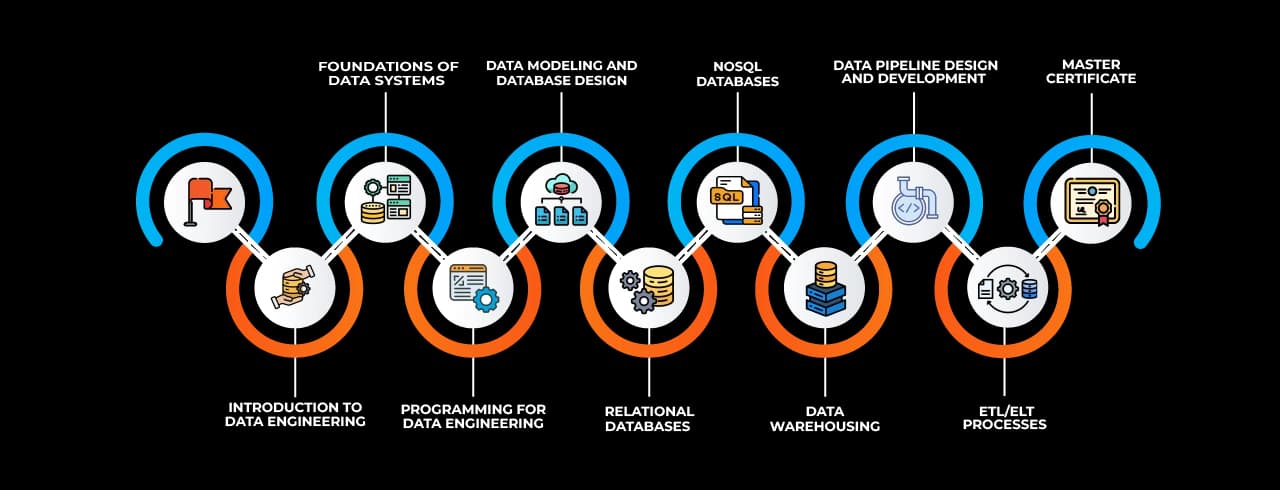
 SQL & Database Management (Relational & NoSQL Databases) – Design, manage, and optimize structured and unstructured databases for efficient data storage and retrieval.
 Data Warehousing(ETL, ELT, Data Lakes) – Build scalable data warehouses and lakes using ETL/ELT pipelines to consolidate and analyze large datasets.
 Big Data Processing (Hadoop, Spark)Process and analyze massive datasets efficiently with distributed computing frameworks like Hadoop and Apache Spark.
 Cloud Platforms (AWS) Leverage cloud-based services to store, process, and manage data at scale with AWS infrastructure.
 Data Modeling & Schema DesignDevelop optimized data models and schemas to ensure seamless data organization, integrity, and performance.
 Programming Languages(Python, Java, Scala) – Utilize programming languages for data manipulation, processing, and pipeline development.
 Data Pipeline Orchestration(Apache Airflow) – Automate, schedule, and monitor complex data workflows using Apache Airflow.
 Data Governance & Security (Data Privacy, Compliance) – Implement data security, privacy policies, and compliance measures to protect sensitive information.
 Tools & TechnologiesApache Spark (Batch & Stream Processing) – Perform high-speed batch and real-time data processing with Apache Spark.
 Kafka (Real-Time Data Streaming) – Enable real-time data ingestion, processing, and streaming with Apache Kafka.
 AWS Data Services (S3, Redshift, Glue, Kinesis) – Store, transform, and analyze large datasets using AWS cloud data services.
 ETL Tools(Informatica, Talend, dbt) – Automate and streamline data extraction, transformation, and loading processes for analytics.
 Containerization & Orchestration (Docker)Deploy and manage scalable, containerized data applications with Docker.
 BI & Visualization Tools(Power BI, Tableau) – Create interactive dashboards and reports to extract insights from data visually.