The Data Structures and Algorithms (DSA) with C & C++ Course by SevenMentor.
A good software engineer is not only good at the syntax of programming languages but also good at how data is stored and how data is processed efficiently for better output. The DSA with C & C++ course at SevenMentor is a training designed specifically for students looking to develop a strong foundation in programming, logical reasoning, and a variety of algorithms. SevenMentor starts with the basic syntax of C and C++ programming and then gradually transitions to studying the complex data structures and various algorithms used by top companies to test a candidate in an interview. This is not a theoretical course where a student is forced to sit through hours of lecture. Instead, it’s an interactive course where every concept is implemented and explained through live code and example. The course has a hands-on approach to learning where a student is provided with a variety of micro-examples and variations of the same example to practice and implement on their own. This is where a student makes mistakes, traces memory, and hence gets to learn to improve his/her own logic to solve a problem. It helps students to develop skills of a software engineer and learn how software is developed from scratch in a structured manner. The basic building blocks of any problem, such as loops, arrays, pointers, and objects of OOP, are studied first and then combined together as a single unit to implement complex problems. As a student progresses through the course, the student learns to apply knowledge to solve medium-level problems and does not get stuck solving a problem.
- Comprehensive Syntax Transition: This course provides a transition from basic C/C++ programming constructs to that of advanced algorithmic thinking.
- Learning Active Logic Building: Engage in learning through active learning micro-tasks to create structure for problem-solving around given formulas.
- Pattern Recognition: Learn how to recognize a pattern in a given complex problem to solve it in the most efficient way possible using recursion, backtracking, and dynamic programming.
- Memory Management Practice: We use C and C++ to understand the memory management through use of pointers, stack, and heap and the corresponding memory allocations.
Why SevenMentor for the Best DSA Training in C & C++?
SevenMentor is a premier training institution in the world for training on data structures and algorithms using programming languages like C and C++. SevenMentor are all development professionals and write code in C and C++ on a daily basis for developing enterprise applications and embedded systems and for participating in coding contests. SevenMentor classroom training sessions are of the highest quality and conducted in a most structured manner. Each training session is made to follow through all the steps of solving a problem at hand, and the trainer makes the student conduct a dry run step by step to arrive at a solution for the problem at hand. He also analyzes the student’s logic for arriving at a solution, points out any inefficiencies in the student’s approach to arriving at a solution, and also makes the student optimize the code to arrive at the best runtime and the best memory footprint for the code that the student writes. All the problems for training are based on real-life problems that a candidate would face during an interview for a software development job, and these problems are embedded within the student’s weekly schedule of study at SevenMentor. At SevenMentor, there is a very controlled and structured method to the manner in which a student is taken through the syllabus for the training, and the small batches of students that are taken through the program ensure that each student gets personalized attention from the SevenMentor trainers. A student at SevenMentor can be a college student, a recent college graduate, or even a software development professional who is looking to get a promotion in his or her job, and the student can be assured of the highest level of personalized feedback and guidance at SevenMentor for all the problems that he or she faces in his or her learning of data structures and algorithms using C and C++. In the long run, SevenMentor is the best place for any software development professional to learn data structures and algorithms because learning DSA at SevenMentor will give the student the much-needed edge to get a promotion at his or her job and also to transition to higher-level languages such as Java and Python and even full-stack web development languages and also provide the student with the best low-level structural skills to face the challenges of any high-level language. c++ dsa course -
- Industry-Experienced Mentors: Learn from development professionals bringing real-world debugging and system design scenarios to the classroom.
- Weekly Practice Sheets: Students go through structured assignments that begin with providing code start points for beginner-level problems and progress to moderate-to-advanced-level problems for students to apply their knowledge.
- Interview Problem Breaking Down & Description Skills: Master how to break down a problem in an interview, then clearly explain your solution approach to a panel of technical interviewers studying your every move.
- Flexible Learning Options: Intensive one-on-one classes or even weekend batches of an interactive kind and 100% online / virtual teaching otherwise.
What Are the Job Roles and Career Opportunities After Completing DSA?
Data structures and Algorithms are the universal language of technical hiring. Learning DSA with C and C++ as the programming languages can open up a wide array of jobs, all of which are well paying across the globe. Since C and C++ are the two languages which give the best execution speed and direct hardware access, big tech companies, gaming companies and companies which deal with embedded electronics systems look for people who can write performance critical code. Thus, by taking this course, you can get transformed from a casual programmer to a high value asset. Such a programmer can look for jobs of entry level software developers as well as systems programmers in companies which develop software for desktop as well as for web. As you get experience and enhance your competitive programming skills, the returns on investment in your skills go up, much faster than you can imagine. Thus, a skilled DSA programmer can look for elite jobs in product based companies and get compensated handsomely for the problem solving skills that he possesses. c++ dsa course :
- Junior C/C++ Developer: Writes core modules for applications (desktop, web etc), operating system utilities, high performance libraries etc and maintain them.
- Embedded Systems Programmer: Design and implement efficient software for a variety of applications such as car electronics, Internet of Things (IoT) devices, medical equipment, and more.
- Game Logic Developer: Responsible for writing game logic for games in the industry. They could be creating real-time physics engines, graphics pipelines or core mechanics of a game to name a few examples.
- Systems & Backend Engineer: Developer of low-latency server architecture, of database engines and of networking protocols. All of these require execution speed to be paramount.
How Does the Online DSA with C & C++ Course Provide a Real Classroom Experience?
Our online DSA with C & C++ course aims to bridge the gap of learning online and attending a classroom for practical hands-on sessions for remote students. We do not provide content in the form of static videos, pre-recorded or otherwise. The online curriculum is provided through live interactive sessions conducted by our mentors, whereby they provide live code walkthroughs (even complex loops are walked through line by line) and memory is allocated in real time on digital whiteboards. We at CnC break down every algorithm problem into small, step-by-step logical ideas before ever putting pen to paper, or in this case, typing a single line of code. Each student is expected to complete mandatory weekly assignments. The code written by the student for the assignments is to be submitted by the student. The CNC team of instructors then goes through the submitted code and provides the student with feedback regarding the logical idea behind the code, the way in which the code has been written, and the way in which the code can be optimized. Moreover, for students having trouble with tougher concepts of algorithms, CnC has live interactive sessions where every student's doubt is cleared. Moreover, each live class is recorded and uploaded to the student’s login account instantly. Thus, even if a student misses a class (say, due to university exams or, say, for a corporate person—shifts), he or she can easily access the recorded class through the student login portal and also use the recording to do a quick revision whenever required.
- Live Interactive Walkthroughs: Watch how an expert developer designs an algorithm from scratch to solve a real-world problem and how he does memory allocations in real time.
- Detailed Review of your submitted Code: Our experienced C / C++ instructor team reviews your submitted assignment code. Your program will be thoroughly evaluated for implementation, design, and coding style & also for optimization issues. The reviews are comprehensive, followed by feedback comments detailing specific changes needed for each submitted code to improve their working, such as fixing bugs and/or enhancing their coding style & code organization.
- Mastering Additional Topics: Join a dedicated extra live class per topic (e.g., recursion, stacks, etc.) where we will practice designing algorithms using binary trees.
- Flexible Learning Portals: To enable students to learn whenever they can (day/night, during university term or during work) between scheduled live classes, we also host a learning portal with recorded sessions, including slides and extra resources to assist students learning in the time frames to suit them.
What Is Covered in the Corporate Training for DSA with C & C++?
Sub-optimal code in modern enterprise environments causes servers to stall, wastes money in the cloud, and slows down applications. Our corporate training in DSA with C & C++ is customized for engineering teams who are building and running high-performance, low-latency applications for business. We will NOT go through generic academic examples of data structures and algorithms. Unlike, we focus on in-depth problem solving for real-world scenarios, micro-optimization and writing robust, scalable code for your industry. Our trainers work very closely with your technical leads to ensure that the curriculum we deliver is current and relevant to what your team is doing with the technology stack they have.Our short, intense, practical sessions of training will teach your engineers to debug and find and fix bugs quickly and to refactor existing sub-optimal code to run faster. They will be able to find the ‘bottlenecks’ in their code and apply the correct data structures to improve performance and reduce execution time.
- Domain-Specific Case Studies: Learn to solve problems in your specific domain of work. Our training will focus on cases similar to the problems that you face on a daily basis. The data structures, the algorithms, the data pipelines,, and the architectures will all be relevant to your specific domain of work.
- Advanced Memory Optimization: The team will delve into how to decrease cache misses and go through how to debug and solve memory leaks that negatively affect the execution speed of large-scale systems.
- Streamlined Debugging Workflows: We teach your developers to use systematic tracing techniques to efficiently debug and fix production problems.
- Code Uniformity & Cleanliness: Our workshops focus on making code written by your developers to be readable, maintainable, and uniform so that it’s very easy to do architecture upgrades in the future.
How Can You Transition from Basic Coding to Advanced Software Development?
This course is an attempt to learn DSA with C & C++ as the primary languages for developing data structures and become an ultimate problem solver instead of being a coder who solves problems by guessing. Typically, most of the development courses start off by teaching the students a foundational programming course. It is really important to note that even after completing such foundational programming courses, moving on to higher levels of software development, such as software engineering as opposed to development, requires a deep understanding of how data structures interact and behave, and therefore, instead of jumping into other languages such as Java, Python, or even full-stack web development, learning DSA with C and C++ serves as a bridge for the students, and this is the only course of its kind that provides students with an ironclad logical foundation, enabling them to be methodical problem solvers and move away from superficial syntax memorization and develop into permanent problem solvers. Moreover, as far as tech companies are concerned, they value this fundamental flexibility above anything else, and this is the reason they test candidates not in terms of the syntax that they have learned from the colleges but in terms of how they would be able to break down a complex problem and then eventually trace the execution of such code on a whiteboard and also be able to defend the time complexity as well as the space complexity of the approach used by them for solving a particular problem.
- Step 1 - Ironclad Logical Foundation: Develop a solid permanent problem-solving framework to program, as opposed to memorizing superficial syntax to program.
- The structures to learn will also give you a logical foundation to learn any other language (e.g., Java, C#, Python, etc.) in a fraction of the time it would normally take to become proficient with the language.
- Whiteboard Interview Readiness: Learn how to clearly articulate your thought process in problem solving, handling edge cases, and optimizing your code to crack tech interviews.
- System-Level Comprehension: This course enables you to have an edge over other developers by understanding exactly how a programmer’s code interacts with the computer’s memory and with the hardware of the computer.
How Does SevenMentor Ensure Quality, Transparency, and Accountability in Your DSA Journey?
At SevenMentor our feedback from students is very important to us. We are building a study environment that is totally based on absolute trust, the highest quality of study material and study environment, and total transparency for the student regarding the career he/she wants to make in life. Learning data structures and algorithms is very, very tough, and study material needed for it is not the same for all students. So, we cannot have a generic syllabus. What is needed is a study environment and study material that is of the highest quality and that are supported by the best study infrastructure. We at SevenMentor understand this problem very well. The biggest problem faced by students in training institutes for learning data structures and algorithms is that of quality of study and study environment and totally no transparency for students regarding the career he/she will make after completing training in that institute. That is why we at SevenMentor have put strict guardrails on all activities of our organization to keep the quality of study and study environment high and totally to protect students from all implications of spending their money and time with us.
All DSA classes at SevenMentor are held under the guidance of a veteran of the trade, a senior developer with years of experience working in some of the biggest enterprises in the world, while the faculty for a typical training institute may comprise recently-passed-out students or greenhorns with little to no real-world experience of the kind that matters.
- Guaranteed Mode Continuity: If you have enrolled and paid for a physical classroom program (in person learning mode), then we guarantee that your batch shall remain in offline mode (in person learning mode). We do not merge such batches mid-course for online learning.
- Zero Hidden Placement Fees: SevenMentor never takes any surprise processing fees in the placement process and never asks for any extra charges from students after clearing the interview or after getting placed in corporate companies through a job offer letter.
- Valid Job Postings—Only Tech Jobs: The SevenMentor Placement Team filters out job descriptions to confirm they are real software jobs (software development, data structures & algorithms, etc.) for software engineering jobs & posts them on the website for students to apply for jobs that match their skills.
- Our Trial Policies are Transparent: We want to ensure our methodology of teaching Data Structures & Algorithms would fit into a student’s way of learning prior to getting them into a course. Thus, details regarding all our various courses are elaborated on in great detail during trial sessions held for interested students.
What Advanced Technology Specializations Can You Pursue After Mastering DSA?
Mastering Data Structures and Algorithms with C and C++ is the best way to hone the problem-solving skills of a candidate and make him / her a good problem solver. The candidate can move to special technical areas of high growth areas with great ease after he / she has gained sufficient expertise in how memory is managed, code can be optimized, and algorithms can be made more efficient. The companies always look for a candidate who has mastered DSA using C and C++ and can easily adapt to special technical areas of high growth and learn the latest frameworks and latest cloud platforms in no time. SevenMentor offers DSA training to its candidates and also makes them familiar with the latest technical areas and their implementation. DSA training by SevenMentor makes a candidate an expert in various technical areas, and candidates can easily learn the latest technical areas and get placed in top companies. Some of the technical areas are artificial intelligence, enterprise software development, cloud architecture, etc.
- Data Science: We can help you write code to develop data-driven web applications on the web and build complex machine learning pipelines and run them optimally.
- Data Analytics: A student using Data Structures and Algorithms training will be able to use the structural logic and mathematical models in data analytics to analyze user behavior and large data and optimize system performance by building web-based applications.
- Python Training: Learn how to use your DSA skills (your pointer and your ability to understand memory and pointers) to make an easy transition to Python, the language of choice for most of the backend development and automation.
- Cloud Computing: Get you ready to scale up your engineering skills by learning to design and deploy global web applications in the cloud, which run on global servers to provide very low latency to users.
- Cyber Security: Utilize the understanding of low-level system execution and memory management for the program in you to detect vulnerabilities and build secure web applications.
- SAP Systems: Use the structural coding in Data Structures and Algorithms to create high-performance enterprise business solutions in SAP Systems (ERP).
- Generative AI & AI Course: Move beyond simply prompting AI and start writing custom code for building intelligent applications & neural networks in no time.
- ChatGPT Course: Learn to build conversational models and deploy AI-powered chatbots within your organization on a variety of platforms.
- DevOps Engineering: Combine systematic problem-solving with automated pipeline architectures for efficient continuous integration and deployment (CI/CD) cycles.
- Power BI Training: Bridge data structures with visual reporting by creating interactive, high-performance data visualization dashboards for corporate stakeholders.
- Salesforce Architecture: Expand your development capabilities by designing CRM-based web solutions and enterprise cloud logic for global businesses.
- Java Development: Transition smoothly into Java, an object-oriented language widely used for building secure, robust, and heavy enterprise web applications.
Got Questions? Here Are Some FAQs
Q1. What will I learn in a Data Structures with C & C++ course?
You will learn arrays, linked lists, stacks, queues, trees, graphs, hashing, sorting, searching, recursion, and how to implement these concepts using C and C++ through practical coding.
Q2. Is this course suitable for beginners?
Yes, beginners can join this course. Basic programming knowledge is helpful, but the course starts with fundamental concepts before moving to advanced data structures.
Q3. Why are Data Structures and Algorithms important?
Data Structures and Algorithms help you write efficient programs, improve problem-solving skills, and prepare for technical interviews at software companies.
Q4. What career opportunities are available after completing this course?
This course can help you prepare for roles such as Software Developer, C/C++ Programmer, Application Developer, and other programming-related positions.
Q5. Does the course include practical coding and projects?
Yes, the course includes hands-on coding exercises, real-world examples, and projects to help you understand concepts and build practical programming skills.
Related Links:
Anthropic AI Tool
What is Writesonic
What is Claude AI
AI Engineer Roadmap
What is JasperAI
What is Copy AI
Do visit our channel to know more: SevenMentor
 Data structures are used to keep and organize information.
  An array is a type of data structure that may store several elements in a single variable.
  C++ also supports some other data structures, each of which is used to manage data in a unique way.
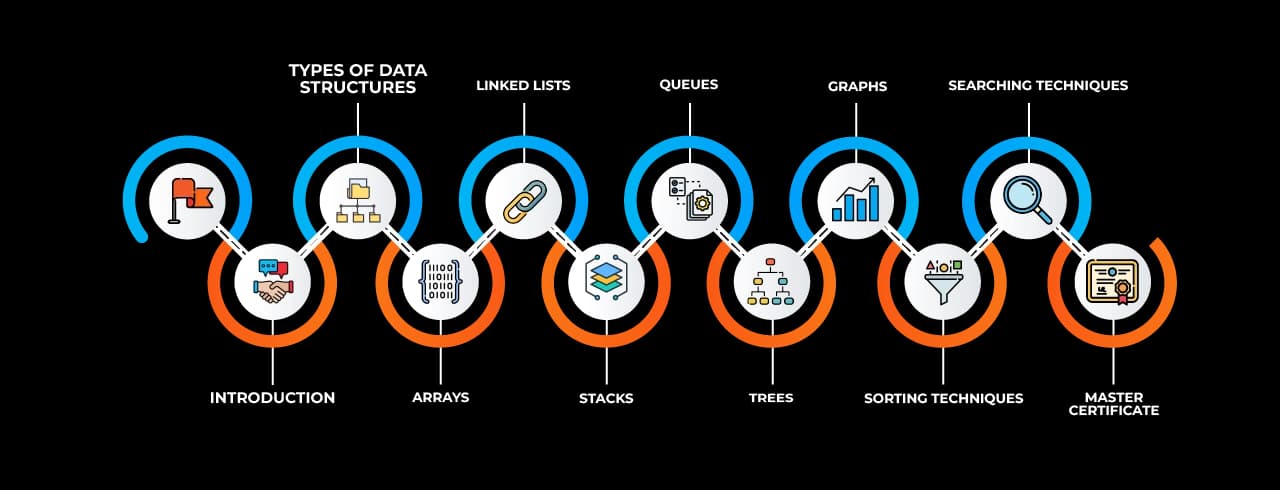
 CA procedural programming language for system and application development.
 C++An object-oriented programming language with features like classes and polymorphism.
 Tools & SoftwareIDEs and utilities for coding, debugging, and compiling C/C++ programs.
 Creating ArrayDeclaring and initializing a collection of elements of the same type.
 Types of ArrayOne-dimensional, multi-dimensional, and dynamic arrays.
 Operations on ArrayInsertion, deletion, traversal, searching, and sorting.
 Creating Linked List Defining nodes and linking them dynamically in memory.
 Types of Linked ListSingly, doubly, and circular linked lists.
 Operations on Linked ListInsertion, deletion, traversal, searching, and reversing.
 Creating StackImplementing a LIFO data structure using arrays or linked lists.
 Terms in StackPush, pop, top, underflow, overflow.
 Operations on StackPush, pop, peek, and checking for empty/full conditions.
 Creating QueueImplementing a FIFO data structure using arrays or linked lists.
 Terms in QueueFront, rear, enqueue, dequeue, overflow, underflow.
 Creating TreeDefining a hierarchical structure with nodes and edges.
 Types of TreesBinary tree, BST, AVL tree, B-tree, etc.
 Terms in TreesRoot, parent, child, leaf, depth, height.
 Operations on TreesInsertion, deletion, traversal (inorder, preorder, postorder).
 Creating GraphRepresenting networks using nodes and edges.
 Types of GraphsDirected, undirected, weighted, unweighted.
 Terms in GraphsVertex, edge, adjacency, degree, path.
 Operations on Graphs BFS, DFS, adding/removing edges or vertices.
 Searching MethodsLinear search, binary search, depth-first search, breadth-first search.
 Sorting MethodsBubble sort, selection sort, insertion sort, merge sort, quick sort, heap sort.
 Code BlocksA popular open-source IDE for C/C++ development.