What Are the Core Concepts and Tools Covered in a Java Course?
A professional training course is so much more than a bunch of theoretical information about the very basics of computer science. The course enables participants to start writing code from the very first day with the help of practical examples using real-life projects using the latest technology. Instead of sitting through long hours of monotonous lectures, students are able to develop fluency in the core structures of Java and usage of modern tools and technologies and use them in real-life scenarios.
The SevenMentor training program is for the beginner to transform into a skilled & employable Java developer.
- Core Java Fundamentals: Learn to understand variables, data types, loops, arrays & controls. Statements of the Java language to develop simple Java programs.
- Object-Oriented Programming (OOP): Learn about the 4 fundamental elements of OOP. i.e., inheritance, polymorphism, abstraction, and encapsulation. Start to apply the concepts to develop good, robust, scalable, and maintainable code.
- Collections Framework & Exception Handling: Learn to work with collections of data such as ArrayList, HashMap, and more with the help of iterators and also know how to handle runtime exceptions to make your Java program robust.
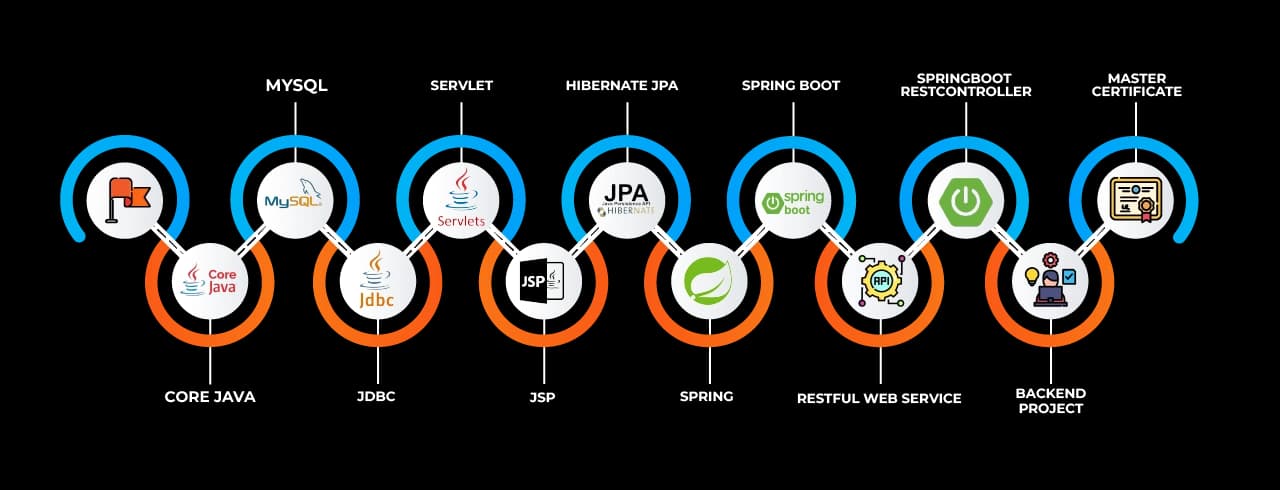
- Database Connectivity & Advanced Frameworks: In this part of the Java training program, participants will find out how to connect a Java application with a MySQL database using the JDBC API. At the end of the section, students will also learn file input and output operations, multi-threading, servlets, and JSPs and will start learning the Spring framework.
- Learn to work with industry-standard developer tools – Learn to work in Eclipse and IntelliJ IDEA. You will learn to manage your project with Maven (dependencies, etc.) and also learn the most used version control system in software development: Git.
- Real Business Use Cases – Create your own projects, like creating automated billing systems, secure login systems, and mini e-commerce applications through capstone assignments.
Why Choose SevenMentor for Your Professional Java Training?
Finding the right training institute for a program is not just for browsing the course syllabus but also for choosing a good mentor and also turning the environment to work like a real development team. At SevenMentor we follow the way of teaching Java training to the students in a mentor-led environment rather than following the crowded traditional classroom methodology. In order to ensure each and every student is provided with the best expertise of the trainers, we follow up with small batch sizes of students to provide them the best possible training by the expert trainers. Most of the trainers also have years of experience working in the corporate world for the development of the live applications. They also teach and make the students practice the shortcuts, optimize the ways to complete the programming tasks, teach to trace the bugs in the code in live debugging, and also teach to use the various tools and features of APIs of Java. They also teach the students to write clean code for the applications.
We know that there are many students with different backgrounds; hence, our methodology supports students to learn at their own pace and gives them enough practical training and engineering skills to make them good software professionals.
- Dual Learning Modes: Study through our innovative Offline or Online Mode of learning, running through Weekday as well as Weekends’ batches.
- Our online Java training sessions are held LIVE, and students can get to see how the trainer is typing on his/her computer through screen sharing. Hence, there is LIVE debugging, and how to fix bugs in a program is also taught. The videos, which are widely used for teaching, are stagnant and hence of no use.
- Industry-Experienced Instructors: Learn directly from working developers who teach the shortcuts, diagnostic methods, and real-world tools used in the software industry today.
- Our Java Training Program comes with a Career Readiness Framework—get more than just learning to code. Also, get assistance for creating your resume, develop a portfolio for yourself, and also go through a series of mock interviews.
- We Create an Approachable & Growth-Oriented Space for Learners: Our program is designed to be absolutely easy for both college students just out of school and working professionals. Learning to program takes time, and that’s exactly how we approach it at SevenMentor.
- Customized Corporate Java Training: Our corporate program for Java is flexible and is custom-developed to address specific needs of a company. The modules, group assignments, and also Spring Boot upgrades are delivered as per the exact technical stack used by the company.
What Are the Career Directions and Salary Expectations After the Java Course?
Java is a backbone of many technologies around the globe. It can be used to create mobile applications, build massive scalable enterprise architectures, and more. It is used for developing banking architectures, tools, and high-traffic web applications (like news aggregators), and large-scale enterprise applications with multiple backend microservices. Our training helps students to graduate from just being able to read & write Java code to that of a logical problem solver who can explain the design of an architecture to tech leads. Many industries, including finance, insurance, logistics & SaaS companies, rely heavily on Java-based frameworks; hence, there are ample job opportunities for the certified ones, and most importantly, they tend to have high job satisfaction. Explore all the possibilities of Java and see how you can apply it in your work, such as building mobile applications or building massive, scalable enterprise architecture for large organizations.
- Java Developer/Backend Engineer: A Java Developer/Backend Engineer is responsible for writing server-side logic, client-side logic, storing data in a database, creating APIs for web applications, and performing them at high scale.
- Software Developer / Full Stack Developer: As the most versatile of all IT roles, you can develop complete applications from idea to deployment. Writing code will become so natural to you that you’ll use it to solve problems and create things on your computer in your free time.
- You can opt for frontend development for client interfaces or move to the backend for server-side development. You can also transition between both, fully well-equipped to handle a full-stack development role.
- Automation Developer: Write scripts for testing software (automated testing scripts) in a continuous integration environment using a variety of frameworks for Java.
- An Android Developer – An Android Developer uses core programming concepts to develop native Android applications with the best possible performance on mobile devices.
- Application Support & Junior Programmer: Make sure critical applications running in production are healthy and ready for maximum performance. Troubleshoot problems and work continuously to optimize the application for even better performance.
- Competitive Salary Packages:
- Fresher’s Salary Package: A fresh graduate can get an average salary package of Rs. 3.5 LPA to 5 LPA during his first placement.
- With Automation/Spring Exposure: You can command packages in the mid-level package range of ₹6 – 10 LPA.
- Experienced Java Developers: They command salaries of up to Rs. 18 LPA or even more depending upon the depth of architecture that they have handled.
How Does Practical Training Build Critical Coding and Debugging Confidence?
When you move from student to professional developer, you will have to undergo a huge change in your mind-set. True Java training is not about memorizing the rules of the syntax of a programming language. It is about training up your structural and logical skills of problem-solving. An amateur panics when the code he wrote does not work; a professional, on the other hand, always methodically traces back the error in his code. When you consistently write down your findings while actively learning as opposed to passively watching a video, you start to change your relationship with problems of a technical nature. Over time writing code will transform from something that you have to do into something that you love to do. It will become your medium of expression and thus your instrument of creation for the digital world and for solving problems in said world.
Writing code becomes second nature to you and you will enable you to solve computer related problems from an application / program perspective.
- Syntax Memorization vs. Deep Logic: Learning to program involves two elements. Learning the syntax of a programming language and learning the deep logic that is behind it.
- Learning to Deconstruct Large Codebases: This is a critical skill for any Java developer. Our instructors will teach you how to write code as well as learn to read and understand code written by others to break down very large engineering problems into smaller, working pieces of code.
- Stress-Free Exception Management: Find out how to trace errors, read diagnostic logs, and handle exceptions with confidence.
- Ability to Explain in Interviews: Learn to articulate your code. Learn the right terminology and develop the ability to clearly and sufficiently explain your logic, your architecture and design decisions, and your software choices to technical interviewers.
- Developing a real IT culture: Our tutors will help you to improve your skills of communication with your colleagues on a daily basis. You will practice how to explain a bug to other people and how to document your code and your logic paths as well as how to work with other developers on a project.
What Can You Expect from the SevenMentor Java Training Experience?
Rather than attending a typical classroom session, by enrolling in our Java training program, you’ll become a part of a fast-paced, corporate-like development environment. All members of the Java training ecosystem from the very first session of your first project will aid in the establishment of your modern, up-to-date Java development skills & good programming practices. The business logic scenarios (and not typical examples copied from some book) are used throughout all the projects. As a result, all the tasks completed during the Java training sessions will immediately translate into projects that can be put into your professional engineering portfolios.
This way, each and every one of your projects can turn into a real and solid addition to your professional engineering portfolio.
- Micro-Batch Optimization: Although we shall be working in very small batches in our classes, each line of code written by a trainee can be read by an instructor to uncover bad programming habits and to give feedback on the logic in their work.You get to set up and work on your programs within the same industry-standard development environments that real engineers use for their production work—within the same directory structures that a real IT department would use.
- Simulated Software Development Life Cycle (SDLC): We go through the life cycle of a simple idea for a software program in a highly condensed but extremely practical fashion.
- Data-Driven Assignments: Learn to tackle software problems using real enterprise data models to mimic how big e-commerce, finance, and retail companies actually implement software.
- End-to-End Placement Architecture: We have created a complete career support system. You will have practice tests, resumes will be refined for you, and you will have an active portfolio of work that is being developed throughout the program.
How Do Online and Corporate Java Training Modules Maximize Flexibility?
Modern learning is highly customizable, whether you’re a university student with exams, a part-time working professional, or an enterprise with an engineering team that is looking to scale quickly. Whether you need classroom training or virtual upskilling, we offer flexible learning pathways that are of highest educational value and are tailored to your specific needs, schedule, and learning goals. Modern learning is highly customizable.
Removing the geographical constraints of specialized software training allows people with an inquiring mind and a desire to engineer a future for themselves to access training whenever and wherever they like.
- Fully Live Online Training: Our fully live online training is the ultimate in specialized software training. With our expert instructors providing real-time guidance and interaction in our live online Java training sessions, you can be sure that you will get the most out of your investment – unlike pre-recorded videos that fail to address individual questions in real time.
- Remote Debugging Environments: Get over technical hurdles quickly by sharing screens in real time and thus guiding students through code corrections live.
- Specialized Software Training: Develop specialized software training for the engineering and technology future that awaits you and invest in it.
- Collaborative Team Assignments: Our Java training for corporate engineers includes collaborative team assignments to inculcate a culture required for promoting engineering standards amongst participants of a corporate batch through developing a team-based approach to software development.
- Advanced Framework Upgrades: Incorporate into an engineer’s customized program advanced specialized training modules such as Spring Boot and other enterprise-specialized software training designed for advanced engineering training for the modern enterprise.
How SevenMentor Addresses Student Feedback to Deliver a Premium Learning Experience to Learn Java Online.
How to Choose the Right Training Institute for Your Career Goals. Most training institutes will tout the features and courses offered but fail to deliver on the most important things—listening to feedback, adaptability to change, and continuous refinement of the student experience. SevenMentor, on the other hand, is a pioneer in collecting feedback of students from all the learning platforms and making changes to transform the typical pain points of the industry into strengths of the organization to deliver very high-value training to students to deliver on their educational investment.
Here is how SevenMentor can safeguard your financial outgo and deliver quality learning:
- Our Trained Faculty Panel: Our core and advanced Java programs are conducted by certified senior developers with over 5 years of experience in the IT industry.
- Guaranteed Batch Integrity: When you enroll for offline classroom training, you will stay in that classroom for the entire duration of the course. We do not merge the offline students with online students halfway through a module.
- Transparent Try-Before-You-Buy Policy - Get to know the SevenMentor syllabus before you invest. Try introductory sessions for free to experience our pedagogy before committing to a course.
- Aggressive, Non-Support Placement Pipeline: Our dedicated placement cell strictly targets technical roles such as Java developer, backend developer, automation developer, etc. and does not waste time in placing students in non-support tech roles like technical support etc.
- Real-Time Student Support Desk: We have a system in place where students can bring up any issues pertaining to the learning process, whether it be the student not meeting the institute’s pace of learning or there being a lack of clarity with regard to a concept, and we rectify the situation immediately.
How Does Java Integrate with Modern Enterprise Technologies and Cross-Functional Domains?
Modern software engineering is not an isolated discipline. Building robust, future-proof software platforms for production environments requires a robust backend language that can easily be integrated with cloud environments, data pipelines, and automation workflows as well as with AI models. Even though Java is the backbone for very trafficked, enterprise-scale solutions, the real power of Java is in its interaction with other technologies. Therefore, it is also important for us to understand the broad, interconnected landscape of other technologies used in software engineering and be able to join top development teams as a complete systems expert.
The understanding of the backend of a website or application provides the necessary logic to be able to work in various technical fields, thus making the engineering skills of a developer very versatile:
- Artificial Intelligence & Automation: Implement intelligent application backends that interoperate with cutting-edge technologies in generative AI & AI courses. Utilize tools such as those taught in ChatGPT courses to implement advanced, AI-powered chatbots in web applications.
- Data Science & Analytics Engineering: Support a data science project for a data-driven web application and a data analytics project to in-depth analyze user behavior and performance metrics of a system for web applications.
- Modern DevOps & Cloud Infrastructure: Develop and deploy high-scale, globally distributed applications to the cloud. Learn the ins and outs of various cloud computing environments, such as AWS, Google Cloud, or Azure. Leverage powerful DevOps tools and methodologies to create powerful CI/CD pipelines for flawless, automated software deployment.
- Enterprise Software & Architecture: Interface with backend microservices of industry-standard SAP applications and specialized web solutions like Salesforce CRM-based web applications. Keep corporate architectures up-to-speed.
- Next-Gen Web Ecosystems & Security: Learn how to write secure, enterprise-grade code for the next generation of web applications and at the same time learn how to use Python for scalable backend development of your web applications.
- Business Intelligence & Dashboards: Connect a backend of records in a database to interactive data visualization of the information in a Power BI dashboard for operational reporting for business leaders.
Got Questions? Here Are Some FAQs
Q1. Who should join a Java course?
Java Course For Java Beginners, Students, Graduates, Working Professionals & IT Employees to learn how to become Software Professionals, Web Professionals, Android App Professionals, and Backend Professionals.
Q2. Do I need programming knowledge before learning Java?
No. Most of the Java courses start from the very beginning of programming and teach students Java after they have learned the basics of programming first.
Q3. What are the career opportunities after completing a Java Course?
After completing a Java Course, the student will be able to apply for a job of a Java Developer, Software Developer, Backend Developer, Full Stack Developer, Application Developer etc. in many industries.
Q4. How long does it take to complete a Java Course?
The duration to complete the course largely depends on the level of the course. For basic to intermediate Java training programs, it may take anywhere from 2 months to 4 months with regular study hours and practice.
Q5. Will I get hands-on practice during the Java Course?
Yes, quality Java Courses include hands-on coding exercises, real life projects, assignments, and even practice interviews to enable the students to acquire necessary skills for real life projects.
Related Links:
Anthropic AI Tool
What is Writesonic
What is Claude AI
AI Engineer Roadmap
What is JasperAI
What is Copy AI
Do visit our channel to know more: SevenMentor
 Java is a programming language and computing platform used to build programs.
 It is an object-oriented language, which is founded on the idea of classes and objects.
 To generate flexible and reusable code, it employs fundamental concepts such as classes, objects
 Object-Oriented Programming (OOP)A programming paradigm based on objects and classes.
 Introduction to JavaOverview of Java's history, features, and applications.
 Java Language FundamentalsCore concepts like variables, data types, operators, and control flow.
 ContainmentA relationship where one class contains an object of another class (HAS-A relationship).
 PolymorphismAbility of an object to take multiple forms via method overloading and overriding.
 Abstract ClassA class that cannot be instantiated and may contain abstract methods.
 AnnotationsMetadata used to provide instructions to the compiler or runtime.
 EnumA special Java type representing a fixed set of constants.
 InheritanceMaster object-oriented programming (OOP) concepts to build modular and reusable code.
 Interface IDoc: An IDoc (Intermediate Document) is a standard data format used in SAP to exchange information between different systems.