What is a Job-Oriented Java Full Stack Course, and Why Choose SevenMentor Java Full Stack Training?
We are living in a digital economy world. Everything around us is getting digitized. Thus, the need of the hour is a software professional who can manage client-side as well as server-side architecture for the development of web applications. A job-oriented Java full-stack course is designed to make students into working experts/developers after training. This course helps participants to develop an entire web application from scratch using Java Full Stack. Thus, participants can get placed in leading IT companies/MNCs.
Choosing the right training provider for job-oriented full-stack Java training ensures that you are not limited to learning individual concepts in isolation and get to understand how different technologies seamlessly integrate together. This is crucial to get the best out of your learning and ensure that you are well equipped to get deployed on projects from the day you start working.
You gain end-to-end expertise in developing end-to-end web applications. You learn to design frontend UIs and a robust backend to support them.
- Massive Career Leverage: Massive job opportunities such as a full-stack developer, software engineer, and backend specialist.
- High Demand & Better Pay: Java full-stack developers get better salaries and are hired more easily, as they have a bigger scope of work for the same salary and are also hired at a higher entry-level salary.
- Future-Proof Technology - Java is the backbone of enterprise software worldwide.
SevenMentor Java Full Stack Curriculum for Job Oriented Java Training for Students.
SevenMentor offers job-oriented full-stack Java classes. SevenMentor's Java training course is designed to deliver solid job-oriented Java full-stack training, which covers the entire Java stack and helps candidates to get a perfect job in the Java industry. The training curriculum is updated on a monthly basis to keep up with the evolving trends in the IT industry. The job-oriented training starts from building the base of core Java and OOP and then moves on to advanced Java and large-scale enterprise architectures.
The backend part of our Java training covers the latest Java technologies used for a large volume of traffic in heavy enterprises and helps students to learn how to develop scalable and secure architecture. On the client side, we cover the latest frontend frameworks to create interactive, fast, and good-looking applications.
Our extensive course content is broadly categorized into the following modules.
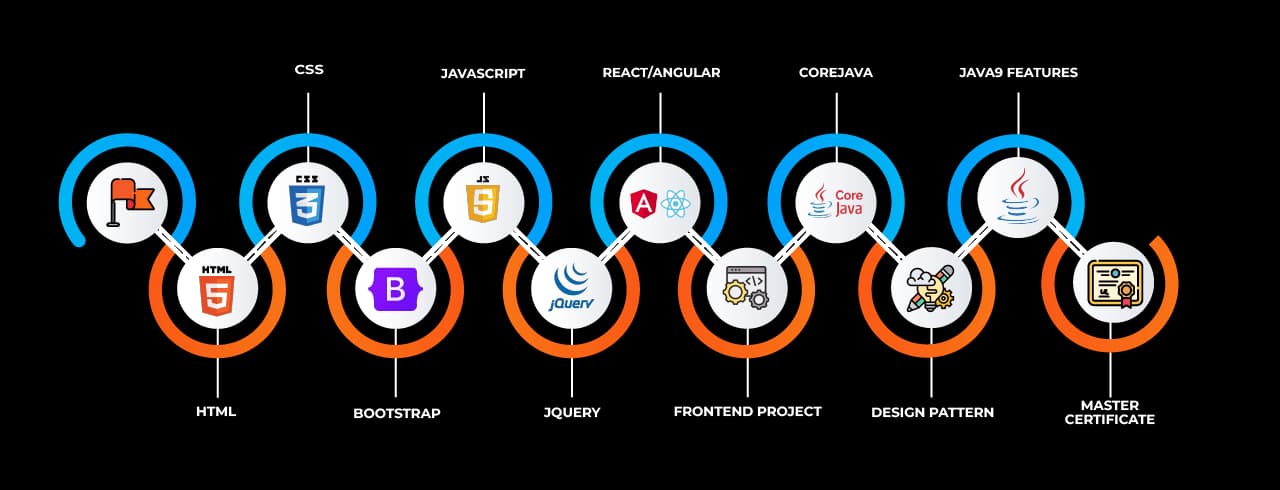
- Core & Advanced Java: Study multithreading, collections, memory management, etc. with database interaction using JDBC and Hibernate.
- Backend Frameworks: Our courses focus on developing robust applications that can run under heavy loads of traffic in large enterprises. The backend frameworks used for developing such applications are covered in the course, such as designing a scalable and secure application using Spring Framework, Spring Core, and MVC.
- Modern Microservices: Building of high-performing, independent & deployable RESTful web services using Spring Boot.
- Frontend Technologies: Beautiful User Interface for a web application using HTML5, CSS3, JavaScript, and a frontend technology such as Bootstrap and one more such as Angular or React.
- DevOps & Industry Tools: Learn development with tools like Git, Maven, Jenkins, etc. to develop job-oriented Java web applications.
How Do the Java Full Stack with Internship Classes Build Practical Skills?
We believe that just learning about Java full stack is not enough to be competitive in the job market. That is why we focus so much on practical knowledge gained through a final capstone project as well as real-life experience on the job at an IT company. Our students do not just sit in class and learn about different topics related to Java full stack. They write clean code, work with different errors, and in the end create deployable software.
Through your capstone project, you will experience the full cycle of developing a product to meet a customer’s needs, from gathering the requirements to designing the system architecture, developing APIs, creating a front-end, and performing cloud-based testing. You will go through the full product development life cycle just as you would in a real IT workplace.
- Projects in our Java Full Stack with internship classes are worked on during the practical training and also during the corresponding part of the internship.
- E-Commerce Platforms: Create a fully functional online shopping website that includes a payment gateway and a catalog of products.
- Hospital Administration Systems: A secure system that can be used by hospital administration for managing patient data, scheduling appointments, and billing patients. administration for managing patient data, scheduling appointments and billing patients. Students work on building up a real-time data tracking system for a company and create an interface for it with the use of charts and alerts. This system can be used for managing the inventory.
- Hotel Booking Platforms: Students are also trained to develop hotel booking platforms, which can be deployed on cloud platforms. This can be developed as a client-server-based system using microservices architecture to deliver a rich user experience.
What Placement and Interview Support is Provided in this Java Program?
Finishing a top-notch training program is just half the story of getting placed in a tech company, and that middle part is taken care of by SevenMentor’s dedicated placement cell, which acts as a conduit for getting the students placed in premier companies for jobs. Our job-oriented Java full-stack training has the framework for making students job-ready while they are completing the advanced modules of the training. The career-readiness of students is enhanced by the aggressive approach of the placement cell.
When the candidate steps into the advanced modules of the training program, the placement team begins to work on the candidate’s corporate presentation. The team at SevenMentor helps the candidate to write a perfect resume for the job after Java training for the job. This includes listing out the capstone projects and microservices portfolios that the candidate developed during the course of the training and the internship that the candidate did before joining the course. The resume is written in such a manner so that it looks perfect to the eyes of the recruiter of the corporate company.
Our structured placement ecosystem includes:
- Mock Technical Interviews: These are conducted by various panels of working developers who test a student’s live coding & problem-solving skills to prepare them for real tech interviews.
- Portfolio Development Seminars: A program that trains students to develop a good portfolio in the form of a clean GitHub repository and also a good LinkedIn profile that can grab the attention of talent acquisition teams of tech companies.
- Soft Skills Training: The way you present yourself, both over the phone and in person, is key to getting through rounds of hiring, especially in today’s cutthroat tech hiring scene. We teach you everything you need to know about proper communication, etiquette at a workplace, and presenting yourself confidently and adeptly in difficult situations.
- Direct Hiring Drives: We also organize direct hiring drives for our students and candidates with SevenMentor’s vast network of partner MNCs & mid-sized tech companies across India.
Why is SevenMentor Considered the Best Choice for Learning Java Full Stack?
There are hundreds of training programs available in the market. It becomes challenging to choose the best training institute that provides good quality training along with placement. SevenMentor is one of the best Java full-stack development training institutes in India. Our approach to training is completely different from the traditional method of memorizing. We train our students in a live, interactive, and peer-to-peer learning environment where they can practice and implement their ideas and come up with solutions to problems.
The programs at SevenMentor are designed to give individual attention to each student. Our training programs are suitable for both the beginners who are just starting to learn about object-oriented programming and the professionals who require advanced training on topics such as microservices architecture. We give individual attention to each student, and our team of mentors works in conjunction with the student’s style of learning.
As a student at SevenMentor, you get to experience learning in a premium learning ecosystem that includes.
- MNC Expert Trainers: Our team of MNC Expert Trainers has 8 to 10 years of experience in software development, and they impart training to our students.
- Dedicated LMS Portal: Students at SevenMentor can log into the LMS portal 24/7 to access the recorded classes, documents, code, and project implementation for practice.
- Lifetime Support: SevenMentor provides lifetime support and guidance to our students even after completion of training and also updates them on the latest and greatest in the software development industry.
- Comprehensive Coding Competitions: SevenMentor hosts weekly technical tests and coding hackathons. In these competitions, participants enhance their problem-solving ability and work under time pressure to deliver quality results to develop the required expertise to resolve complex problems in real time.
How Do the Online Classes and Corporate Training Options Work?
SevenMentor’s programs are extremely flexible. We bring the energetic and rigorous program of a physical classroom to your home. The online job-oriented Java full-stack training program is not a bunch of pre-recorded videos. It’s a real-time, live, and live instructor-led session. In these sessions, you can raise a hand, ask a question, and even share your screen for instant debugging. SevenMentor provides companies with corporate training tailored to meet their technical needs. Our corporate training programs are designed in consultation with tech managers of companies to create a customized learning path for the employees of a company. We create learning programs for companies that can be put to use immediately, leading to a high return on investment.
Our specialized training formats provide distinct advantages:
- Online Interactive Classrooms—Running in real time through a forum for doubt clearing, virtual pair programming, and shared repositories for code.
- Specialized Corporate Training: Our engineers deliver highly customized training for a company’s technical assets. We work in tandem with the tech manager to deliver the highest quality of training in the form of a custom-designed learning track. The training is very promptly followed up with a swift return on investment.
- Equivalent Placement Support: At SevenMentor, we are committed to providing equivalent interview opportunities and placement support to students learning in online formats as we do to students in our offline classes.
- Post-Training Evaluation: We provide detailed assessment reports and knowledge transfer documents to corporate clients to gauge the level of learning achieved by their employees.
How Does SevenMentor Directly Overcome Common Industry Training Challenges?
The fears of a fast-paced course, crowded classes, and a nonfunctional placement cell for the job-oriented Java full-stack course are addressed by the SevenMentor team, who have worked hard to restructure the Java full-stack development training program from scratch, incorporating feedback from students and thereby designing a well-structured, transparent, and job-oriented training program for corporate placement.
We address the problems associated with learning as well as administrative issues:
- Rigorous Trainer Vetting: SevenMentor’s Java Full Stack trainers are all software developers with 8 to 10 years of experience in the Java technology stack. All of them are specially trained to teach absolute beginners to develop software using complex frameworks. They are not academic lecturers who just read from books and deliver.
- Smaller Batch Size: SevenMentor adheres to a strict criterion of managing small batch sizes of students so as to avoid the typical problem faced in larger classes where students fail to get adequate attention from instructors. Also, our smaller batch sizes ensure that instructors are able to thoroughly assess the code written by students and resolve their problems related to Hibernate or Spring Boot. In addition, one-to-one types of sessions facilitate providing one-to-one types of guidance to students.
- Paced Learning Flexibility: If you feel that you are being rushed through concepts like microservices architecture or others, the advanced LMS portal and live doubt-clearing forums help you pause your learning and work through the required material from recorded sessions of previous classes. You can ask questions and clear your doubts from trainers and peers in real time.
- A Proactive Placement Pipeline: SevenMentor’s dedicated placement team ensures that there are sufficient graduate-level interviews with suitable employers to counteract the bottleneck often experienced when placing graduates in non-support roles such as development roles using Java technologies like Hibernate and Spring Boot for Java full-stack development.
How Does Java Full Stack Integrate with Other Advanced Technology Fields?
Java has evolved to become the backbone of modern web applications, which are no longer confined to static web pages and simple databases. Most of the modern web applications are highly complex and are interlinked with various other systems and technologies, like cloud, artificial intelligence, etc. So, to develop such world-class applications, the architecture built for developing Java-based enterprise applications needs to be integrated with these modern technologies. SevenMentor’s Job-Oriented Java Full Stack Course will teach you how to develop a robust Java Full Stack development backend, which can be used as a foundation for integrating with other advanced technical topics.
Our Java Full Stack Training Program begins with a good foundation for a job-oriented Java Full Stack Development course and then goes on to specialize in the following technical domains of enterprise architecture:
- Data Science & Data Analytics: Build Java-based web applications that are data-driven and support analysis of user behavior to fine-tune performance of the platform.
- Artificial Intelligence & Automation: Using intelligent systems as part of our generative AI & AI course offerings. Creating conversational interfaces on top of ChatGPT as part of our ChatGPT course offering for creating AI-powered chatbots.
- Cloud Computing & DevOps: Build scalable applications on cloud platforms (AWS, Azure, etc.) and work with the DevOps tools and methods to implement a continuous integration and delivery automated pipeline to deploy your applications.
- Cyber Security: Learn how to harden your application, Spring Framework, and APIs using the latest security protocols and keep your application safe from cyber threats.
- Enterprise Tech (SAP & Salesforce): Connect a robust Java backend to develop solutions using SAP for enterprise solutioning & leverage Salesforce for building seamless web solutions on top of CRM.
- Data Visualization & Polyglot Backends: Process heavy data pipelines using Python (very popular for many complementary backends) and then visualize the data in Power BI reports, to name one example of data visualization.
Got Questions? Here Are Some FAQs
FAQ 1 - What is Job-Oriented Java Full Stack Course?
A Job-Oriented Java Full Stack Course is designed for teaching front-end as well as back-end development using Java technologies. Here, emphasis is given to providing learners with Job Oriented skills i.e. skills that are required to complete real life projects and in turn to prepare learners for interviews so that they can become industry ready and get placed in best IT Companies of world.
FAQ 2: Who can join a Java Full Stack Course?
A Java Full Stack Course is for everyone interested in software development. This includes students, recent graduates, working professionals as well as individuals looking to change their career and enter the web development field.
FAQ 3: What technologies are covered in a Java Full Stack Course?
In a Job-Oriented Java Full Stack Course students learn front-end and back-end development with various Java technologies such as Java, Spring Boot, Hibernate as well as HTML, CSS, JavaScript, and React on the front-end side as well as SQL and REST APIs on the back-end side. Above all, in addition to developing full web applications, learners of a Java Full Stack Course also learn about version control using Git.
FAQ 4: Does a Java Full Stack Course help with placements?
There are many Job-Oriented Java Full Stack courses that help you in getting placement in top IT companies and also help in improving skills in making web applications. The placement support team in these courses also help students in making resumes, giving mock interviews, and also training them in aptitude.
FAQ 5: What are the job opportunities for a Java Full Stack Development Course?
With this Java Full Stack Course, you can get a job of Java Developer, Full Stack Developer, Software Engineer, Web Developer, or Application Developer in a Software Development Company.
Blog Links:
Anthropic AI Tool
What is Writesonic
What is Claude AI
AI Engineer Roadmap
What is JasperAI
 A Java full-stack developer uses the Java programming language that interacts with the front-end and the back-end functions.
 Java Full Stack Development encompasses both the front-end (client-side) and back-end (server-side) components of a web application.
  Its done utilising the Java programming language and front-end technologies such as HTML, CSS, JavaScript, and frameworks
 ContainmentA relationship where one class contains an object of another class (HAS-A relationship).
 PolymorphismAbility of an object to take multiple forms via method overloading and overriding.
 Abstract ClassA class that cannot be instantiated and may contain abstract methods.
 AnnotationsMetadata used to provide instructions to the compiler or runtime.
 EnumA special Java type representing a fixed set of constants.
 InheritanceMaster object-oriented programming (OOP) concepts to build modular and reusable code.
 Interface IDoc: An IDoc (Intermediate Document) is a standard data format used in SAP to exchange information between different systems.
 Swing A Java library for building desktop applications with rich UI components.
 Object-Oriented Programming (OOP)Programming approach based on classes and objects.
 Introduction to Java Learn Java basics and how it powers enterprise applications.
 Java Language Fundamentals Core syntax, datatypes, and control structures in Java.
 Functional-style ProgrammingUse lambdas and streams for cleaner, concise code.
 Utility ClassesJava’s built-in helper classes like Math, Arrays, and Collections.
 Exception HandlingManage runtime errors using try-catch blocks.
 GUI with AWT & SwingBuild desktop interfaces using Java’s GUI toolkits.
 MultithreadingRun multiple threads to improve performance and responsiveness.
 Lambda / Stream APIFunctional programming tools for efficient data processing.
 Collection FrameworkJava structures like List, Set, Map for data management.
 Generics Enable type safety in collections and methods.
 File I/O & Object SerializationRead/write files and save Java objects.
 Networking Build apps that communicate over the internet.
 Unit Testing Verify code reliability using testing frameworks.
 Introduction to SQLLearn to query and manage databases.
 JDBC Connect Java apps with databases using Java Database Connectivity.
 Maven / XMLBuild automation and project configuration tools.