Reinforcement Learning Chip Design Course
feature-iconLook Forward To Building A Future-Ready Career In Machine Learning

feature-iconGain In-Depth Knowledge Of Algorithms, Predictive Modeling, And Machine Learning Implementation

feature-iconKickstart Your Machine Learning Career Today At The Top Choice For Enthusiasts

020-71177359

Start Today!

CONSULT WITH OUR ADVISORS

  • Course & Curriculum Details
  • Flexible Learning Options
  • Affordable Learning
  • Enrollment Process
  • Career Guidance
  • Internship Opportunities
  • General Communication
  • Certification Benefits

Request Call Back

Loading...

Learning Curve for Reinforcement Learning Chip Design
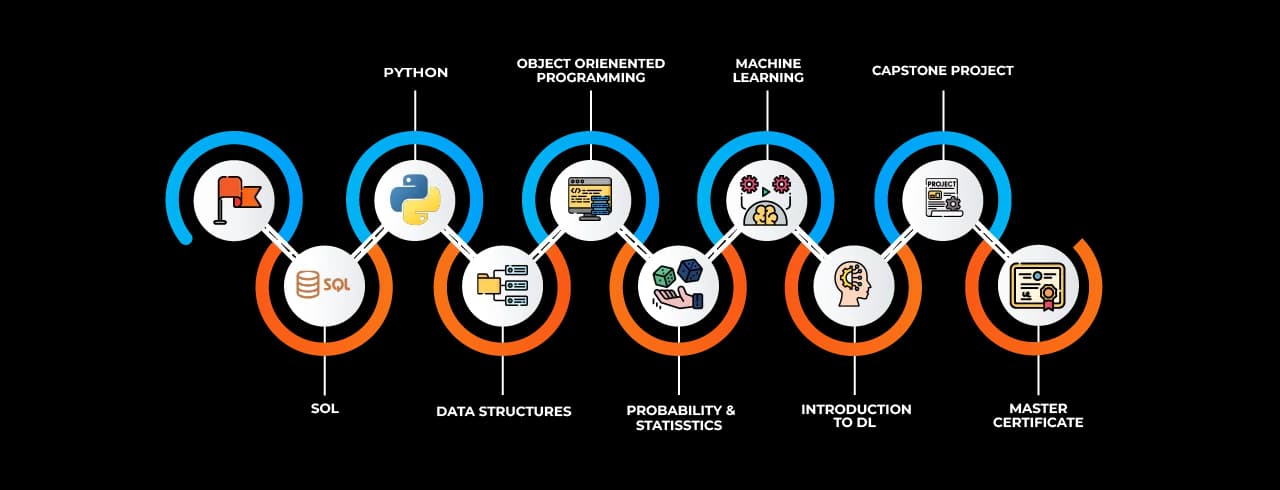
Learning curve for Reinforcement Learning Chip Design

Master In Reinforcement Learning Chip Design Course

OneCourseMultipleRoles

Empower your career with in-demand data skills and open doors to top-tier opportunities.

Machine Learning Engineer
Data Scientist
AI Engineer
Deep Learning Engineer
Business Intelligence Analyst
Data Analyst
Computer Vision Engineer
Natural Language Processing (NLP) Engineer
Data Engineer
Robotics Engineer

Skills & Tools You'll Learn -

Scikit learn iconScikit learnA machine learning library for predictive modeling and analysis.
Probability & Statistics iconProbability & Statistics Fundamental concepts for making data-driven predictions and decisions.
Machine Learning Algorithms iconMachine Learning Algorithms Core algorithms that enable machines to learn patterns from data
Feature Engineering iconFeature EngineeringTechniques to transform raw data into meaningful input for models.
Data Preprocessing iconData PreprocessingCleaning and preparing data to improve model performance.
Model Evaluation & Validation iconModel Evaluation & ValidationMethods to assess and fine-tune machine learning models.
Hyperparameter Tuning iconHyperparameter TuningOptimizing model parameters to enhance accuracy and efficiency.
Python iconPythonA versatile programming language widely used for machine learning. R: A statistical computing language popular for data analysis and visualization. Scikit-learn: A powerful Python library for implementing machine learning algorithms.
Jupyter Notebook iconJupyter NotebookAn interactive environment for coding, visualizing, and documenting ML projects

Why Choose SevenMentor Reinforcement Learning Chip Design

Empowering Careers with Industry-Ready Skills.

Specialized Pocket Friendly Programs as per your requirements

Specialized Pocket Friendly Programs as per your requirements

Live Projects With Hands-on Experience

Live Projects With Hands-on Experience

Corporate Soft-skills & Personality Building Sessions

Corporate Soft-skills & Personality Building Sessions

Digital Online, Classroom, Hybrid Batches

Digital Online, Classroom, Hybrid Batches

Interview Calls Assistance & Mock Sessions

Interview Calls Assistance & Mock Sessions

1:1 Mentorship when required

1:1 Mentorship when required

Industry Experienced Trainers

Industry Experienced Trainers

Class Recordings for Missed Classes

Class Recordings for Missed Classes

1 Year FREE Repeat Option

1 Year FREE Repeat Option

Bonus Resources

Bonus Resources

Curriculum For Reinforcement Learning Chip Design

BATCH SCHEDULE

Reinforcement Learning Chip Design Course

Find Your Perfect Training Session

Aug 23 - Aug 29

1 session
29
Sat
Classroom/ Online
Weekend Batch

Aug 30 - Sep 5

2 sessions
30
Sun
Classroom/ Online
Weekend Batch
31
Mon
Classroom/ Online
Regular Batch

Sep 6 - Sep 12

1 session
07
Mon
Classroom/ Online
Regular Batch

Learning Comes Alive Through Hands-On PROJECTS!

Comprehensive Training Programs Designed to Elevate Your Career

Sales Forecasting Using Time Series Analysis

Sales Forecasting Using Time Series Analysis

Fake News Detection

Fake News Detection

Resume Screening System

Resume Screening System

Disease Prediction Using Patient Symptoms

Disease Prediction Using Patient Symptoms

Music Genre Classification

Music Genre Classification

No active project selected.

Transform Your Future with Elite Certification

Add Our Training Certificate In Your LinkedIn ProfileLinkedIn

Our industry-relevant certification equips you with essential skills required to succeed in a highly dynamic job market.

Join us and be part of over 50,000 successful certified graduates.

Student 1
Student 2
Student 3
Student 4
Student 5
Join 15,258 others learning today
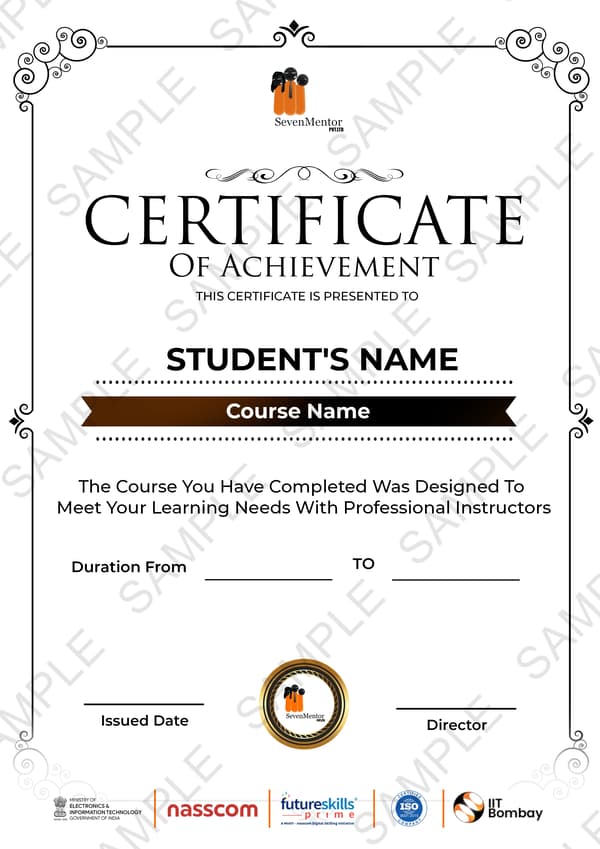
Certificate Preview

KEY Features that Makes Us Better and Best FIT For You

Expert Trainers

Industry professionals with extensive experience to guide your learning journey.

Comprehensive Curriculum

In-depth courses designed to meet current industry standards and trends.

Hands-on Training

Real-world projects and practical sessions to enhance learning outcomes.

Flexible Schedules

Options for weekday, weekend, and online batches to suit your convenience.

Industry-Recognized Certifications

Globally accepted credentials to boost your career prospects.

State-of-the-Art Infrastructure

Modern facilities and tools for an engaging learning experience.

100% Placement Assistance

Dedicated support to help you secure your dream job.

Affordable Fees

Quality training at competitive prices with flexible payment options.

Lifetime Access to Learning Materials

Revisit course content anytime for continuous learning.

Personalized Attention

Small batch sizes for individualized mentoring and guidance.

Diverse Course Offerings

A wide range of programs in IT, business, design, and more.

Course Content

Why Is Reinforcement Learning Disrupting Traditional Chip Design Today?

This era of unprecedented change for the semiconductor industry is significantly impacting how chip floorplanning, placement and routing are designed. Traditionally, these stages of semiconductor design were manual or based on a set of rules for Electronic Design Automation (EDA) tools. A design could take months to optimize for power, performance and area (PPA) using traditional engineering methods. Recently, deep learning is being used to automatically optimize the positions of thousands or millions of modules (cells) on a silicon canvas to meet design goals such as delay and hot spots (thermal). By modeling the design space of a semiconductor as a game, a design can be optimized by a deep reinforcement learning (RL) agent within hours instead of months while delivering better PPA. This era of design requires specialized training in using deep RL for chip floorplanning, placement and routing.

  • Autonomous Layout Synthesis: Deep RL is used for autonomous placement of macro blocks and cell instances on the silicon real estate to optimize timing and thermal hotspots.
  • Design Time Reduced to Hours: We can now complete layout cycles in hours rather than months with better PPA.
  • Reduction of Fabrication Costs: Predictive verification using ML in early design stages avoids costly silicon re-runs and re-manufacturing of multi-million-dollar worth of silicon.
  • There is tremendous interest in design labs for experts who understand the intersection of Verilog/VHDL design with PyTorch-based Deep RL experts to automate hardware design.
  • Future-Proofing Hardware Careers: Providing a platform for hardware engineers to learn about automation using AI to transition into high-paying physical design and silicon architecture roles.


What Core Technical Skills Do You Gain From Advanced Training?

The rare double advantage of specialized reinforcement learning chip design training is core VLSI physical design expertise and modern deep learning frameworks. Instead of studying two distinct subjects, chip design with deep reinforcement learning training is structured as a single subject. You will move beyond the basics of reinforcement learning and implement your own reward function, implement a custom environment for floorplanning agents, and learn to handle complex continuous action spaces to wire up silicon structures, all while adhering to Design Rule Checking (DRC) constraints.

Hands-on RTL-to-GDSII automated design flows, including logic synthesis, static timing analysis (STA), clock tree synthesis (CTS),, and sign-off using Python to control industry-standard EDA tools.

  • Custom RL Environment Design: Learn how to model the floorplanning problem as a Markov Decision Process (MDP) and how to create deep Q-learning networks for solving it.
  • Scripting EDA Tools using APIs: This module will enable the student to script industry-standard EDA tools using their Python API and carry out an entire automated design flow.
  • Optimization of Thermal and Congestion Problems: Design models that predict and prevent congestion and thermal hot spots.
  • Capstone Hardware-AI Projects: Design full design flows for benchmark circuits.


How Does AI Automation Boost Salary Potential & Career Trajectories?

The highest-paying technical intersection in global tech right now is combining artificial intelligence with the physical design of hardware. VLSI designers are stuck in a rut, performing tedious and time-consuming manual design work. Designers who can place chips using deep reinforcement learning to automate their design work are paid a substantial premium to their physical design counterparts. Silicon design companies of all types (fabless semiconductors, cloud-based design, etc.) and startups designing custom AI accelerators are actively seeking designers who can write custom scripts to automate design tasks to meet tight product schedules.

The unique benefits to your career and compensation that you will realize by mastering this specialized skill set include:

  • Significant Compensation Multipliers: Individual with Chip Layout skills + Reinforcement Learning skills command higher total compensation than peers in purely physical design roles.
  • Rapid Career Progression: In automating design cycles to design novel architectures, designers can bypass manual routing of entry-level positions and immediately enter roles of high visibility in silicon architecture.
  • Global Hiring Demand: The demand for VLSI engineers who possess cross-disciplinary skills between physical design of hardware and AI applications is very high globally as leading chipmakers and AI-based startups are racing against time to meet their product launch commitments.
  • Design of specialized hardware accelerators for generative AI models: Skills learned to apply floorplanning agents to design specialized hardware accelerators for generative AI models.
  • Cross-Domain Mobility: As you master the use of deep RL frameworks and EDA scripting for the hardware layout teams, you can easily transition to the core AI research labs developing innovative generative AI models that need specialized accelerated hardware.


What Are the Essential Prerequisites & Who Should Enrol in This Course?

Most students and career switchers have no idea that automating silicon design for high-end FPGAs does not require decades of experience in the field of semiconductors. In fact, comprehensive training in reinforcement learning for chip design is provided on top of an intermediate level of hardware knowledge. This training is specifically designed for students and working professionals with a background in electronics, Electrical Engineering, computer science, or other relevant STEM fields. The training provides a perfect pathway into the emerging field of EDA automation for EDA professionals. Furthermore, the high-quality training provided in this course enables both fresh graduates and working professionals to learn and master the latest chip design with deep reinforcement learning within a very short space of time. In addition to getting familiar with the latest commercial tool flows, they would also learn how to tune reward architectures and automate physical sign-off.

This specialized training program is tailored for:

  • Electronics & VLSI Students: Fresh B.E., B.Tech, or M.Tech students aiming to gain a differentiating edge in their placements in colleges or outside.
  • Physical Design & EDA Engineers: Skilled EDA and physical design engineers interested in transitioning from writing scripts for manual layout to AI-based floor planning and physical signoff.
  • Machine Learning Engineers: These professionals can benefit greatly from a training program that specializes in reinforcement learning chip design, as they can easily transition into high-paying hardware optimization roles.
  • Embedded Systems Developers: System engineers looking to understand the deep low-level integration in current and future embedded systems with AI silicon acceleration.
  • Researchers & Enthusiasts: Working on innovative research projects and developing cutting-edge prototypes using state-of-the-art hardware, specifically in the field of autonomous microchip layout design.


How Does Deep RL Integration Synergy Across Broader Tech Domains?

Learning how to optimize silicon for autonomous agents requires an understanding of how chip automation can be made to work with software, cloud infrastructure, and large enterprise data pipelines. By mastering reinforcement learning chip design, engineers will be able to design hardware that is specifically optimized for training large AI models, for high-throughput real-time analytics, and for secure cloud-native platforms. Learning how to build next-generation physical silicon that can power high-throughput applications in a wide variety of industries will require an understanding of the larger technology ecosystem in which chip design sits today.

The curriculum is aligned with essential modern technologies and hence connects hardware optimization with them.


Got Questions? Here Are Some FAQs

Q1: Do I need prior machine learning experience to enroll in this course?

Our courses do not require any prior knowledge of deep learning, but do assume prior knowledge of typical VLSI layout concepts and some programming experience in Python (or another language). The first part of the course covers the basic concepts of reinforcement learning, while the latter part introduces more advanced concepts for fully automated silicon placement.

Q2: How does reinforcement learning differ from traditional automated EDA tool scripting?

Traditional EDA scripting typically uses set algorithms that are driven by heuristics that were created by a human to solve a problem. The Deep Reinforcement Learning approach on the other hand uses an autonomous agent to explore millions of potential floorplans and through the learning process, creates a continuous policy function to optimize for PPA (power, performance and area) metrics.

Q3: What software tools and frameworks will I hands-on practice during training?

Hands-on practice with the following tools and frameworks will be provided for the hands-on work: Python, PyTorch, custom Gym/Gymnasium environments, open-source physical design tools (e.g. OpenROAD) and commercial EDA scripting interfaces.

Q4: Can experienced Physical Design (PD) engineers transition through this program?

Yes! Many experienced Physical Design (PD) / CAD engineers benefit greatly from our course and go on to leverage their automation knowledge to transition into Physical Design Automation / Architect roles which command high salaries.

Related Links:

Anthropic AI Tool

What is Writesonic

Career Objectives For Fresher

Resume Tips For Software Developers

Do visit our channel to know more: SevenMentor 


Frequently Asked Questions

Everything you need to know about our revolutionary job platform

1

What tools and technologies will I learn in the Machine Learning Classes?

Ans:
You'll work with tools like Python, TensorFlow, Keras, Scikit-learn, Pandas, NumPy, Matplotlib, and big data tools like Hadoop and Spark.
2

Does the Machine Learning Certification include real-world projects?

Ans:
Yes, the certification program includes real-world projects to help you gain practical experience and build a strong portfolio.
3

What career opportunities are available after completing the Machine Learning Classes?

Ans:
You can pursue roles like Machine Learning Engineer, Data Scientist, AI Engineer, NLP Specialist, or Deep Learning Engineer
4

How does the Machine Learning Certification add value to my career?

Ans:
The certification validates your Machine Learning expertise, making you a competitive candidate for high-demand roles in AI and data science.
5

Can I take Machine Learning Classes online?

Ans:
Yes, SevenMentor offers both classroom and online Machine Learning Classes to accommodate your learning preferences.
6

Will I receive study materials during the Machine Learning Certification program?

Ans:
Yes, you will get comprehensive study materials, including lecture notes, assignments, and access to recorded sessions.