Why is Reinforcement Learning Revolutionizing the Modern Semiconductor and Chip Design Industry?
The landscape of semiconductor design is currently undergoing a paradigm shift where traditional Electronic Design Automation (EDA) tools and methodologies, designed to manage complex design processes of sub-3nm silicon, are no longer sufficient. The design space of modern ICs is characterized by extremely high-dimensional search spaces that even exceed the number of atoms in the observable universe. In order to arrive at a manually designed IC, designers and engineers have to go through months of tedious manual floorplanning, place-and-route, and PPA (power, performance, area) optimization. This can change within hours instead of months if autonomous AI-based design agents are integrated into the typical IC-design flow. Therefore, a structured reinforcement learning chip design course in Nagpur would be an ideal entry point into this area of tremendous growth for individuals interested in learning to automatically generate IC layouts, design deep Q-learning state representations, and leverage hardware accelerators.
Key reasons why reinforcement learning is reshaping silicon architecture:
- Exponential Reduction in Floorplanning Cycles: There is an exponential reduction in the number of cycles of floorplanning of a chip using Deep RL models, as it treats floorplanning of a chip like a game of chess and places macro blocks and standard cells on a grid while trying to minimize wirelength and reduce congestion at the same time.
- Better trade-off between Power, Performance and Area: The reinforcement learning system automatically finds non-intuitive placements of individual cells that would be out of reach for a human designer. This results in better power consumption and higher frequencies.
- Design Space Exploration (DSE): Instead of having to search through huge design spaces by trial and error, an RL system can be adapted to search within specific constraints to arrive at the optimal hardware configuration very quickly.
- Reinforcement learning can create massive opportunities in a cross-disciplinary area of VLSI architecture and machine learning to create a plethora of jobs for experts in deep learning and silicon design.
- Future Proof Yourself: As more and more tech giants and fabless semiconductor companies move to AI-based EDA tools, it will be very important to have a hardware engineering skillset that is future proof and can be applied to emerging technologies.
Accelerate Your Silicon Career with SevenMentor: India’s Premier Tech Training Hub
As the technology industry continues to grow, a new kind of engineer is becoming increasingly valuable: someone with experience of both AI and hardware, able to drive the development of intelligent EDA workflows for next-generation chips. At SevenMentor, we provide training in this emerging area, with advanced classes on chip design using deep reinforcement learning offered in our Nagpur learning hub and core training to form the basis of a career in technology offered in our learning hub.
Our commitment to students extends beyond the delivery of a high-quality training program. We have dedicated career placement support and our resume building, mock interviews and referrals to top technology companies enable our students to secure the best job for them and capitalize on the current IT salary boom.
Why choose SevenMentor for your tech transformation?
- Industry-Vetted Curriculum: Updated modules to incorporate best industry practices for students' development to make them corporate-ready.
- Expert Mentorship: Get to learn from senior practitioners with vast experience and hands-on knowledge of projects.
- End-to-End Placement Assistance: Our dedicated team of career counselors, who work to polish your resume and then to assist you in getting through the final interview at leading technology companies, shall assist you in your end-to-end placement.
- Flexible Learning Hubs: We have the best-in-class facilities to carry out training at our SevenMentor learning hubs located across Mumbai and Nagpur.
How Does Macro Placement Automation Work Using Deep Reinforcement Learning Algorithms?
Macro placement is one of the most time-consuming tasks in Physical Design (PD), involving memory blocks such as SRAMs, analog IP blocks, and processors. By treating the entire chip floor plan as a bounded grid environment, deep reinforcement learning can learn to place the various macros one by one in an optimal fashion. To this end, the floorplan is modeled as a grid environment, where the DL agent takes actions on the various cells of the grid. The agent learns a strategy by receiving feedback in the form of dynamic reward functions that can depend on a variety of different metrics, such as wire length, routing congestion, and even density. The engineer learns to apply AI-driven layout techniques for chip placement with deep reinforcement learning training in Nagpur to master tasks such as the construction of a Markov Decision Process (MDP), the representation of a netlist by means of a Graph Neural Network (GNN), and the fully automated computation of reward functions for a given chip.
The core components and associated tasks required to implement the RL-based macro placement are
- Graph Neural Network (GNN) Netlist Encoding: Mapping a design’s netlist to a fixed-size vector representation (feature-space) that a reinforcement learning (RL) agent can understand and work with to determine appropriate connections between individual macros.
- Markov Decision Process (MDP) Formulation: We model the problem of chip placement into a Markov Decision Process (MDP) with a canvas represented as a state space, a set of actions (where to place a macro) as an action space, and a transition function between states.
- Dynamic Multi-Objective Reward Functions: These functions in turn are designed to compute scalar values indicating negative wire congestion, pin displacement, and thermal hot spots and positive density compliance.
- Policy Gradient and Deep Q-Learning Optimizations: We can fine-tune deep neural networks for macro placement in chip design, such as using Proximal Policy Optimization (PPO) for Policy Gradient optimization and using Deep Q-Networks (DQN) for Deep Q-Learning. This is done to discover placement policies for various designs.
- Automated Fine-Tuning and Legalization: The output from the RL agent is automatically routed and legalized in order to interact with standard EDA placer tools to generate DRC-compliant physical design after continuous placement of nodes by the RL agent.
What Core Prerequisite Skills and Frameworks Are Essential to Excel in Reinforcement Learning Chip Design?
As AI is increasingly becoming the mainstream in VLSI design, it is essential for designers to have a unique blend of software intelligence and fundamental VLSI design skills. The industry-led reinforcement learning chip design training program in Nagpur helps learners gain hands-on experience in reinforcement learning design using open-source EDA toolflows and learn to write Python scripts that run on the large-scale neural networks for training using Linux automation and scripting skills. They become a ‘bridge engineer’ to build, fine-tune, and deploy their own custom RL design within a mainstream semiconductor design team after mastering both the software and hardware sides of design.
Essential technical tools and core skills required to build a career in AI chip design:
- Libraries in Python for AI: Knowledge of Python is expected along with knowledge of popular AI libraries such as PyTorch and TensorFlow. Additionally, proficiency in OpenAI Gym and Gymnasium, along with the ability to construct customized environments for reinforcement learning, will be expected.
- Basic Concepts in Physical Design (PD) and VLSI: The student must be aware of the RTL to GDSII process, static timing analysis (STA), power-performance-area (PPA) trade-off, and basic physical verification (DRC/LVS).
- Graph Machine Learning: Study GNN architectures for non-Euclidean netlist graph structures and associated node and matrix computations in graph ML.
- Open-Source & Commercial EDA Tool Integration: You should know to script OpenROAD, OpenDB or even a simple TCL interface for industry-standard EDA tools like Cadence, Mentor, etc., to name a few.
- Reinforcement Learning Algorithms: Model free RL through actor-critic architectures such as PPO (Proximal Policy Optimization) and DQN (Deep Q Network) to solve problems as a combinatorial optimization problem.
- Linux Infrastructure and Automation: Ability to write Bash scripts for workflow management, use Git for version control, and use Docker containerization for training large neural networks.
What High-Paying IT Career Roles Can You Unlock After Master Class Certification?
We are experiencing a severe shortage of specialized engineering talent globally. Top fabless chip companies, hyperscalers building custom silicon for their datacenters and EDA software companies are competing for the best engineers to automate the stages of hardware design (synthesis, layout, and verification) using artificial intelligence. Having done an accredited course in reinforcement learning chip design in Nagpur opens up the possibility of high-paying jobs for trained professionals across India’s semiconductor hubs—Bangalore, Pune, Hyderabad and Mumbai. Given the large impact on reducing the chip tape-out schedule that a person with such specialized skills can have, they will command a higher salary than one can earn as a software developer or even a physical design engineer.
Prominent career tracks and roles available for trained professionals:
- AI-EDA Methodology Engineer – Develop custom machine learning pipelines and RL scripts to automate floorplanning, routing & placement within corporate EDA workflows.
- Machine Learning Architect for Hardware: Responsible for architecting deep neural networks and policy networks to solve complex semiconductor design optimization problems and develop corresponding algorithms.
- Physical Design (PD) Automation Specialist: Expert in writing intelligent scripts that can automate IC design and utilize reinforcement learning models to get the best design possible with the fastest possible timing closure and best possible PPA.
- VLSI Research Scientist (AI/Hardware): As a VLSI Research Scientist (AI/Hardware), you will be working with top silicon labs and doing cutting-edge research in areas of autonomous macro placement, clock-tree synthesis, and dynamic power tuning using AI/Hardware.
- Semiconductor Systems Optimization Engineer: The role involves working with cloud giants and their silicon design teams to help optimize and accelerate custom silicon floorplanning for AI accelerator chips and datacenter processors.
How Does SevenMentor’s Ecosystem Prepare You for Next-Gen Tech Roles Beyond Chip Design?
Integrate Silicon Floorplans into Enterprise Clouds and Software Applications—Need Hardware Engineers to Link Deep Learning with Scalable Enterprise Solutions. This will require hardware engineers to learn not only to design optimized hardware layout algorithms but also to implement and deploy intelligent web platforms for enterprise applications, be based in major tech hubs like Mumbai, and be able to connect design choices to end-user applications. To support complete end-to-end tech career transformation, SevenMentor offers a comprehensive suite of industry-aligned domain programs.
Got Questions? Here Are Some FAQs
1. What makes reinforcement learning superior to traditional EDA toolflows in chip design?
Traditional Electronic Design Automation (EDA) techniques such as placement and routing rely heavily on manual heuristics, which need to be tweaked manually by designers and, in some cases, make use of deterministic solvers to optimize various design objectives. Moreover, designing sub-3nm chips is extremely challenging for traditional EDA techniques. Interactive reinforcement learning chip design training in nagpur at SevenMentor teaches you to train AI policy agents to play autonomous floorplanning decisions as a game and find millions of possible floorplans within hours. They offer superior PPAA (Power, Performance and Area trade-off) to designers while enabling them to complete design cycles within hours as opposed to days or even weeks.
2. Do I need prior experience in VLSI to enroll in this course?
No prior experience with VLSI is required. Basic knowledge of Digital Electronics, VLSI Fundamentals or Python programming is sufficient. The curriculum for reinforcement learning chip design training in nagpur for beginners includes introductory sessions related to Neural Networks, Netlist, and RL Algos. The learning can then progress to advanced topics such as automation of macro placement of various cells on the chip floorplan.
3. What kind of jobs one can get and corresponding salaries after the training ends?
Top class salaries are offered to Engineers with expertise in the combination of AI algorithms and hardware architecture. This course can get you a job of AI-EDA Methodology Engineer, Physical Design Automation Specialist, ML Hardware Architect etc. with very high salaries.Mumbai, Pune and Bangalore are hubs for major Semiconductor and IT companies.
4. What support does SevenMentor provide for Placement Assistance after completion of courses?
SevenMentor provides support for career placement of students enrolled in the training. SevenMentor helps in getting right resume prepared, preparing portfolio with live projects, making students conversant in soft skills and conducting mock technical and behavioral interviews. Also, SevenMentor has active referral links with leading semiconductor companies, IT and other technology startups across India.
5. Will I get hands-on experience with real AI frameworks and EDA environments?
Yes. The course includes practical training in project development using Python, PyTorch/TensorFlow and custom Gymnasium environments. You will learn to implement Autonomous Macro Placement agents for EDA using OpenROAD and GNN libraries on realistic netlist benchmarks for training and evaluation purposes.
Related Links:
Anthropic AI Tool
What is Writesonic
Career Objectives For Fresher
Resume Tips For Software Developers
Do visit our channel to know more: SevenMentor
 Look Forward To Building A Future-Ready Career In Machine Learning
 Gain In-Depth Knowledge Of Algorithms, Predictive Modeling, And Machine Learning Implementation
 Kickstart Your Machine Learning Career Today At The Top Choice For Enthusiasts
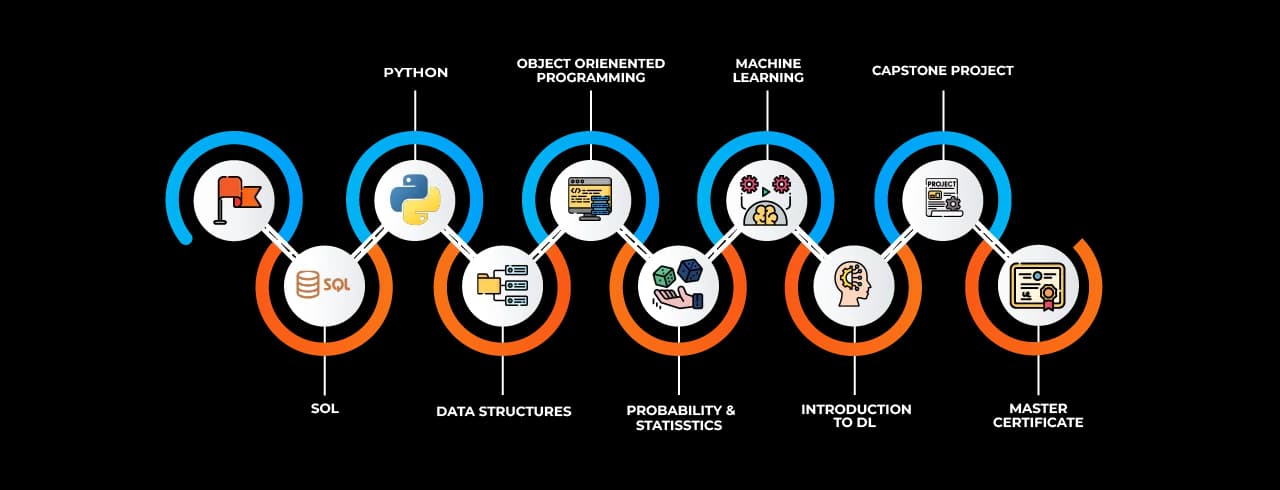
 Scikit learnA machine learning library for predictive modeling and analysis.
 Probability & Statistics Fundamental concepts for making data-driven predictions and decisions.
 Machine Learning Algorithms Core algorithms that enable machines to learn patterns from data
 Feature EngineeringTechniques to transform raw data into meaningful input for models.
 Data PreprocessingCleaning and preparing data to improve model performance.
 Model Evaluation & ValidationMethods to assess and fine-tune machine learning models.
 Hyperparameter TuningOptimizing model parameters to enhance accuracy and efficiency.
 PythonA versatile programming language widely used for machine learning.
R: A statistical computing language popular for data analysis and visualization.
Scikit-learn: A powerful Python library for implementing machine learning algorithms.
PythonA versatile programming language widely used for machine learning.
R: A statistical computing language popular for data analysis and visualization.
Scikit-learn: A powerful Python library for implementing machine learning algorithms.
 Jupyter NotebookAn interactive environment for coding, visualizing, and documenting ML projects