Reinforcement Learning Chip Design Course in Pune
feature-iconLook Forward To Building A Future-Ready Career In Machine Learning

feature-iconGain In-Depth Knowledge Of Algorithms, Predictive Modeling, And Machine Learning Implementation

feature-iconKickstart Your Machine Learning Career Today At The Top Choice For Enthusiasts

020-71177359

Start Today!

CONSULT WITH OUR ADVISORS

  • Course & Curriculum Details
  • Flexible Learning Options
  • Affordable Learning
  • Enrollment Process
  • Career Guidance
  • Internship Opportunities
  • General Communication
  • Certification Benefits

Request Call Back

Loading...

Learning Curve for Reinforcement Learning Chip Design
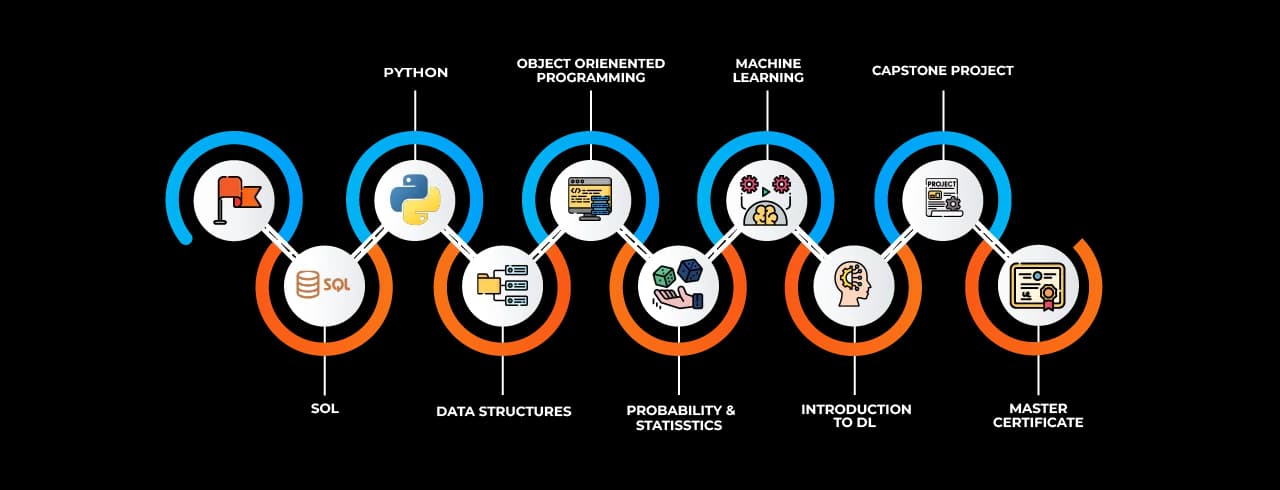
Learning curve for Reinforcement Learning Chip Design

Master In Reinforcement Learning Chip Design Course

OneCourseMultipleRoles

Empower your career with in-demand data skills and open doors to top-tier opportunities.

Machine Learning Engineer
Data Scientist
AI Engineer
Deep Learning Engineer
Business Intelligence Analyst
Data Analyst
Computer Vision Engineer
Natural Language Processing (NLP) Engineer
Data Engineer
Robotics Engineer

Skills & Tools You'll Learn -

Scikit learn iconScikit learnA machine learning library for predictive modeling and analysis.
Probability & Statistics iconProbability & Statistics Fundamental concepts for making data-driven predictions and decisions.
Machine Learning Algorithms iconMachine Learning Algorithms Core algorithms that enable machines to learn patterns from data
Feature Engineering iconFeature EngineeringTechniques to transform raw data into meaningful input for models.
Data Preprocessing iconData PreprocessingCleaning and preparing data to improve model performance.
Model Evaluation & Validation iconModel Evaluation & ValidationMethods to assess and fine-tune machine learning models.
Hyperparameter Tuning iconHyperparameter TuningOptimizing model parameters to enhance accuracy and efficiency.
Python iconPythonA versatile programming language widely used for machine learning. R: A statistical computing language popular for data analysis and visualization. Scikit-learn: A powerful Python library for implementing machine learning algorithms.
Jupyter Notebook iconJupyter NotebookAn interactive environment for coding, visualizing, and documenting ML projects

Why Choose SevenMentor Reinforcement Learning Chip Design

Empowering Careers with Industry-Ready Skills.

Specialized Pocket Friendly Programs as per your requirements

Specialized Pocket Friendly Programs as per your requirements

Live Projects With Hands-on Experience

Live Projects With Hands-on Experience

Corporate Soft-skills & Personality Building Sessions

Corporate Soft-skills & Personality Building Sessions

Digital Online, Classroom, Hybrid Batches

Digital Online, Classroom, Hybrid Batches

Interview Calls Assistance & Mock Sessions

Interview Calls Assistance & Mock Sessions

1:1 Mentorship when required

1:1 Mentorship when required

Industry Experienced Trainers

Industry Experienced Trainers

Class Recordings for Missed Classes

Class Recordings for Missed Classes

1 Year FREE Repeat Option

1 Year FREE Repeat Option

Bonus Resources

Bonus Resources

Curriculum For Reinforcement Learning Chip Design

BATCH SCHEDULE

Reinforcement Learning Chip Design Course

Find Your Perfect Training Session

Aug 30 - Sep 5

3 sessions
30
Sun
Classroom/ Online
Weekend Batch
31
Mon
Classroom/ Online
Regular Batch
05
Sat
Classroom/ Online
Weekend Batch

Sep 6 - Sep 12

1 session
07
Mon
Classroom/ Online
Regular Batch

Learning Comes Alive Through Hands-On PROJECTS!

Comprehensive Training Programs Designed to Elevate Your Career

Sales Forecasting Using Time Series Analysis

Sales Forecasting Using Time Series Analysis

Fake News Detection

Fake News Detection

Resume Screening System

Resume Screening System

Disease Prediction Using Patient Symptoms

Disease Prediction Using Patient Symptoms

Music Genre Classification

Music Genre Classification

No active project selected.

Transform Your Future with Elite Certification

Add Our Training Certificate In Your LinkedIn ProfileLinkedIn

Our industry-relevant certification equips you with essential skills required to succeed in a highly dynamic job market.

Join us and be part of over 50,000 successful certified graduates.

Student 1
Student 2
Student 3
Student 4
Student 5
Join 15,258 others learning today
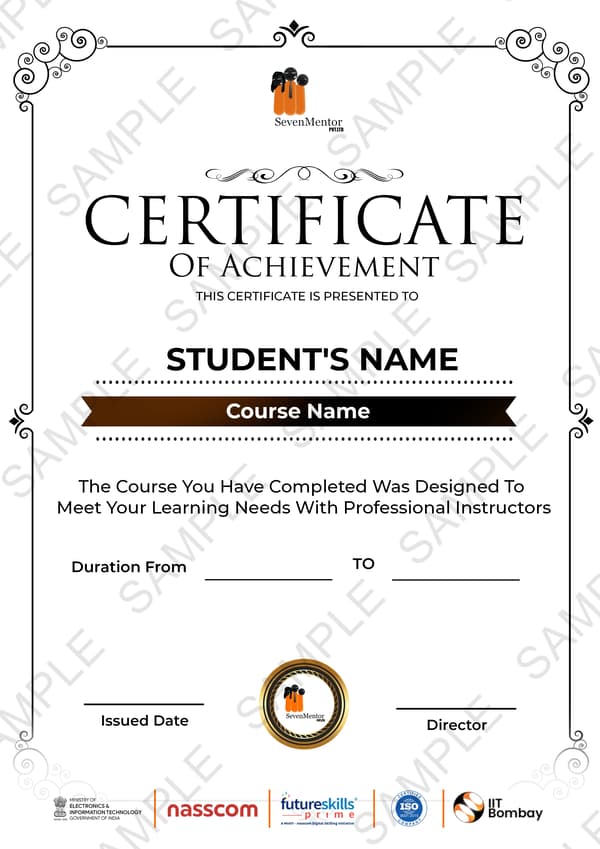
Certificate Preview

KEY Features that Makes Us Better and Best FIT For You

Expert Trainers

Industry professionals with extensive experience to guide your learning journey.

Comprehensive Curriculum

In-depth courses designed to meet current industry standards and trends.

Hands-on Training

Real-world projects and practical sessions to enhance learning outcomes.

Flexible Schedules

Options for weekday, weekend, and online batches to suit your convenience.

Industry-Recognized Certifications

Globally accepted credentials to boost your career prospects.

State-of-the-Art Infrastructure

Modern facilities and tools for an engaging learning experience.

100% Placement Assistance

Dedicated support to help you secure your dream job.

Affordable Fees

Quality training at competitive prices with flexible payment options.

Lifetime Access to Learning Materials

Revisit course content anytime for continuous learning.

Personalized Attention

Small batch sizes for individualized mentoring and guidance.

Diverse Course Offerings

A wide range of programs in IT, business, design, and more.

Course Content

Why Is Deep Reinforcement Learning Revolutionizing Microchips Floor planning and placement?

Most current EDA (Electronic Design Automation) tools are based on heuristics and rely on humans to set up scripts to perform tasks like block floorplanning or power planning. Because of the increasing complexity of today’s chips containing billions of transistors at sub-3 nm, manual layout optimization has reached its physical limits. Deep RL (Reinforcement Learning) treats the whole chip design space like a very high-dimensional chess board. While the chip is still in a digital format (before manufacturing), an RL agent can interact with a Design Rule Checking (DRC) environment to find optimal floor plans for given Power, Performance, and Area (PPA) targets.

Reinforcement learning chip design training in Pune enables engineers to learn building custom environments for their design space using OpenAI Gymnasium to enable them to design and tape-out AI silicon within days instead of quarters.

  • Autonomous Space Exploration: In such scenarios a reinforcement learning agent can evaluate millions of placement options and can find non-obvious placements of blocks that a human designer may miss.
  • Multi-Objective PPA Optimization: Today’s deep RL agents are capable of solving and even optimizing multiple competing goals and constraints (e.g., wire length, thermal distribution, STA) online.
  • Deep learning algorithms to predict the routing congestion in the synthesis phase to enable sign-off of the routed design without any DRC violations in post-layout verification.
  • Standard Cell Layout Automation: Design Automation for Standard Cells using RL for tiling and routing of cells to achieve maximum density and preserve timing integrity.
  • A scalable EDA architecture: The student will learn how to integrate a Python-based RL framework into an EDA framework.


Which are the required skill sets to be an AI-driven VLSI/EDA engineer?

The area of VLSI physical design is highly specialized and thus requires a very unique skill set, best represented by the intersection of hardware architecture and modern machine learning frameworks. Typically, engineers are taught to design in VLSI physical design within the confines of RTL-to-GDSII flows and then learn machine learning as a completely separate discipline that they can apply in a variety of different ways.

As you progress through the reinforcement learning chip design classes in Pune, you will systematically acquire in-depth knowledge to apply in your work. This knowledge allows you to program a reward function that represents several aspects, such as timing closure, silicon area penalty, clock tree synthesis targets, etc.

Experience with different deep reinforcement learning techniques like policy gradient, DQN (Deep Q-Networks), PPO (Proximal Policy Optimization), and continuous action space.

  • Physical Design Fundamentals Knowledge: RTL to GDSII flow, logic synthesis, floor planning, Clock Tree Synthesis (CTS), and Static Timing Analysis (STA).
  • Environment Architecture: Develop an environment to model a chip designer’s environment and constraints in Python. The environment should be able to model the DRC rule check in the environment as well.
  • EDA Tool Automation: Hands-on experience with scripting ML Python pipelines to interface with industrial synthesis and place&route tools like synthesis, placement, routing, etc.

High-Level Hardware Description Languages (HDLs)—Understanding Verilog/SystemVerilog along with C++/Python for optimizing performance-critical parts of design automation.


How Does Expertise in AI Silicon Layout Impact Your IT Career and Salary Growth?

The global shortage of semiconductors and explosive growth of generative AI and edge computing have created a war for talent in the semiconductors industry. Giants in technology, fabless chip designers, and EDA software providers are competing furiously for talent who have experience in both silicon layout design and deep learning. The number of individuals with expertise in chip placement using a deep reinforcement learning course in Pune is scarce and hence commands premium compensation over software designing and traditional CAD designing roles.

As automation moves to handle routine physical design tasks, the high-value work in the industry will be done by the AI-EDA architects who design, train and deploy the autonomous design agents in the industry. Hence, investing in this skill set will get you to the top end of the semiconductor engineering compensation.

  • Elevated Entry-Level Pay Scale: The person with AI-VLSI-related project work in his academic project will command a higher CTC than his counterpart who has only gone through physical design for an entry-level job.
  • Accelerated Career Progression: Take a quantum leap in your career as junior physical design engineer, move on to become an AI EDA Architect, and eventually lead as a hardware optimization specialist.
  • Global Mobility & Demand: All major semiconductor hubs around the world are aggressively looking for experts who can design and automate chip synthesis using AI for the design of autonomous vehicles, server chips, specialty accelerators for AI workloads, etc.
  • High-Impact Domain Relevance: You will be working at the cutting edge of hardware design for products such as autonomous vehicles, Cloud Servers and custom AI accelerators for a variety of industries.
  • Future-Proof Job Security: While you may be worried that layout tasks will be automated, the creator of the RL layout agent and the person who controls such an agent will be highly sought-after assets.


Who Should Enroll in an Advanced AI Hardware Optimization Course?

Intersections between the latest technologies, such as Artificial Intelligence (AI) and VLSI Chip Design, present exciting career transitions for technically qualified people from all backgrounds and ages to take up very high-paying jobs in the semiconductor chip design industry in Pune after undergoing a structured training program in Pune on Reinforcement Learning (RL) for floor planning of chips.

The training program is designed to fill in the knowledge gaps of various technical professionals, irrespective of whether they are hardware designers or software developers.

Electronics & VLSI Graduates: B.E., B.Tech, or M.Tech students who wish to get an edge over other students (and placing) in physical design using the latest automation using AI.

  • Physical Design & EDA Engineers: Individuals who are currently engaged in physical design of ICs using Tcl/Perl scripts for layout and want to automate the layout design using intelligent agents for designing chips autonomously.
  • Machine Learning & AI Developers: ML/AI experts looking to move into complex physical hardware optimization using their deep learning skills.
  • Embedded Systems Engineers: You are an Embedded Systems Engineer working with Embedded Systems but want to understand Silicon Acceleration for Next Generation AI-enabled Hardware.
  • Research Scholars & Tech Enthusiasts: People with academic backgrounds in VLSI design, including research scholars, professors and tech enthusiasts designing prototypes of innovative autonomous microchip architectures and their placement.


Dedicated Career & Placement Support at SevenMentor

The transition to a dream job in leading semiconductor and EDA companies requires not only technical expertise but also professional career guidance. SevenMentor has a specialized placement cell that supports ambitious learners to transition to jobs in companies where they can apply their newly acquired skills and knowledge.

Comprehensive Career Development Support: We will provide students with comprehensive career development support and help them differentiate from others with rare skills of ML & HW Layout Design from Day 1.

  • Dedicated Placement Assistance:  Placement Assistance for Jobs in Leading Chip Design, EDA and AI Products Companies.
  • Resume & Portfolio Building: Help in expressing your RL floorplanning projects to recruiters in order to make you stand out in resume/portfolio reviews.
  • Mock Technical Interviews: Experts at SevenMentor simulate real-life technical interviews to train the student on topics such as VLSI physical design, Python EDA scripting and application of research learning for chip design.
  • Soft Skills & Career Coaching: Seminars for developing the skill sets for your job interviews and salary negotiations.


Which Interdisciplinary Skill Sets Power the Technology Solutions of Today Across the IT Sector?

In addition to specialized hardware acceleration that powers next-generation silicon, modern IT solutions are a multi-disciplinary concoction of tools, cloud services and software frameworks. It is highly desirable for engineers today to gain insight into how all these various elements interact and this is exactly what one would expect from a holistic technology learning experience that enables end-to-end digital transformation, which is what SevenMentor offers its learners.


Got Questions? Here Are Some FAQs

Q1: What background do I need to enroll in this course?

A candidate with background of Electronics & Telecommunication, Electrical Engineering, Computer Science or any other relevant technical discipline would find this course highly useful. A basic understanding of Python programming along with basic concepts of digital design will be helpful for candidates to get the best out of this course.

Q2: Is deep learning knowledge mandatory before joining?

No, you don’t. The course first introduces students to basics of Machine Learning, followed by step by step progression to deep reinforcement learning and its architectures and models for environment.

Q3: How does SevenMentor help with job placements?

Placement support at SevenMentor includes resume building, Mock Technical Interviews, Portfolio Optimization and Hiring Drives for tech jobs with IT companies and semiconductor firms.

Q4: Are both classroom and online batches available in Pune?

Yes, we have weekday/weekend classroom batches running in our Pune centers as well as live online batches running all across the country.

Q5: What EDA tools and libraries will I work with?

Python-based Reinforcement Learning libraries (Gymnasium/PyTorch) as well as industry-standard EDA physical design automation scripts and DRC verification tools.

Related Links:

Anthropic AI Tool

What is Writesonic

Career Objectives For Fresher

Resume Tips For Software Developers

Do visit our channel to know more: SevenMentor 


Frequently Asked Questions

Everything you need to know about our revolutionary job platform

1

What tools and technologies will I learn in the Machine Learning Classes?

Ans:
You'll work with tools like Python, TensorFlow, Keras, Scikit-learn, Pandas, NumPy, Matplotlib, and big data tools like Hadoop and Spark.
2

Does the Machine Learning Certification include real-world projects?

Ans:
Yes, the certification program includes real-world projects to help you gain practical experience and build a strong portfolio.
3

What career opportunities are available after completing the Machine Learning Classes?

Ans:
You can pursue roles like Machine Learning Engineer, Data Scientist, AI Engineer, NLP Specialist, or Deep Learning Engineer
4

How does the Machine Learning Certification add value to my career?

Ans:
The certification validates your Machine Learning expertise, making you a competitive candidate for high-demand roles in AI and data science.
5

Can I take Machine Learning Classes online?

Ans:
Yes, SevenMentor offers both classroom and online Machine Learning Classes to accommodate your learning preferences.
6

Will I receive study materials during the Machine Learning Certification program?

Ans:
Yes, you will get comprehensive study materials, including lecture notes, assignments, and access to recorded sessions.